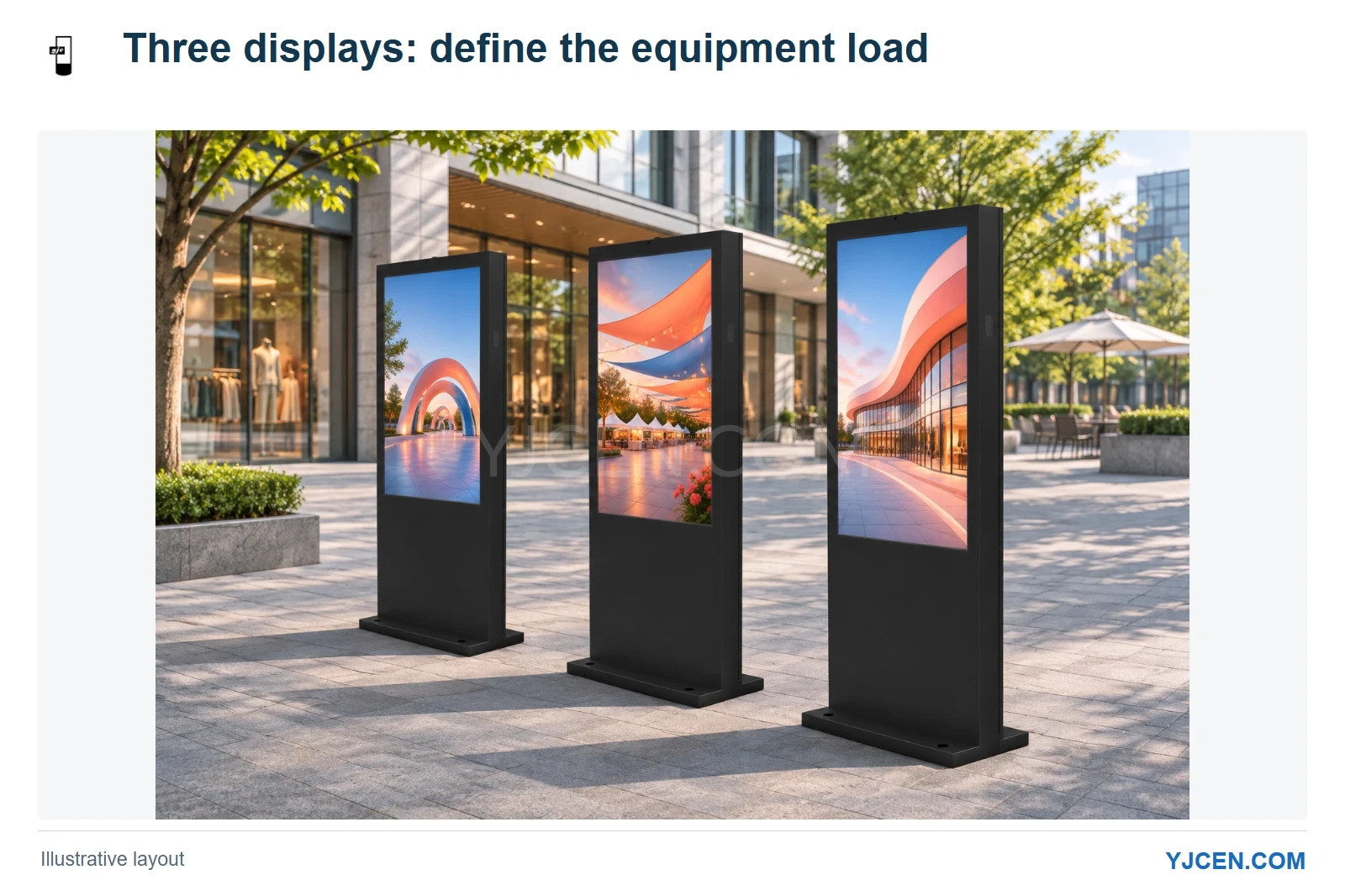
For three specified single-sided YJC-550-OD-F units, 3 × 290 W = 870 W of listed maximum power. The layout is illustrative and the total is a calculation.
For an outdoor display project, use each complete unit’s maximum power figure to build the equipment load schedule, then use operating power and running hours to estimate energy use. Three 55-inch units from our Outdoor Floor-Standing Digital Signage range have a combined listed maximum of 870 W. That gives the integrator a defined equipment load for the site team; the electricity budget needs a separate calculation.
Which power figure belongs in the equipment schedule?
Start with the model and configuration that will actually be installed. Our single-sided OD-F range includes the following maximum power figures; the same screen diagonal in another enclosure or a double-sided configuration needs its own figure.
| Single-sided configuration | Model | Listed maximum power | Supply |
|---|---|---|---|
| 43-inch | YJC-430-OD-F | 230 W | AC 100–240 V, 50/60 Hz |
| 55-inch | YJC-550-OD-F | 290 W | AC 100–240 V, 50/60 Hz |
| 65-inch | YJC-650-OD-F | 400 W | AC 100–240 V, 50/60 Hz |
If a layout changes from three 55-inch units to three 65-inch units, the listed total rises from 870 W to 1,200 W. We would update the load schedule when that size decision changes, before the electrical work is finalized. Keeping the model beside the wattage prevents a larger screen from being installed against the smaller unit’s allowance.
How should several screens and external devices be counted?
Multiply each complete display’s maximum power by its quantity, then add the model groups. Three 55-inch OD-F units give 3 × 290 W = 870 W; one 43-inch, one 55-inch and one 65-inch unit give 230 + 290 + 400 = 920 W. These are arithmetic sums of published maximum figures.
Keep the equipment boundary consistent. A whole-display rating should not be followed by another allowance for the same built-in components already covered by that configuration. A separately powered network device or external player has its own line in the project load schedule, using its actual input rating.
| Project item | How we would enter it | Reason |
|---|---|---|
| Three specified 55-inch OD-F displays | 3 × 290 W = 870 W | Complete display units, counted once |
| Internal components within the specified complete unit | Included in that unit’s rating | Avoid counting the same load twice |
| Separately powered project equipment | Its own model, quantity and input rating | Make the extra load visible |
| Changed thermal or system configuration | Use the rating for the revised complete configuration | Keep the electrical schedule aligned with the order |
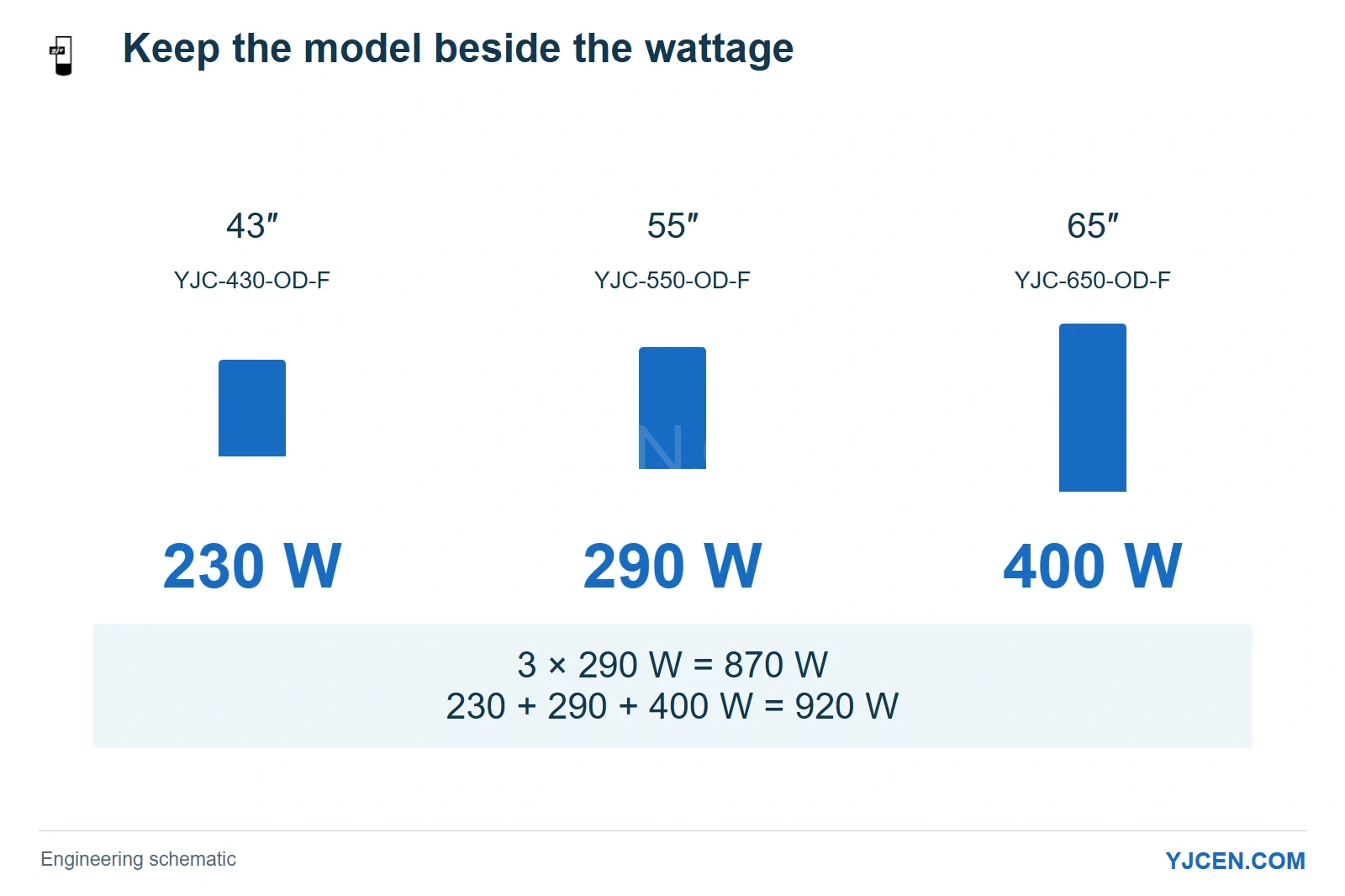
For a rollout across several sites, we would retain this model-by-model schedule instead of issuing one undifferentiated total. It lets the installer see whether an added screen, a changed size or an external device caused the load to change.
How do watts become an electricity-cost estimate?
Watts describe power; kilowatt-hours describe energy used over time. Energy use is calculated by multiplying average power in kilowatts by operating hours. For the display project, use the average power over the period you are budgeting.
Energy (kWh) = average input power (W) × hours ÷ 1,000.
For a simple maximum-power reference, 870 W held continuously for 12 hours equals 10.44 kWh. Label that calculation “12 hours at the listed maximum”; it is not a measured daily consumption figure for three YJCEN screens. A cost calculation then multiplies the applicable kWh by the site’s electricity tariff, with any separate tariff charges handled in the project budget.
We recommend building the operating estimate around the intended daily schedule. Where daytime and evening settings differ, calculate those periods separately, and include any powered hours after the content stops. This produces a more useful budget than treating every hour as identical.
What should change when automatic brightness is used?
The OD-F range provides automatic brightness adjustment. A bright daytime message and an evening message can therefore operate under different brightness conditions, which is a reason to measure the planned settings before assigning an average wattage.
For a site where the display runs into the evening, we would first set the output for readable, comfortable viewing, using the intended ambient-light brightness control. Then record energy over representative operating periods. Dimming percentages alone do not establish an equal percentage reduction in the complete unit’s input power.
Retain the conditions beside each energy reading: model, content schedule, brightness mode, operating hours and relevant weather conditions. Those details make a later comparison useful when a client asks whether a different schedule or configuration changes running costs.
What does the electrical installer need from us?
The integrator’s handover should identify the selected complete units, quantities, maximum power, supply range and any separately powered equipment. Our OD-F range is rated for AC 100–240 V, 50/60 Hz; the installer also needs the site supply and the proposed cable route. The equipment position and cable entry belong on the same outdoor totem installation layout.
The project’s electrical designer uses the applicable input-current and startup information, cable run and local requirements to select circuit protection and conductors. We would keep that design task separate from the simple wattage sum, so a figure such as 870 W is not mistaken for a complete circuit specification.
Frequently asked questions
How much power do three 55-inch YJCEN outdoor totems require?
The specified single-sided YJC-550-OD-F units total 870 W at their listed maximum. Each is rated at 290 W, so the equipment schedule uses 3 × 290 W.
Is maximum power the same as average consumption?
No, average consumption depends on the actual operating conditions and schedule. Use measured operating data when preparing a running-cost estimate.
Should I add the internal player and cooling system again?
No, components already included in the complete-unit rating should be counted once. Separately powered equipment and revised configurations need their own applicable ratings.
Build the load schedule for your display layout
Before the site supply is finalized, send us your display sizes and quantities, single- or double-sided arrangement, and operating hours, with any separately powered equipment listed alongside. We can identify the applicable YJCEN unit ratings and discuss configuration changes that affect the load, giving your installer a defined equipment list for supply planning and your team a basis for the energy budget.