Totem configurations
| Configuration |
Sizes |
Brightness |
Use |
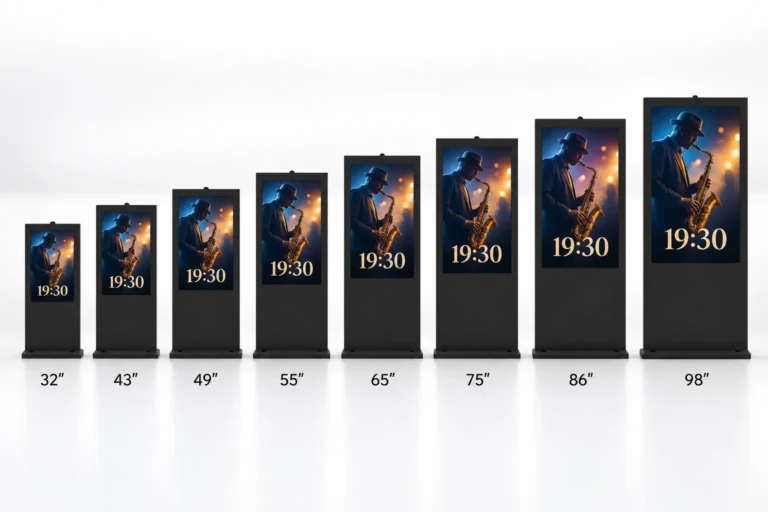
| Single-sided, portrait |
43–75" |
1,500–2,500 nits |
Wayfinding, menu, promotion |
| Double-sided, portrait |
43–75" |
1,500–2,500 nits |
Pavement, station forecourt |
| Single-sided, landscape |
55–98" |
2,500–3,000 nits |
Roadside, forecourt |
| Slim indoor totem |
43–65" |
500–700 nits |
Retail, lobby, exhibition |
Three decisions drive the configuration:
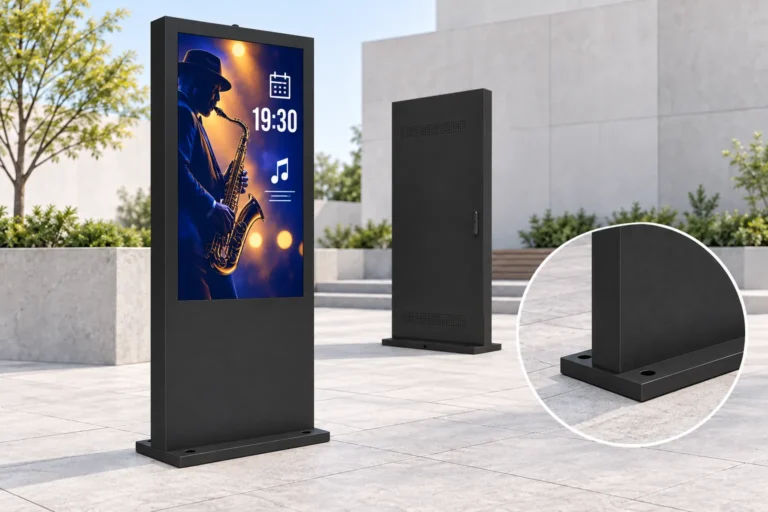
Single or double-sided. A double-sided totem shows two audiences at once, but needs service access from one side and a larger foundation. Confirm the maintenance procedure before choosing it.
Portrait or landscape. Portrait suits wayfinding, queues and single-message advertising; landscape suits maps, timetables and multi-column content. A landscape 98" totem has a large sail area and needs a wind-load calculation.
Brightness and IP. 1,500–2,500 nits with IP65 covers most street furniture. Direct sun and coastal sites move the specification to 3,000 nits and IP66.
This page covers the specification for this model. For the category-level comparison, see the Outdoor Information range.
Installation and foundation
A totem is a small civil project.
- Foundation — the supplier should provide anchor drawings and a wind-load calculation. A 2 m totem with a 75" panel has a large sail area.
- Base and drainage — the base should not collect water; check the cable-entry height.
- Power — a dedicated circuit at the base; confirm the full-brightness draw.
- Network — wired Ethernet preferred; if 4G, test coverage at the exact height.
- Service access — front access lets a technician work from the pavement; rear access may need the unit moved.
- Earthing and surge — outdoor units need surge protection and a proper earth bond.
Send a site photo and the pavement dimensions; most foundation questions are answered by one photo.