10-Year Industry Veteran’s Candid Advice on Avoiding the #1 Mistake 90% of Businesses Make with High Brightness Displays.
Hello! My name is Gary and I am a solutions architect who has spent over a decade in the trenches of the Digital Out-of-Home (DOOH) and commercial display industry. I’ve been on-site for hundreds of projects, from flagship stores on bustling city streets to local shops on quiet town avenues. I’ve witnessed breathtaking digital art installations, and I’ve also had to troubleshoot countless heartbreaking failures.
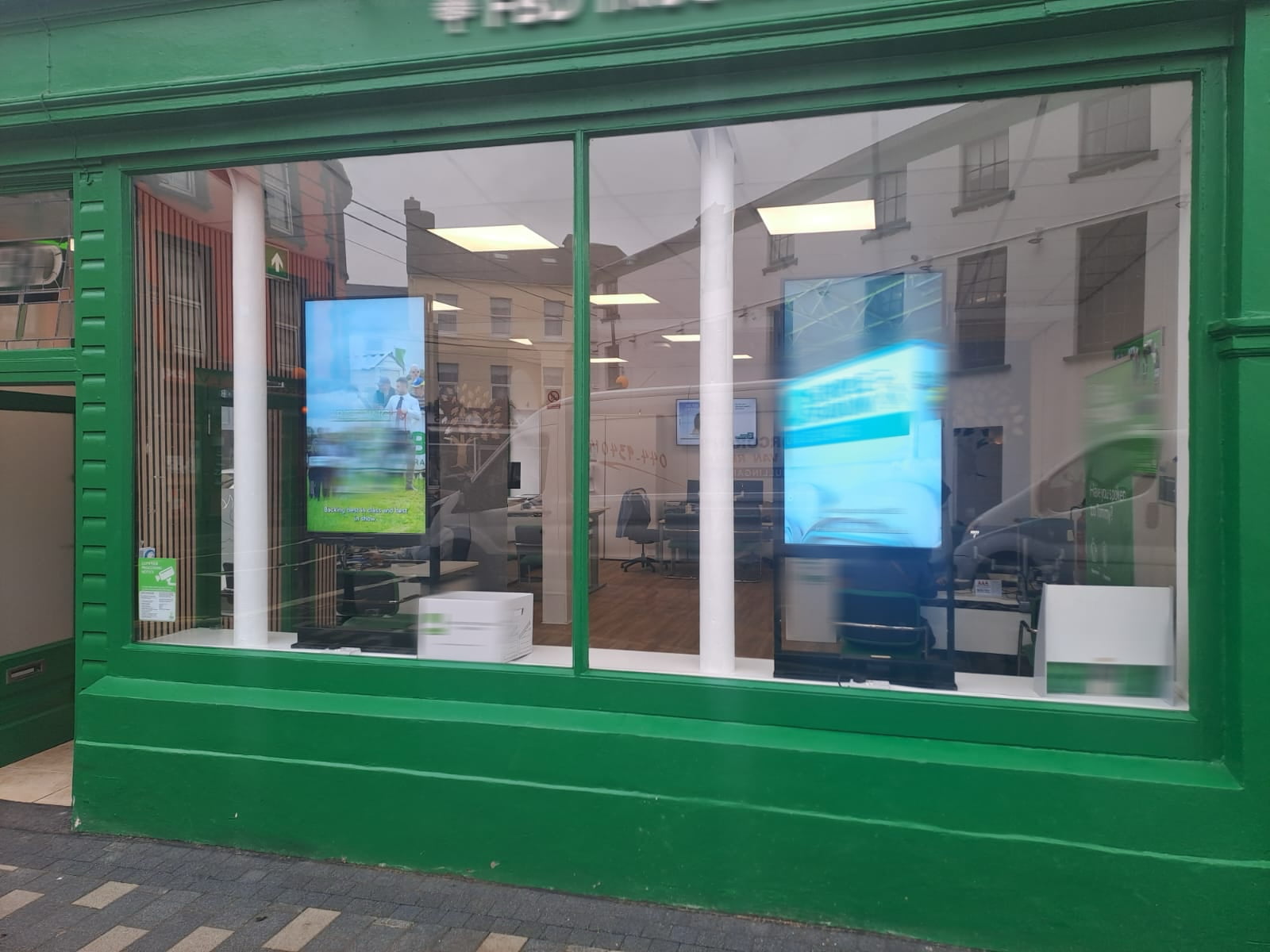
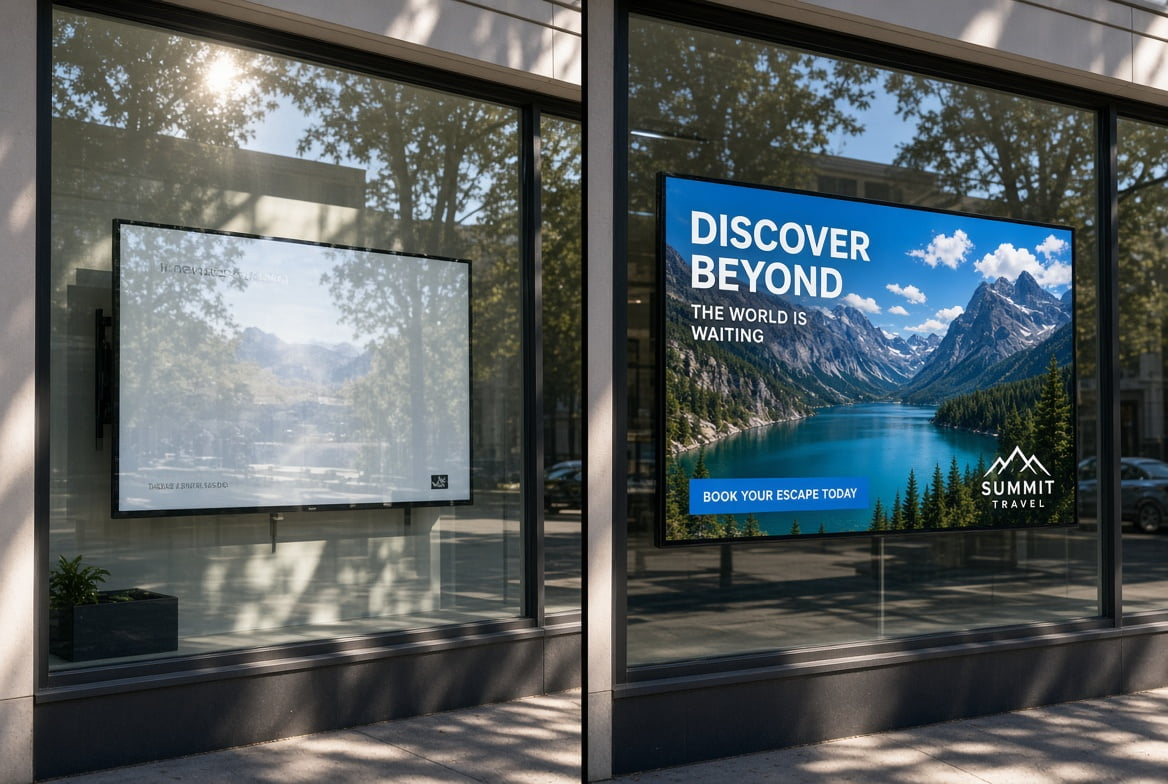
The most common—and most painful—failure scenario always plays out the same way: An enthusiastic business owner invests a significant sum in a brand-new window advertising screen. At the grand opening, the screen is brilliant, captivating the morning crowd with vibrant colors. But as the clock strikes noon and bright sunlight floods the street, the screen—once the star of the show—fades into a blurry, washed-out, almost unreadable “electronic mirror.” The owner’s initial excitement slowly turns to confusion, and then to deep disappointment.
The root cause of this tragedy isn’t a faulty product. It’s a single, often misunderstood technical specification that dictates success or failure: Brightness (measured in Nits).
Today, I am going to pull back the curtain and share everything I’ve learned about high brightness display technology over the past decade. This isn’t just a technical guide; it’s an investment protection manual. After reading this, you will think like an expert and ensure every dollar you invest works for you, every second of the day.
Our core principle is this: Ambient light is the only true measure of the brightness you need.
Part 1: Demystifying Nits — From a Single Candle to the Blazing Sun
Let’s break this down in the simplest way possible.
1. What Exactly is a “Nit”?
Technically, 1 Nit is equal to 1 candela per square meter (1 cd/m²)[1] But let’s forget the jargon.
Just remember this analogy: Imagine you are in a pitch-black room. The light produced by a single standard candle over a one-square-meter area is roughly equivalent to 1 Nit.
So, a 400-Nit display has the brightness of 400 candles lighting up that one-square-meter space.
To give you some real-world context:
- Professional Cinema Screen: ~50 Nits (designed for maximum contrast in a completely dark room)
- Your Home TV / Desktop Monitor: 250 – 400 Nits (perfect for a light-controlled living room)
- Your Smartphone (at max brightness): 600 – 1000 Nits (designed for you to barely read messages outdoors)
- The reflection off asphalt on a sunny day: Over 10,000 Nits!
Now you see the problem. When your screen has to compete with the “Sun” — a cosmic-level display with tens of thousands of Nits — a consumer-grade device with a few hundred Nits doesn’t stand a chance.
2. Deep Dive: Why You Absolutely Cannot Use a Consumer TV in a Commercial Window
This is a question I get all the time. “My 65-inch 4K TV from the big-box store was so cheap. Why can’t I just hang that in my window?”
The answer is that they are two fundamentally different products, designed with opposing philosophies. The reasons go far beyond just brightness:
- Designed Duty Cycle: A consumer TV is engineered for 4-6 hours of use per day. A commercial window display brightness screen is built for 16/7 or even 24/7 continuous operation. Its power supply, mainboard, and internal components are all industrial-grade and ruggedized.
- Thermal Management: A TV relies on passive cooling. A high brightness display, especially one rated at 2500 Nits or more, generates immense heat. Without a professional active cooling system (like thermostatically controlled fans or even an integrated air conditioner), it will overheat, automatically dim, shut down, or suffer permanent damage on a hot summer day.
- Core Functionality:Commercial displays have built-in Content Management Systems (CMS), allowing for remote content scheduling, timed on/off, multi-screen synchronization, and other critical business operations features that TVs lack.
- Brightness Degradation: If you run a consumer TV at its maximum brightness for extended periods, its brightness will degrade incredibly fast. It can be effectively “burned out” in a matter of months. Professional high brightness display panels and their LED backlights are specifically designed to maintain stable brightness for tens of thousands of hours under heavy load. [2]Using a TV in a window might save you money upfront, but you will pay for it later in frequent failures, poor performance, and massive opportunity cost.
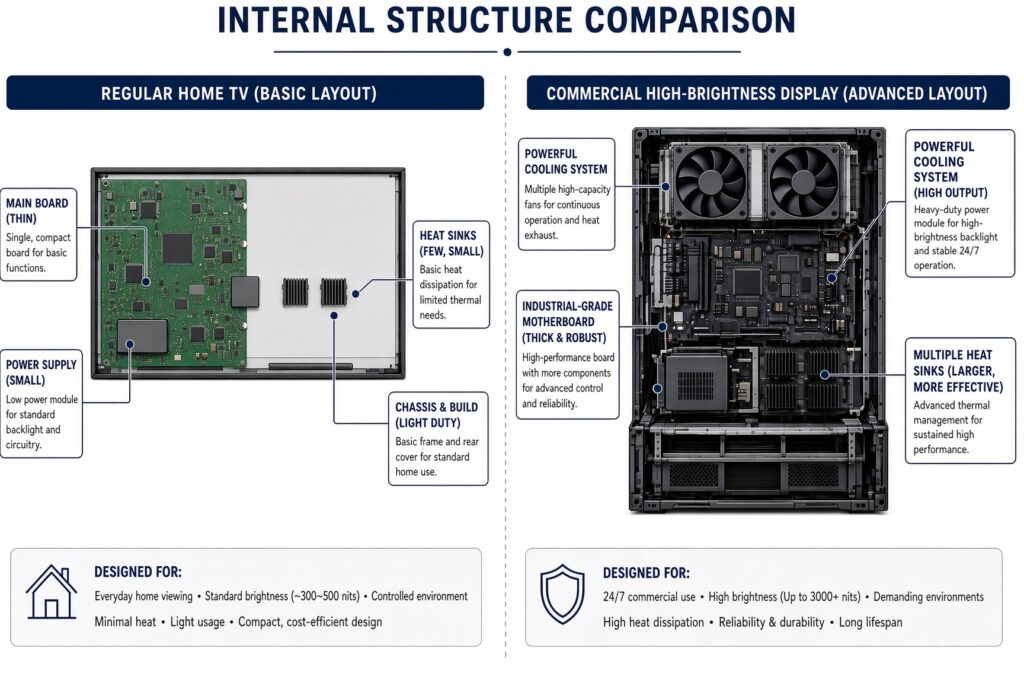
This technical comparison infographic illustrates the engineering differences between standard home televisions and professional, high-brightness commercial displays. The left side depicts the internal architecture of a typical consumer-grade TV—featuring a slim motherboard, a compact power supply, and minimalist heatsinks—designed for controlled home environments. In contrast, the right side showcases the robust architecture of a commercial display, equipped with an industrial-grade motherboard, a powerful dual-fan cooling system for 24/7 continuous operation, a large heatsink array to maintain high performance, and a heavy-duty power module capable of driving a high-brightness backlight exceeding 3,000 nits. Part 2: The Kingdom of Context — Matching Precise Nits to Your Environment
When it comes to screen brightness, there is no “best”—only “most appropriate.” Let’s dive deep into the specific requirements for each scenario.
Scenario 1: Pure Indoor Displays
- Typical Applications: Shopping mall interiors, corporate lobbies, meeting rooms, subway stations (away from direct sunlight).
- Ambient Light Level: Typically 100 – 300 Lux.
- Recommended Brightness: 350 – 700 Nits
- Expert Analysis: In this controlled lighting environment, excessive brightness is aggressive and counterproductive. It not only wastes energy but also causes eye strain and discomfort for the viewer, actually reducing the effectiveness of your message. A 700-Nit display is more than enough to stand out against bright indoor lighting while providing a comfortable and clear viewing experience.
Scenario 2: Semi-Outdoor / Window-Facing Displays (The Most Important Section!)
This is the most complex scenario and where the costliest mistakes are made. If you are searching for a “window advertising screen,” pay very close attention to this section. Your decision here will make or break your investment.
Key Variable #1: Storefront Orientation
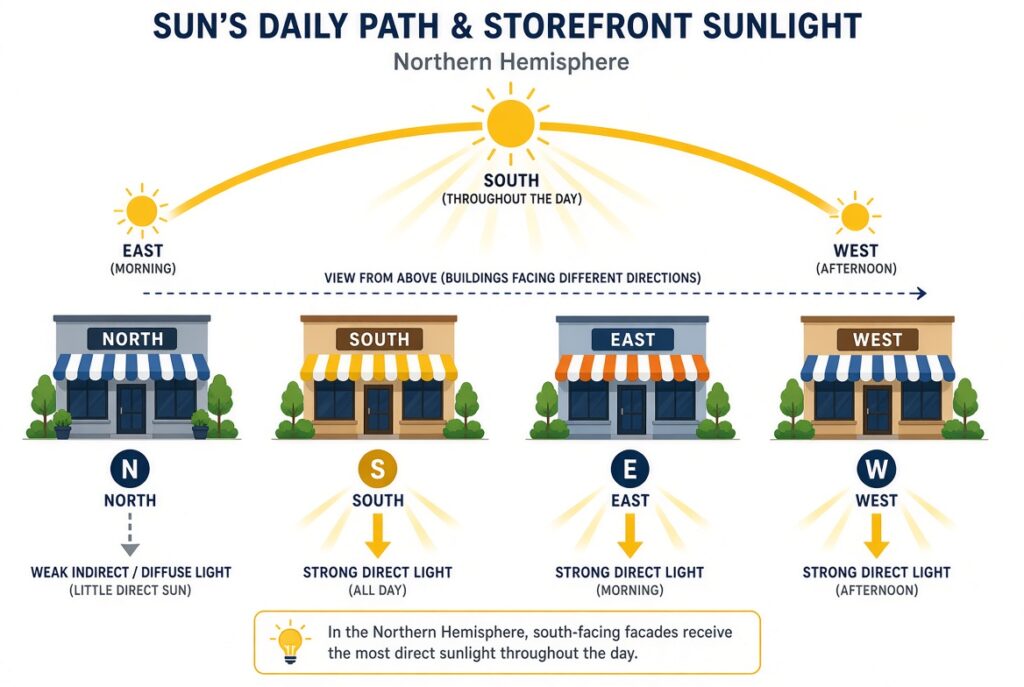
This comprehensive solar path diagram illustrates the optimal orientation and layout for digital window signage based on daily sunlight patterns. The infographic explains how the sun’s east-to-west trajectory dictates visibility requirements for displays in storefronts facing different directions: south-facing facades receive intense direct sunlight throughout the day, necessitating high-brightness displays (exceeding 2,500 nits); east-facing storefronts are exposed to strong morning sun; west-facing locations contend with intense afternoon glare; and north-facing windows receive minimal direct sunlight, with lighting conditions dominated by diffuse light. - North-Facing Windows: This is the ideal orientation. Your window receives almost no direct sunlight and is in shadow for most of the day.
- Recommended Brightness: 700 – 1500 Nits. You might ask, “Why so high if there’s no sun?” Because you still need to combat the high ambient daylight and reflections from the glass itself. A screen below 700 Nits can still look dim and grey on a bright, overcast day.
- East-Facing Windows:You will face the “sunrise attack.” The sun will shine directly on your screen from sunrise until midday.
- Recommended Brightness: 2000 – 2500+ Nits. If you want to capture the morning rush hour traffic, this brightness is non-negotiable. The screen can then automatically dim in the afternoon when the sun has passed.
- West-Facing Windows: You will face the “sunset challenge,” especially in the summer when the afternoon sun from 3 PM to 6 PM is intensely bright and angled low.
- Recommended Brightness: 2500 – 3500+ Nits. This is prime time for retail—foot traffic from people leaving work is at its peak. If your screen is unreadable during these golden hours, your losses are incalculable.
- South-Facing Windows (The Ultimate Challenge): In the Northern Hemisphere, a south-facing window is exposed to direct or angled sunlight for the longest duration of the day.
- Recommended Brightness: Strongly Advise 3000 – 5000 Nits. This is the ultimate test of a display’s performance. Investing in a high brightness display of this caliber is the ultimate insurance policy for your brand image and advertising effectiveness.
Key Variable #2: The Impact of Glass
Don’t forget the layer of glass between your screen and your customer!
- Reflections: Glass reflects the outside world (the sky, trees, buildings across the street), creating “visual noise” that competes with your content. Higher brightness is the weapon you need to punch through this noise.
- Tinted / Low-E Glass: Many modern buildings use tinted or coated glass for insulation. This glass absorbs a percentage of the light passing through it. This means the light from your screen is already weakened before it even reaches the customer’s eyes. In these cases, you should add a 20-30% brightness buffer to your initial calculation.
The Golden Rule of Window Display Brightness (and Nits for Outdoor Screens):
When your budget allows, always choose one level of brightness higher than you think you need. You are not just buying brightness; you are buying an all-weather, all-lighting-condition insurance policy for your investment. A 2500-Nit screen is your entry ticket to being seen in the sun.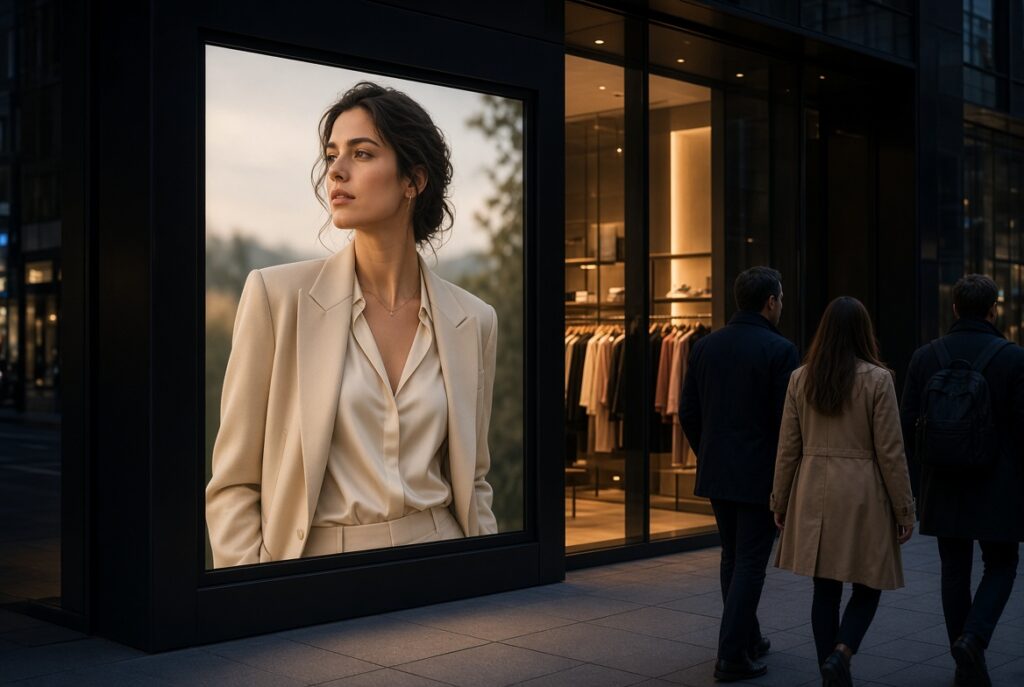
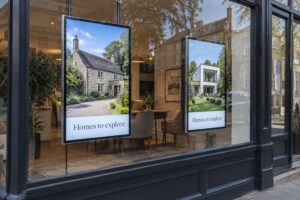
Stunning real-world example of high-brightness digital signage transforming luxury retail storefront marketing. Professional window display featuring crystal-clear fashion video content with vivid colors and dynamic visuals that capture pedestrian attention even during evening hours. The seamless integration of commercial-grade display technology (2500+ nits brightness) complements the boutique’s premium aesthetic while delivering superior visibility in challenging ambient lighting conditions. Demonstrates effective use of digital window displays for fashion retail, showcasing new collection launches, seasonal campaigns, and brand storytelling that drives foot traffic and enhances customer engagement in competitive high-street retail environments. Scenario 3: Full-Outdoor Displays
- Typical Applications: LED billboards on buildings, roadside digital signs, bus shelter information kiosks, stadium scoreboards.
- Environment: Completely exposed to rain, snow, dust, and the full force of the sun.
- Recommended Brightness: 2500 – 7000+ Nits
- Expert Analysis:
- LCD vs. LED: For smaller sizes (under 100 inches), ultra-high brightness LCDs (2500-5000 Nits) are used. For massive sizes (billboards), the display is built from self-emissive LED modules, which can easily achieve 5000-7000 Nits or more.
- More Than Just Brightness: A full-outdoor screen is an entire engineered system. Beyond brightness, you must consider:
- IP Rating (IP65/IP67)[3] To ensure it is sealed against dust and water.
- IK Rating (IK10): To ensure it is vandal-proof and impact-resistant.
- Wide Operating Temperature: The ability to function flawlessly in extreme cold (-30°C / -22°F) and extreme heat (+50°C / 122°F).
- Superior Cooling: Often requires a built-in industrial air conditioning unit for active cooling, not just fans.
Part 3: The Three “Punishments” of a Wrong Choice — Real Financial and Brand Damage
Choosing the wrong brightness is a grave error. It will punish your business in three costly ways.
Punishment #1: “The Invisible Billboard” — Zero Return on Investment
Imagine you spent $5,000 on an ad campaign, but for half the day, nobody could see your ad. How would you feel? This is exactly what happens with an under-specced screen every single day.
- Zero Effectiveness: During the brightest, busiest hours of the day, your content is invisible. Your message fails to deliver. Your beautifully produced videos and promotions are wasted.
- Damaged Brand Perception: A screen that is sometimes clear and sometimes blurry sends a negative message: “unprofessional,” “cheap,” “cutting corners.” Instead of elevating your brand, it devalues it.
- The Opportunity Cost Black Hole: You will never know how many potential customers you lost because they couldn’t see your promotion and walked right by. The loss is unquantifiable but very, very real.
Punishment #2: “The Energy Vampire & Light Polluter” — A Slow Financial Bleed
Using too much brightness in the wrong environment is also a disaster.
- Shocking Electricity Bills: Brightness is the #1 consumer of power in a display. A 5000-Nit screen can use more than double the power of a 2500-Nit screen. Using an ultra-high brightness screen indoors is like burning money every day.
- Visual Pollution: At night, a screen blasting thousands of Nits without dimming is as obnoxious as a searchlight. It repels passersby and can even violate local city ordinances, leading to complaints and fines. Your business becomes the “unfriendly neighbor.”
Punishment #3: “The Silent Killer” — Thermal Meltdown
A simple law of physics: Light = Energy = Heat.
The higher the brightness, the more intense the heat. If a screen’s cooling system cannot keep up, a chain reaction of failures begins:
- LCD Blackening (Mura Effect): At high temperatures, the liquid crystals in an LCD panel can break down, causing permanent black or dark patches on the screen, especially in areas hit by direct sun.
- LED Backlight Decay: Extreme heat dramatically accelerates the aging of the LED backlight, causing the screen’s brightness to drop permanently and the colors to shift and become yellow.
- Component Failure: The mainboard, power supply, and other critical components “bake” inside the chassis, leading to an exponential increase in failure rates and eventual catastrophic failure of the unit.
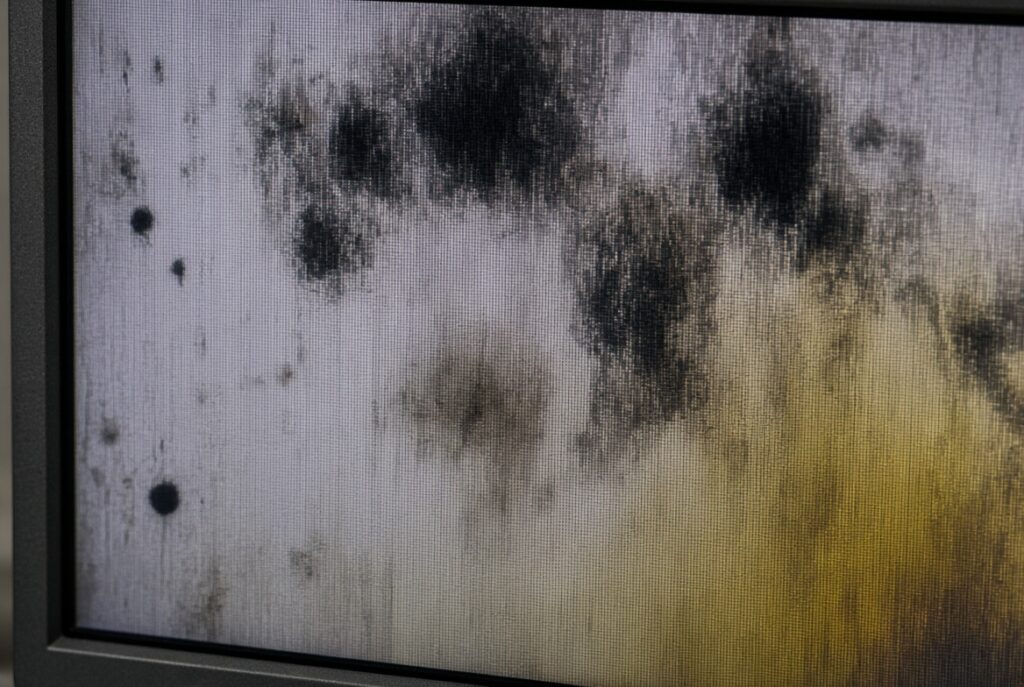
Critical display failure example showing severe heat-induced damage on LCD screen with visible black spots, color uniformity issues, and thermal degradation. This image illustrates common consequences of using consumer-grade TVs in high-brightness commercial applications without proper cooling systems. Dark blotches and discoloration indicate LCD panel damage from sustained high temperatures exceeding manufacturer specifications. Essential cautionary reference for businesses considering window digital signage, demonstrating why commercial-grade displays with industrial cooling fans, robust heat sinks, and thermal management systems are necessary for demanding retail environments with direct sunlight exposure and 24/7 operation requirements. Part 4: Beyond Nits — 4 Advanced Details Every Pro Buyer Considers
If you’ve grasped the importance of Nits, you’re already ahead of 80% of buyers. Now, let’s step into the expert’s circle and look at the details that define a product’s true quality and longevity.
1. The “Smart Brain” — Auto-Brightness Sensor
This tiny component delivers immense value. It acts as the screen’s “eyes,” constantly measuring the ambient light and adjusting the screen’s brightness automatically.- The Effect: Full power under the midday sun for clarity; a gentle glow at dusk for comfort; a dim presence at night to save energy and avoid disturbance.
- The ROI: This feature alone can save 30-50% on energy costs and dramatically extends the life of the backlight. It is a standard feature on any modern high brightness display. Be wary of any product that lacks it.
2. The Ultimate Test — Polarized Sunglasses Viewability
In sunny climates, many people wear polarized sunglasses to cut glare. However, the light from a standard LCD is polarized. If its polarization axis is perpendicular to the sunglasses, the screen appears completely black to the wearer. This is a critical failure point. Professional displays use a special film (a Quarter-Wave Plate or QWP) to solve this, ensuring the screen is perfectly visible to everyone, no matter what they’re wearing.3. The “Cool Heart” — Advanced Thermal Management
As we’ve established, cooling is the lifeblood of a high brightness display. When consulting with a vendor, you must ask:- What is the cooling method? Is it an intelligent array of fans (air-cooled)? Or a more powerful direct-air or closed-loop air conditioning system (recommended for 3500+ Nits in direct sun)?
- What is the airflow design? A superior design ensures cool air flows evenly over every heat-generating component, preventing hot spots.
4. The “Nervous System” — Remote Management & Monitoring
For any business with multiple locations or unmanned digital signs, this is a game-changer. A robust cloud-based platform should allow you to:- Publish content remotely: Update ads across all your stores nationwide with a single click.
- Monitor operational status: See the internal temperature, fan speed, and network status of every screen in real-time.
- Receive fault alerts: Get notified of a potential issue before it becomes a critical failure.
- Schedule power on/off: Precisely manage the operating hours of every display to save energy.
Conclusion: Make Every Penny of Your Investment Shine
Your screen’s brightness is not just a cold number on a spec sheet. It’s the factor that determines if your brand is seen, if your story is told, and if your investment yields a return.
Choosing the right window display brightness is a science, not a gamble. It requires a combined understanding of optics, architecture, engineering, and marketing.
Are you still feeling overwhelmed about your digital signage project?
Worried about overpaying, but even more worried about buying the wrong thing?Stop guessing. Let a team with a decade of real-world experience be your expert technical advisor.
We understand that your project is unique. That’s why we offer a 100% FREE, no-obligation Project Needs Assessment.
In a brief 15-minute call, you will receive:
- ✅ A Precise Brightness Recommendation: Scientifically calculated for your exact store address, orientation, and glass type.
- ✅ Tailored Product Matching: We’ll suggest 2-3 of the most cost-effective high brightness display solutions for your specific needs and explain the pros and cons of each.
- ✅ A Preliminary Budget Outline: A clear cost range covering the product, installation, and support, so you can plan effectively.
- ✅ Critical Pitfall Warnings: We’ll identify potential risks in your project that you may not have considered.
This is more than a sales call; it’s a transfer of knowledge and experience. Our goal is to empower you to make the best possible decision, whether you choose to work with us or not.
Email: info@yjcen.com
Office: Building 15, No. 420, Lidu Road, Loucun Second Industrial Zone, Xinhu Street, Guangming District, Shenzhen, China, 518107Trust in professional expertise. Let your brand be seen, be brilliant, and shine in any light.
References
“Candela per square metre – Wikipedia”, https://en.wikipedia.org/wiki/Candela_per_square_metre. The nit is defined as one candela per square meter (cd/m²) in the International System of Units, a standard measure of luminance used in display technology and photometry. Evidence role: definition; source type: encyclopedia. Supports: The technical definition and equivalence of the nit as a unit of luminance. ↩
“LED Backlight Lifespan: How Long Monitors Really Last – KTC”, https://us.ktcplay.com/blogs/technology-hub/monitor-led-backlight-lifespan?srsltid=AfmBOoqWXBUrn8EVdT2km_2hCOQaMrpp3Zzpb0VAp5M3YQmYh0T1g1yA. Commercial-grade LED backlights are typically rated for 50,000-100,000 hours of operation with gradual brightness degradation, engineered to maintain 50% or more of initial brightness at end-of-life, significantly exceeding consumer-grade specifications. Evidence role: general_support; source type: research. Supports: The operational lifespan and brightness stability of commercial-grade display backlights. Scope note: Actual lifespan depends on operating conditions, thermal management, and initial brightness settings.↩
“IP code”, https://en.wikipedia.org/wiki/IP_code. The IP (Ingress Protection) rating system defined in IEC standard 60529 classifies degrees of protection against solid particles and liquids, where IP65 indicates complete dust protection and water jet resistance, while IP67 provides dust-tight sealing and protection against temporary water immersion. Evidence role: definition; source type: institution. Supports: The technical definition and protection levels of IP ratings. ↩