Quick Guide: Choosing a Display for a Bright Shop Window
For a street-facing shop window, YJCEN recommends display configurations with a typical brightness of 3,000 nits. A suitable installation also needs to account for reflections, heat and the position from which customers view the content.
- Assess the brightest conditions: Check the window when sunlight and street reflections are strongest.
- Understand the brightness specification: Confirm whether a quoted figure represents maximum or typical brightness.
- Check suitability for sun exposure: Review operating conditions and ventilation requirements alongside brightness.
- Match the format to the storefront: Choose a wall-mounted or floor-standing arrangement around the available space.
- Review the message from outside: Test actual promotional content at the intended viewing distance.
A screen can look bright inside a showroom and appear faded once it is installed behind a shop window. From the pavement, customers see the display through glass that also reflects the sky, buildings and passing vehicles.
For buyers, this raises two related questions: will the content remain readable during the day, and is the equipment suitable for the heat at that installation position?
YJCEN offers wall-mounted and floor-standing configurations with a typical brightness of 3,000 nits for projects where bright viewing conditions are a concern. Understanding the value of that specification starts with the effects of light and heat on a window display.
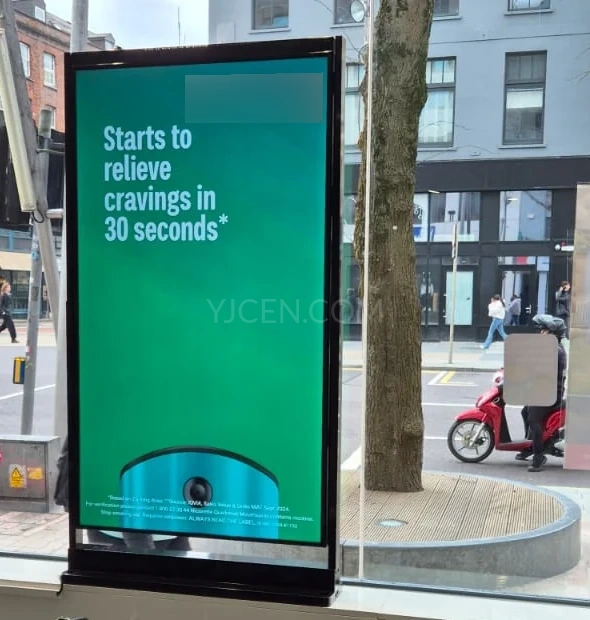
The Washout Effect: Why an Indoor Screen Can Look Faded in a Shop Window
Consider an indoor display specified at 500 nits. In a controlled indoor setting, its content may look clear. Behind a bright storefront window, reflected daylight adds light to the image the viewer sees.
Dark areas can appear lighter, colours can look less saturated, and text can become harder to distinguish from its background. The display may still be operating normally, yet its message appears washed out.
Research published through the US National Institute of Standards and Technology examines daylight readability through measurements of display reflection and ambient contrast. This supports evaluating a screen under its actual lighting conditions, rather than relying only on contrast specifications measured in a controlled environment.
NIST: Display Daylight Ambient Contrast Measurement Methods and Daylight Readability
For a retailer, the practical consequence is that a screen which performs well inside the store may need a different brightness configuration when it faces the street.
Sunlight and Screen Brightness Use Different Units
Environmental illumination is measured in lux, while screen luminance is measured in nits.
NIST reference material lists full daylight without direct sun at approximately 10,000–25,000 lux, and direct sunlight at approximately 32,000–130,000 lux. These are illustrative ranges; conditions at an individual window vary with weather, orientation and shading.
NIST lighting-condition reference, PDF
A sunlight reading of 100,000 lux therefore cannot be divided by a screen specification of 500 nits to calculate how much brighter the display needs to be. The relationship also depends on how light is reflected and how the installation is viewed.
What Does 3,000 Nits Typical Brightness Mean?
A nit is a unit of luminance used to describe display brightness, equal to one candela per square metre (cd/m²).
For the YJCEN configurations discussed here, 3,000 nits is the specified typical brightness. Typical brightness describes representative luminance under specified operating conditions; actual output can vary with settings, content and operating conditions.
When comparing quotations, distinguish between the following:
| Brightness description | What to establish before buying |
|---|---|
| Maximum brightness | The highest stated output and the conditions under which it is achieved |
| Typical brightness | The representative output specified under defined operating conditions |
| Brightness during operation | The output available with the intended settings, content and installation conditions |
This distinction helps buyers compare specifications on a consistent basis. It is especially relevant when a display will operate behind glass during the brightest and warmest parts of the day.
Why Consider 3,000 Nits for a Street-Facing Display?
For a bright shop window, greater available luminance can help the image remain distinguishable against reflected light. That is the basis of YJCEN’s recommendation to consider configurations specified at 3,000 nits typical brightness.
The outward-facing screen serves an audience in a different environment from customers inside the shop. A passerby may approach from an angle, see reflections across the window and have only a short time to understand the promotion.
Samsung’s official OMN-D datasheet provides a relevant example of this distinction: its double-sided window display specifies 3,000 nits on the outward-facing side and 1,000 nits on the inward-facing side.
Samsung OMN / OMN-D official datasheet, PDF
The outward-facing Samsung example and the YJCEN configurations discussed here both specify 3,000 nits as typical brightness. This makes the type of brightness rating comparable; it does not establish identical optical or thermal performance.
Does Every Shop Window Require 3,000 Nits?
Brightness requirements change with the environment.
A 2022 study published in Optics Express examined display luminance under different ambient light levels in a simulated cockpit. Its fitted model estimated an optimum of approximately 912 cd/m² at 10,000 lux, based on visual performance, comfort and fatigue. That result applies to the study’s conditions and is not a universal threshold for retail windows.
A shaded storefront may have different needs from a window exposed to direct afternoon sunlight. Our recommendation is to assess the 3,000-nit typical brightness specification together with the site, rather than select solely from a headline number.
Beyond Brightness: Heat-Induced Blackening in LCD Panels
Sunlight also creates a thermal challenge. A screen may be bright enough for the location but still require careful assessment of its suitability for solar exposure.
LCD image formation depends on the ordered arrangement and optical properties of the liquid-crystal material. When sufficiently heated, that material can enter an isotropic phase, losing the orientational order needed for normal operation. The transition temperature is commonly called the clearing point.
Liquid Crystal Displays, academic handbook chapter, PDF
Depending on the panel’s optical design, excessive heating can produce dark patches or other image abnormalities. Samsung’s outdoor-display white paper specifically identifies sunlight-related heating as a potential cause of LCD discolouration and black blotches.
Samsung: The Display’s the Thing, PDF
This is a different issue from washout: reflections reduce the image’s apparent contrast, while heat can disrupt the panel’s operation.
What Should a Buyer Check?
Ask the supplier to confirm:
- Whether the selected model is suitable for the intended direct-sunlight exposure.
- Its permitted operating conditions and any separate restrictions under direct sunlight.
- Required ventilation clearances and installation provisions.
- How brightness and image performance are maintained during extended operation at the proposed location.
A panel material’s clearing point is not the same as the complete display’s permitted operating temperature. Likewise, a 3,000-nit brightness specification alone does not establish resistance to heat-induced blackening.
For procurement, brightness capability and thermal suitability should be reviewed together.
Wall-Mounted or Floor-Standing: Match the Display to the Window
Once the viewing conditions are understood, choose an installation format that places the screen where customers can see it clearly.
Wall-Mounted Displays
A YJCEN outdoor wall-mounted display is an option to assess where the site provides a suitable supporting surface and a clear view through the window.
Confirm the mounting height, supporting structure, cable route and maintenance access. Check the proposed position from outside: window frames, posters or merchandise should not obscure important parts of the message.
The quotation should identify the selected brightness configuration and the installation conditions it supports.
Floor-Standing Displays
A YJCEN floor-standing display provides a freestanding format for a dedicated area inside the storefront.
Consider the base footprint, securing requirements and visible screen height. The unit should fit the window layout while leaving the necessary access around it.
For a bright street-facing project, specify the configuration with a typical brightness of 3,000 nits when discussing the order. Installation format and brightness configuration are separate selection decisions.
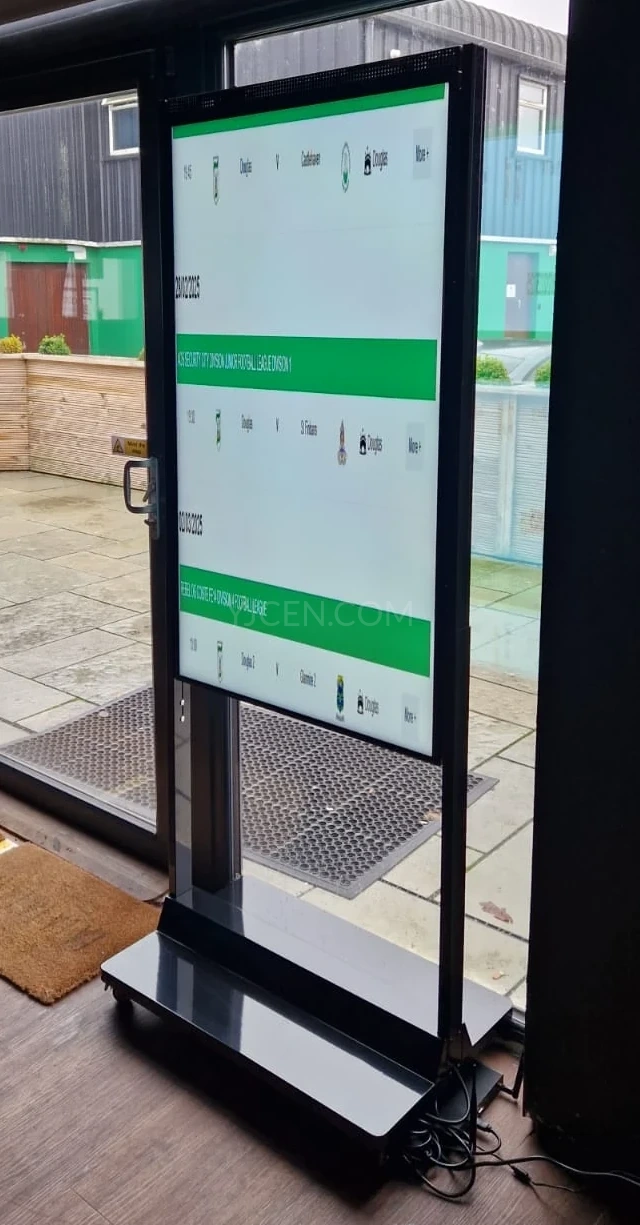
Real Projects: High-Brightness Displays Behind Retail Windows
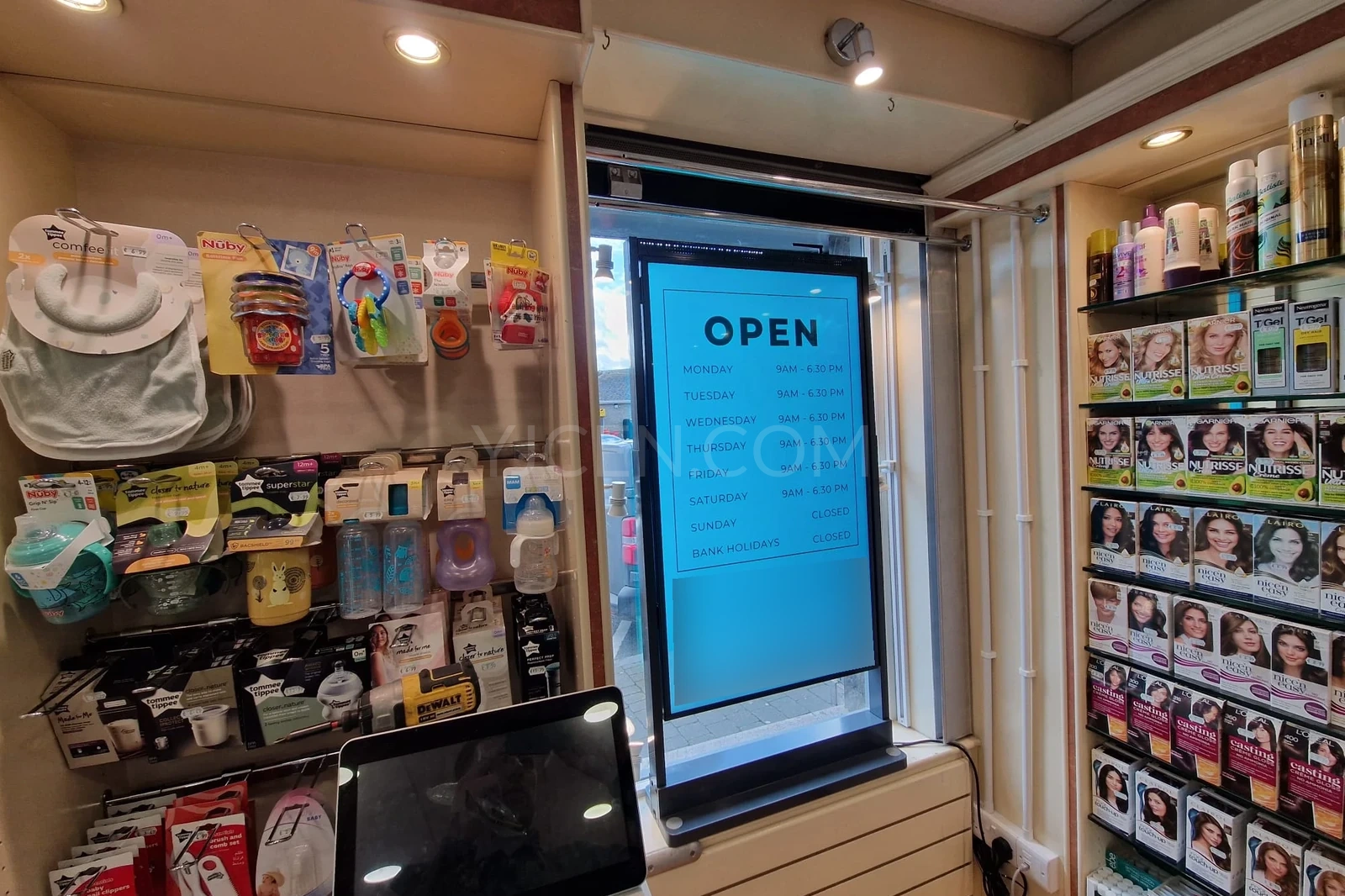
55-Inch Window Displays for a Retail Store in Ireland
YJCEN’s retail window project in Ireland used 55-inch single-sided displays installed inside street-facing glass windows. The published project specifications list a brightness of 3,000 nits, with the screens facing outward to present promotional content.
This installation illustrates a practical distinction: although the equipment is inside the store, its content is viewed from outside. Selection therefore needs to account for the daylight, glass reflections and viewing position at the storefront.
See the Ireland retail window display project for the installation details.
75-Inch Floor-Standing Displays for a European Furniture Retail Chain
In 2026, YJCEN supplied 20 units of 75-inch floor-standing displays for a European furniture retail chain. Installed inside storefront windows, the screens face outward to show furniture imagery and promotional messages.
The supplied units used a configuration with 3,000 nits typical brightness.
The photographs on the linked case page show the display arrangement through the storefront glass, including reflections from the surrounding environment. They also help buyers assess practical details such as screen size, base footprint and the amount of content presented at once.
Those case photographs document an actual installation under the conditions present when they were taken. They provide a project reference, rather than a measurement of screen luminance or thermal performance.
See the full European furniture retail installation case for additional photographs and project details.
Make the Available Brightness Work for Your Message
A high-brightness screen still needs content suited to the way people approach the shop.
For storefront promotions, we recommend beginning with one main message, a clear product image and a short call to action. Give prices and essential offer details enough space to be read from the pavement.
Before finalising the layout:
- Preview the content at the intended screen size.
- Check it from the expected viewing distance and both approach directions.
- Look for text or images obscured by window frames and reflections.
- Review it during the brightest part of the trading day.
- Check the appearance again after dark, when the surrounding light is different.
This review connects the hardware specification to the actual purpose of the display: helping a passing customer understand the message.
Plan Your Shop Window Display with YJCEN
For a bright street-facing window, YJCEN recommends configurations with a typical brightness of 3,000 nits, supported by a review of the glass, sun exposure, installation layout and content.
To help us recommend a suitable option, share:
- Exterior and interior photographs of the proposed installation area.
- Usable window dimensions and any mounting restrictions.
- The times when direct sunlight reaches the window.
- Expected viewing distance and daily operating hours.
- Your preferred wall-mounted or floor-standing format.
- A sample of the content and the number of displays required.
Contact YJCEN to discuss your storefront and request a display configuration and project quotation.