Hello, fellow warriors of the restaurant industry!
I’m Gary, a sales engineer who has been deeply involved in the commercial display industry for over a decade. I often find myself replying to emails late at night from passionate Quick-Service Restaurant (QSR) owners just like you. The questions you ask, when boiled down, all point to a single, shared anxiety: in this ever-accelerating world, how can my restaurant operate more efficiently and become more profitable?
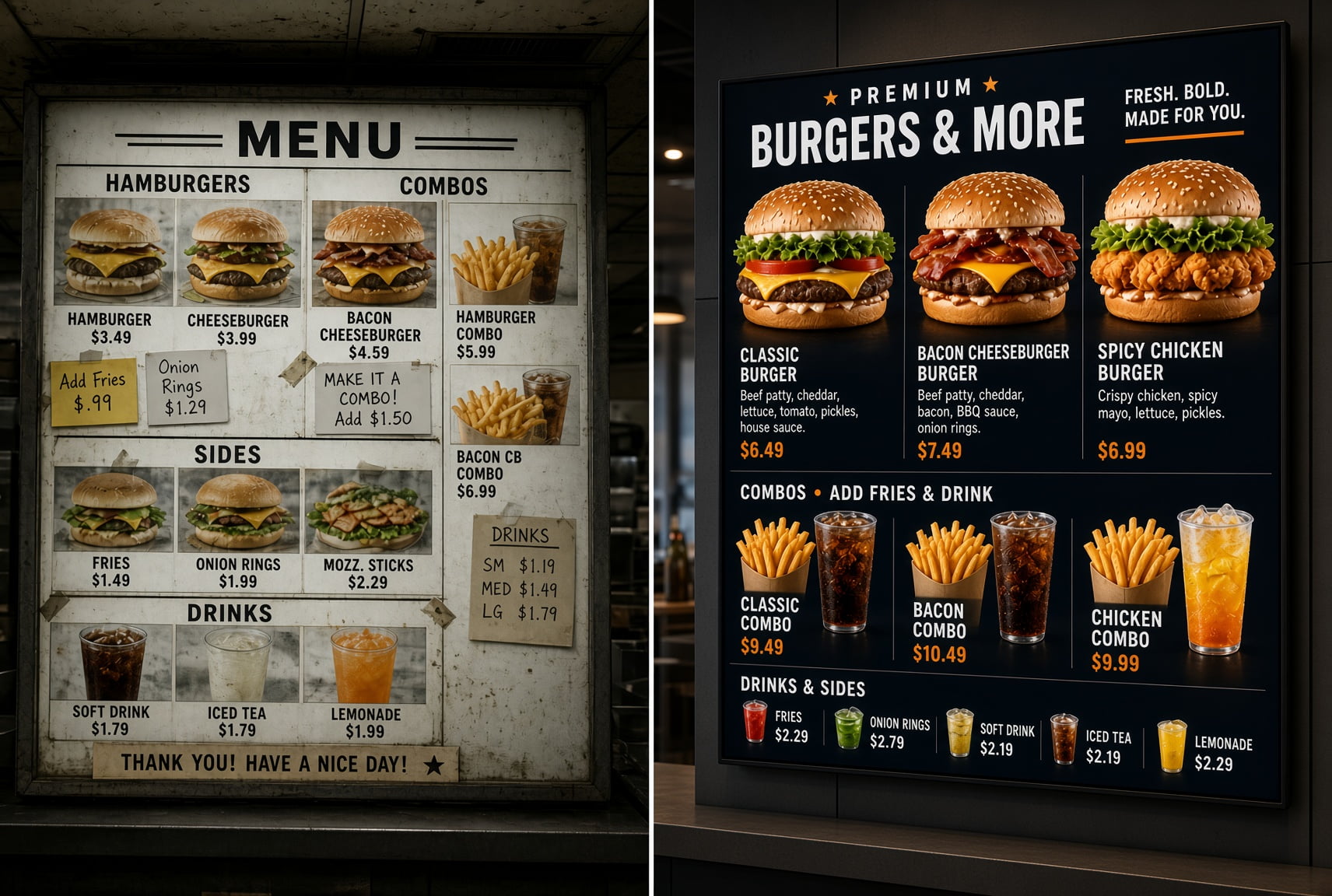
As we delve deeper, I’ve found that the root of many operational headaches often points back to that unassuming, traditional lightbox menu hanging on your wall. It may not seem like a major issue, but in reality, it’s quietly eroding your profits and slowing your growth.
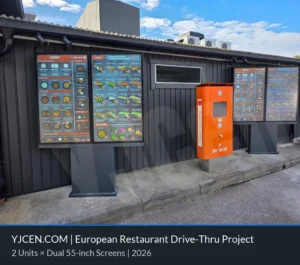
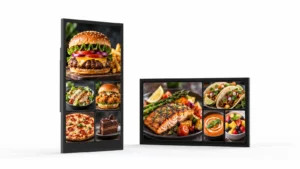
Today, I want to help you say a final goodbye to the old era of “one menu print for the entire season.” **Digital menu boards for restaurants** are no longer a luxury reserved for massive chains; they are an efficiency revolution sweeping the industry and an essential engine for growth for every modern QSR.
—
1. Day-parting: The Right Product, to the Right Customer, at the Right Time
This is, without a doubt, the most powerful feature of a QSR digital menu. It is the fundamental game-changer that sets it apart from any traditional menu.
Your restaurant plays several different roles throughout the day:
- Morning (7-10 AM): It’s an “energy station” for commuters, where coffee + sandwich combos are the undisputed stars.
- Midday (11 AM – 2 PM): It becomes a “quick canteen” for office workers seeking value-for-money lunch specials.
- Afternoon (2-5 PM): It transforms into a “leisure spot” for friends, where demand for specialty drinks, desserts, and snacks emerges.
- Evening (6 PM onwards): It’s the “late-night diner” for families and couples, where higher-value dinner combos and new items are more popular.
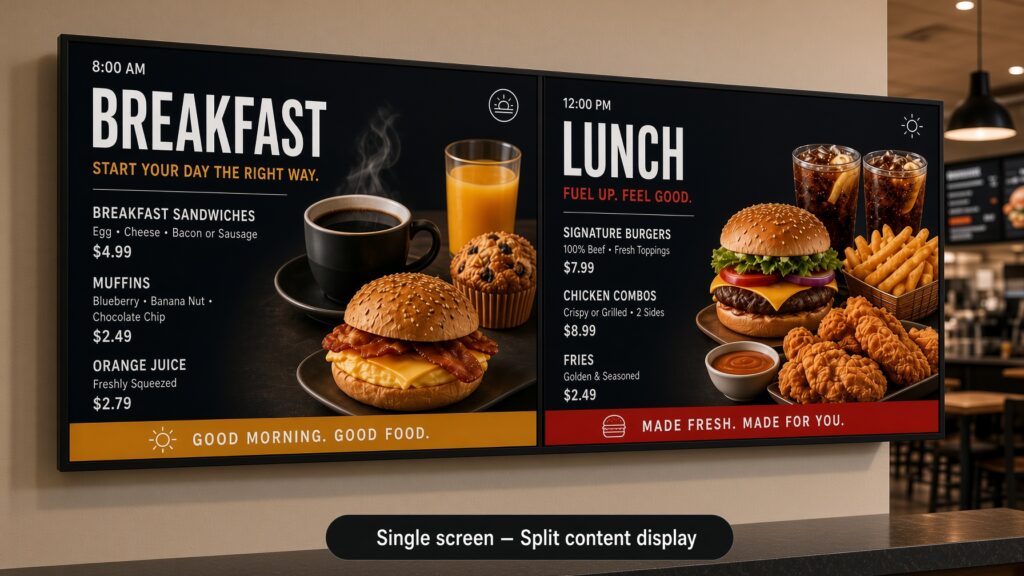
A traditional menu can only cram everything together, forcing customers to hunt through a maze of options. A digital menu board, however, enables true smart operation through preset, automated “day-parting” playlists. Imagine this:
At 10:59 AM, your screen displays a vibrant breakfast combo. The clock strikes 11:00 AM, and the menu seamlessly transitions. An aromatic grilled chicken burger special appears, accompanied by a dynamic flame effect, and the background color shifts from a bright morning yellow to a warm, inviting lunch-time orange.
The benefits are exponential:
- Simplified Customer Decisions: By presenting the most relevant choices, you drastically reduce hesitation and ordering time, boosting front-of-house throughput.
- Maximized Sales Potential: Focus your promotional firepower on the highest-margin products during peak times.
A slow-motion, high-definition video of a cheesecake during the afternoon slump has a seductive power that a static image could never hope to match[1]
—
2. Instant Cloud Updates: Giving You “Hyper-Speed” to React to the Market
The market moves fast, and ingredient costs fluctuate. Imagine your main beef supplier informs you of a 15% price hike starting next week. With a traditional menu, you face a dilemma: either absorb the profit loss for at least a week while waiting for new prints or ruin your brand aesthetic with an ugly price sticker.
The core of an electronic menu board is its powerful, cloud-based Content Management System (CMS). This means that no matter where you are, you can control the menus of all your stores with any internet-connected computer, tablet, or even your smartphone.
- Cost Fluctuations? Log in to the backend, find the item, enter the new price, and hit “Publish.” Within seconds, the menus in all your locations—even across different cities—are updated.
- New Items or Promotions? For new products, BOGO offers, or a “Today’s Special,” simply prepare the image or video assets, set the start and end times, and the system will execute the campaign automatically, down to the minute.
- A/B Testing for Optimization? You can even set different layouts on two menu screens and analyze backend data to see which one achieves a higher conversion rate, allowing you to make data-driven decisions for continuous improvement.
This ultimate agility transforms you from a passive market reactor into a proactive market maker.
—
3. Smart Upselling: Your Most Tireless Star Salesperson
“Would you like to upgrade to a large combo for just one dollar more?”
How many hundreds of times a day do your employees need to repeat this? They get tired, they forget, their mood affects their delivery, and they might hesitate to ask a customer who seems to be in a hurry. But your QSR digital menu never will.
Using carefully designed visual psychology, it becomes your most powerful and relentless salesperson:
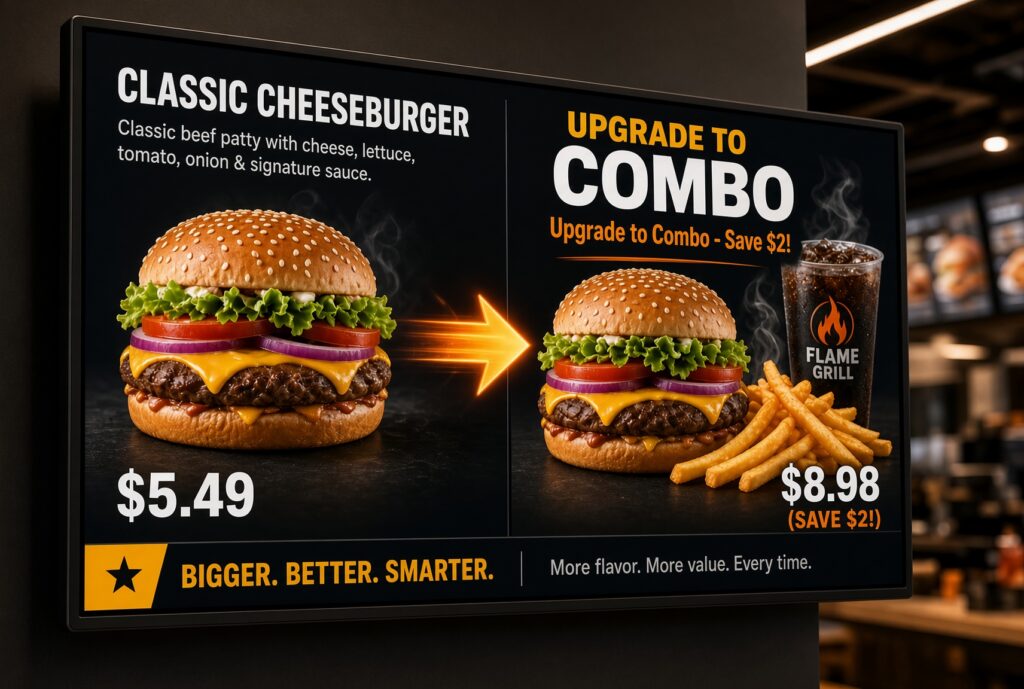
- Visual Upgrade Prompts: Next to the medium-sized soda, a flashing arrow and dynamic icon highlight: “+$1 for a Large!” This visual stimulus is far more persuasive than a verbal suggestion.
- Dynamic Combo Recommendations: As a customer’s eyes linger on the burger section, a side screen can seamlessly play a video of crispy golden chicken nuggets with the text, “The perfect side, only $4.99!”
- Spotlighting High-Margin Items: Use the screen’s “prime visual real estate” (typically the top-right or center) to display your key high-profit items with the biggest, brightest, and most dynamic effects. The human eye is naturally drawn to motion, instantly bringing that item into the customer’s consideration set.
Industry data shows that visually-driven, dynamic upselling prompts can easily increase the Average Order Value (AOV) by 5%-15%. This increase is almost pure profit.
4. Optimizing the Customer Journey: Eliminating “Waiting Anxiety”
Lines are the arch-nemesis of QSR operations. Long waits not only frustrate customers and lower satisfaction but can also cause potential patrons to turn away before they even enter[2].
Digital menu boards for restaurants tackle this problem from two angles:
- Reducing “Actual Wait Time”: Clear layouts, high-quality images, and dynamic item showcases allow customers to decide what they want while they are still in line. By the time they reach the counter, they’re ready to order, significantly speeding up the entire process[3]
- Reducing “Perceived Wait Time”: In the menu’s playback loop, you can intersperse brand story shorts, food safety commitments, fun animations, or even local weather updates. This engaging content effectively distracts customers, making them feel like “the wait wasn’t long at all,” thereby dramatically improving the overall dining experience.
Back to Business: A Clear ROI (Return on Investment) Calculation
After all these benefits, let’s get down to the most practical question: “Is this investment worthwhile? How long until it pays for itself?”
Let’s set aside feelings and look at the data. When you invest in a set of electronic menu boards, your return comes from two primary areas: cost reduction and revenue growth.
Cost Savings:
- Printing & Material Fees: Say goodbye to the recurring costs of menu design, printing, shipping, and installation (easily saving you thousands of dollars annually).
- Labor & Time Costs: Free up your management team from the tedious menu update process, allowing them to focus on more valuable operational tasks.
Revenue Growth:
- Upselling Increase: If your daily revenue is $3,000, a 5% increase in AOV adds an extra $150 per day. That’s over $54,000 in additional revenue per year.
- Day-parting Precision: Industry data suggests this feature alone can contribute to a 5%-15% increase in overall sales.
- Promotional Agility: The ability to launch instant promotions helps you clear inventory, reduce waste, and attract extra foot traffic during holidays.
On balance, the vast majority of our QSR clients see a full return on their hardware and software investment within 6 to 18 months. After that, every bit of growth your digital menus generate is pure, solid profit.
Conclusion: This Isn’t an Upgrade, It’s a Strategy for Survival
In today’s fiercely competitive market, efficiency is your lifeline, and customer experience is your defensive moat.
The traditional lightbox menu is a relic that is actively holding your business back. What a QSR digital menu offers is the agility, insight, and profitability you need to stay ahead in the digital age. This is no longer a question of “if” you should make the switch, but a mandatory question of “when and how” you will do it to secure your future.
—
Call to Action:
Ready to see a quantum leap in your restaurant’s operations and revenue?
Click here to contact us or email us [info@yjcen.com]
Don’t let outdated technology slow down your path to profitability. Contact our team of experts today for a FREE, in-depth Return on Investment (ROI) analysis tailored specifically to your restaurant, and schedule a live online product demo.
Let us show you how a well-designed digital menu board solution can bring real, measurable change to your business.
—
Reference:
- “Influence of short video content on consumers purchase intentions on …”, https://pmc.ncbi.nlm.nih.gov/articles/PMC12075488/. Consumer psychology research on food imagery has found that dynamic visual presentations, including video and animation, can enhance perceived food quality, appetite appeal, and willingness to purchase relative to static images, with effects linked to simulation of sensory experience and increased mental imagery vividness. Evidence role: general_support; source type: research. Supports: That dynamic or video representations of food products elicit stronger appetitive responses and purchase intentions compared to static photographs. Scope note: Effect sizes reported in controlled laboratory studies may be attenuated in real-world QSR environments where customers are subject to time pressure and competing stimuli.↩
- “Waiting Patiently: An Empirical Study of Queue Abandonment …”, https://faculty.wharton.upenn.edu/wp-content/uploads/2013/04/Waiting_Patiently-MS.pdf. Queuing theory and consumer behavior literature document the phenomenon of ‘balking,’ whereby potential customers choose not to join a queue upon observing its length, with empirical studies in retail and foodservice contexts confirming that perceived wait time is a significant determinant of service entry decisions. Evidence role: general_support; source type: research. Supports: That observable queue length influences prospective customers’ decisions to enter a service establishment, a phenomenon studied under the concept of ‘balking’ in queuing theory. Scope note: The magnitude of balking behavior varies substantially by context, customer segment, and availability of alternatives, making generalization to any specific QSR setting uncertain.↩
- “Customer Restaurant Choice: An Empirical Analysis of … – PMC”, https://pmc.ncbi.nlm.nih.gov/articles/PMC7503372/. Operations management research in quick-service foodservice has examined the relationship between pre-order decision-making and counter transaction time, finding that reducing in-transaction deliberation is a significant lever for improving service rate and reducing queue length. Evidence role: mechanism; source type: research. Supports: That customers who have reviewed menu options prior to reaching a service counter require less transaction time, thereby improving service throughput. Scope note: Empirical studies isolating the specific contribution of digital menu boards to pre-decision behavior, as distinct from other operational factors, are limited in the published literature.↩