What can a restaurant self-service kiosk help with?
A configured kiosk gives customers another place to browse the menu, review choices and submit an order. Payment and receipt functions depend on the selected hardware and software.
- Use clear item details, prices and an editable basket review.
- Confirm how orders and payment status reach the POS and kitchen workflow.
- Provide staff help and a fallback ordering route.
- Pilot the complete service, including collection and exceptions, before assuming a queue or sales benefit.
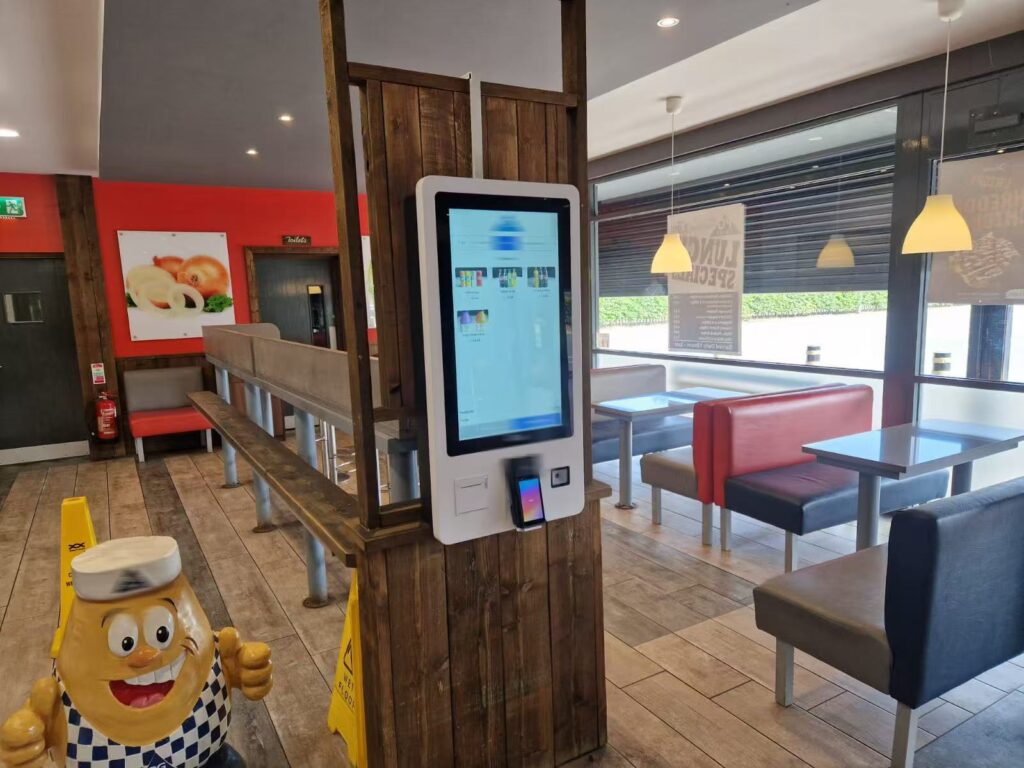
What a Restaurant Kiosk Can Do
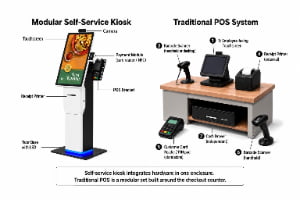
A self-service kiosk for restaurants combines a screen with a computing platform and selected accessories. The software provides the menu and ordering flow. Payment devices, printers and other modules depend on the configuration.
Start with the task you want to improve. A restaurant may need another ordering point, clearer menu choices or a better way to review a basket. Define that task before comparing screens and features.
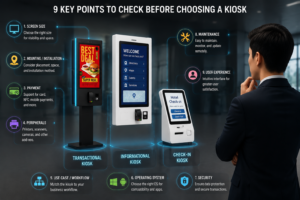
- Hardware: Check the screen, touch input, mounting and required accessories.
- Software: Confirm menu management, order handling and the customer interface.
- Connections: Check the POS, payment provider and any kitchen or collection system.
- Service: Plan staff help, maintenance and a fallback ordering route.
Give Customers Time to Review an Order
A clear screen lets customers browse at their own pace. They can see item names, images and prices before choosing. A basket review page gives them a chance to correct a selection before confirming.
This can reduce reliance on spoken order-taking, but it does not remove every source of error. A confusing menu or an incorrect software setting can still lead to mistakes. Check the customer screen and the order received by staff together.
Keep Menu Choices Clear
Use short category names and familiar labels. Show the price of an item and the cost of any added option before checkout. Make back, edit and cancel actions easy to find.
Do not assume a larger screen makes a crowded menu easy to use. Test the interface with real menu items. Ask users to find a product, change a choice and review the basket without prompting them.
Support Questions and Special Requests
If the software supports item details or customisation, confirm that the information is maintained accurately. Make it clear when a customer should speak to staff. Do not rely on a kiosk to resolve every unusual request.
Food information should follow the restaurant’s established review process. The presence of an ingredient field or a filter is not a guarantee that a meal is suitable for a particular customer. Keep a clear route to staff assistance.
Share the Ordering Workload
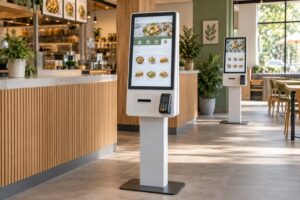
A kiosk adds an ordering point beside the staffed counter. Customers who want self-service can use it while staff help other guests or handle preparation and collection. The right balance depends on the restaurant.
Do not treat the terminal as a replacement for all front-of-house support. Some users need help with language, touch controls or payment. Others prefer to order with a person. Plan for both routes.
Look at the Whole Queue
A shorter line at the counter can hide a longer wait for food. Review ordering, payment, preparation and collection as one process. The kitchen and pickup area must be able to handle incoming orders.
Several kiosks can provide several ordering points. One screen is still normally used by one customer at a time. Check capacity during busy periods before assuming that extra screens will solve a queue problem.
Give Staff Clear Responsibilities
Decide who helps customers, who checks failed orders and who reports technical problems. Staff should not have to guess whether the hardware supplier, software team or payment provider owns an issue.
- Provide a short guide for starting and closing the kiosk.
- Explain how staff recognise an incomplete or cancelled order.
- Show where customers can ask for help.
- Keep contact details for the responsible support teams.
Present Menu Options and Offers Consistently
The selected ordering software may show product images, sizes, extras and offers. A consistent layout can make these choices easier to compare. Each offer should be clear, relevant and easy to decline.
Suggested extras do not guarantee a larger order. Measure what customers choose and whether prompts make checkout harder. An offer that slows the process or confuses the final price may not help the business.
Keep Prices and Availability Current
Agree where menu data is managed. If the kiosk and POS use separate updates, decide how staff keep them in step. Test a price change and an unavailable item before launch.
For a chain, confirm whether the software supports shared menus and local changes. Do not assume that every terminal comes with cloud control or a multi-site dashboard. These are software features to verify.
Prepare Content for the Screen
Use images that match the actual product. Keep descriptions short enough to scan. Make the basket summary readable without forcing the customer through repeated screens.
Preview the layout at the installed height and angle. Check the first screen, product options, basket, payment instructions and final confirmation. These steps should use consistent language.
Connect Orders to the Restaurant Workflow
A kiosk’s value depends on what happens after the customer presses confirm. The order must reach the intended system, with the correct items and payment status. Confirm each connection before buying the hardware.
POS means point of sale. It is the system a restaurant may use to record transactions and manage orders. A kiosk can connect to a POS only when the chosen software and interfaces support that connection.
Check Compatibility Before Deployment
- Confirm the operating system and supported software version.
- List the POS and payment provider by name.
- Identify any printer, scanner or kitchen-system connection required.
- Agree how menus, prices and sold-out items are updated.
- Confirm who will build, test and maintain each integration.
A hardware description alone does not prove that a specific payment service or POS will work. Ask the responsible teams to confirm the complete setup. Include that scope in the project documents.
Test Success and Failure Paths
Test more than a normal completed order. Check cancellation, payment failure and an interruption during checkout. Confirm what the customer sees and what staff receive in each case.
Offline operation and battery backup are not universal kiosk features. Ask which functions remain available if the network or power fails. Keep a fallback plan that does not depend on unconfirmed capabilities.
Use Reporting Only Where It Is Available
Some ordering software provides reports on completed orders, popular items and busy periods. The available data depends on the software and connected systems. Do not assume that the screen records every interaction.
Choose a small set of measures linked to the project goal. If the aim is easier ordering, record completion and requests for help. If the aim is queue management, review waiting and collection times.
Compare Like-for-Like Service Periods
Compare similar days and meal periods. Note changes in demand, staffing, menu and promotions. Otherwise, a change caused by another factor may be mistaken for a kiosk result.
Review both benefits and new work. A terminal may reduce some order-taking tasks while adding content updates, paper checks or customer support. Include that work when assessing the outcome.
Plan Installation and Daily Care
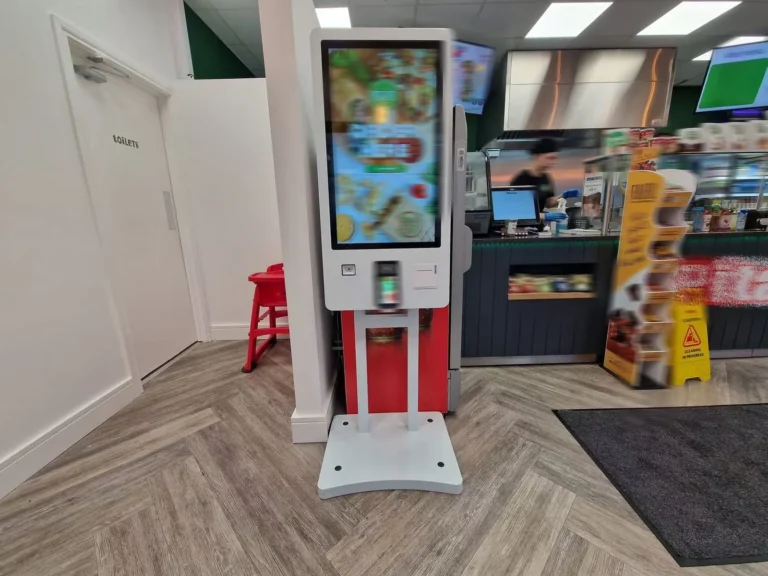
Choose a location where people can find the kiosk and stand without blocking a route. Confirm wall-mounted or floor-standing options for the actual model. Leave room for service as well as customer use.
Check screen reach, payment-device access and receipt collection with the intended users. Accessibility depends on the whole installation and interface; it is not established by screen size alone.
Power, Network and Service Access
Plan power and network access before delivery. Keep cable routes protected and confirm any mounting work with the installer. Leave the clearances required by the product documents.
Agree who will apply approved software updates and handle faults. If remote support is included, confirm its scope and access arrangements. Do not assume that on-site service or replacement parts are included in every quote.
Cleaning Is Still Required
A touchscreen is a shared touch surface. It is not contactless simply because customers order without speaking to staff. Follow the manufacturer’s cleaning instructions and the restaurant’s normal cleaning process.
Do not assume the housing has an antimicrobial coating or that voice and gesture controls are included. Confirm such features for the selected model if the project requires them.
Understand the Full Project Cost
Ask for an itemised quote rather than relying on a generic price range. Screen size, computing hardware, payment modules, installation and software work can all affect the total.
- Initial costs: Hardware, accessories, delivery, mounting and setup.
- Software costs: Licences, configuration, integration and testing.
- Ongoing costs: Support, payment fees, connectivity and agreed maintenance.
- Internal work: Training, menu updates and customer assistance.
Compare quotes using the same scope. A lower hardware price may exclude software or installation that another quote includes. Confirm support terms and responsibilities before placing an order.
Frequently Asked Questions
Will a kiosk reduce restaurant queues?
It may help by adding an ordering point. The result depends on customer use, the software flow and kitchen capacity. Measure the full service process rather than promising a fixed reduction.
Can it work with an existing POS?
Only if the chosen software and interfaces support that POS. Confirm the exact system and version, then test menu data, orders and payment status before launch.
Does every kiosk include payment and receipt printing?
No. These depend on the hardware modules and software setup. List the required payment methods and receipt process in the project specification.
Does it keep working without internet or power?
Do not assume so. Confirm offline behaviour and any backup-power option for the selected setup. Staff need a fallback route for orders when required functions are unavailable.
How should a restaurant begin?
Define one problem, document the current process and test a suitable setup at a manageable scale. Review the results before adding more terminals. This gives the team evidence for the next decision.