The most fundamental difference between a self-service kiosk and a Point of Sale (POS) system lies in who uses it. A self-service kiosk is designed for the customer to place and pay for their own order, while a POS system is designed for an employee to process orders and accept payments on behalf of the customer.
This distinction shapes the hardware, software interface and workflow. A kiosk provides a customer-operated ordering route; a staffed POS supports employee-assisted transactions. Inventory, reporting and customer-management functions depend on the POS software and connected modules. Queue times, order accuracy and staffing outcomes depend on how the complete setup is configured and used.
A kiosk does not have to replace the existing POS system. Restaurants can offer self-ordering alongside a staffed counter, provided the ordering application, POS and payment services work together. For buyers, the practical questions are who supplies each part and whether their existing payment terminal can be mounted on the kiosk.
A Quick Comparison: Kiosk vs. POS System
What is the difference between a kiosk and a POS system?
The main difference is who operates the interface. A self-service kiosk lets customers enter their own selections; a staffed POS lets employees handle the transaction.
- Kiosk: supports a customer-led browsing and ordering flow when the required application and payment setup are configured.
- POS: supports staff-led orders, assistance and exceptions.
- A combined setup can serve both routes, but menu data, orders and payment status must be integrated and tested.
| Feature | Self-Service Kiosk | POS System |
|---|---|---|
| Primary User | Customer | Employee / Cashier |
| Purchase Flow | Customer browses, selects, customizes, and pays independently. | Employee takes customer's verbal order, inputs it into the system, confirms, and processes payment. |
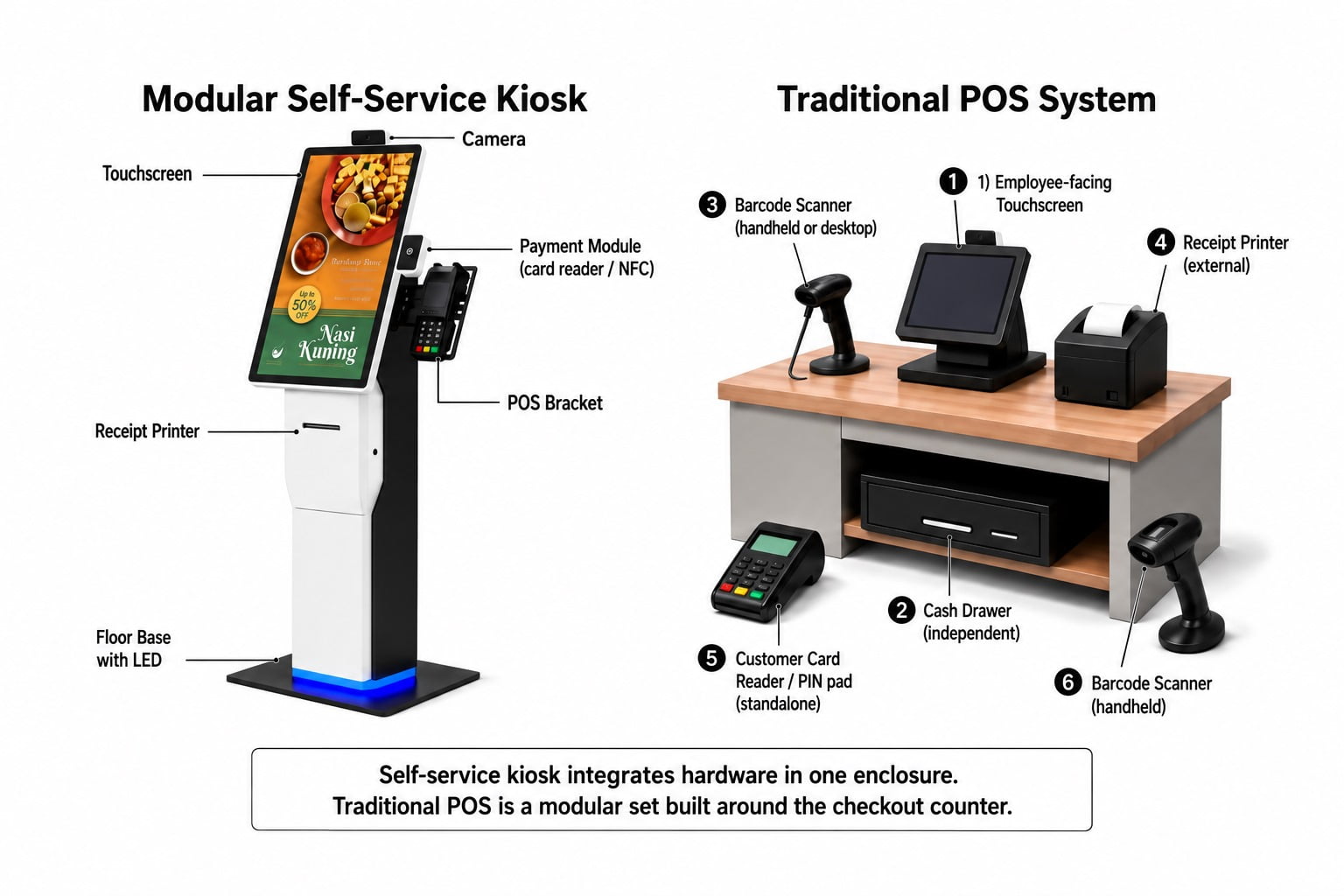
| Hardware | Customer-facing touchscreen with project-selected mounting, payment and receipt-printing hardware. | Typically a modular setup with a touchscreen monitor, separate cash drawer, barcode scanner, card reader, and receipt printer. |
| Primary Goal | Provide a self-ordering route and present menu choices; operational results depend on the deployment. | Support staffed transactions and the management functions included in the selected POS software. |
| Software UI | Customer-oriented menu, selection and payment prompts, with assistance available when needed. | Feature-rich and complex, designed for trained staff to handle diverse and complex scenarios quickly. |
| Staffing Needs | Reduces reliance on frontline cashiers, though one staff member may be needed to assist customers. | Requires dedicated cashiers or service staff to operate the terminal for every transaction. |
| Ideal Scenarios | Quick-service restaurants (QSRs), cinemas, airports, hotel check-ins, retail product lookup, bill payment centers. | Full-service restaurants, boutique retail, supermarkets, any scenario requiring consultation or complex transactions. |
Deep Dive: Key Differences Explained
While the table provides a high-level overview, let's explore the critical differences that will inform your technology investment strategy.
User and Interaction Model
A kiosk interface guides customers through menu selection, order review and payment using clear prompts and readable controls. Test the application with the intended users and actual screen layout, and provide staff assistance when needed.
In contrast, a POS system's interaction model is built for a power user—an employee who performs the same tasks hundreds of times a day. Here, functionality and speed trump simplicity. The interface may contain abbreviations, shortcuts, and multi-layered menus that enable a trained employee to rapidly handle complex situations like splitting a bill, applying multiple discounts, processing a return, or checking stock levels.
Hardware Configuration
A restaurant self-service kiosk combines a customer-facing touchscreen with the payment and receipt-printing hardware selected for the project. Screen size, installation format and peripherals vary by model. A complete wall-mounted or floor-standing unit and a terminal with detachable components offer different layout options; confirm the screen, printer, payment device and interfaces against the ordering application.
A traditional POS system, by comparison, is a set of components arranged around a checkout counter. It includes an employee-facing touchscreen (usually smaller than a kiosk's), a separate cash drawer, a handheld or in-counter barcode scanner, an external receipt printer, and a customer-facing card payment device. This modularity allows for flexible arrangement on various counter sizes and layouts.
Software and Integration
The kiosk application presents the menu or catalog, captures selections and passes the order to the connected systems. Optional add-on prompts, payment steps and receipt behavior depend on that application and its integrations. For YJCEN projects, the customer prepares the ordering software, POS system and payment services; YJCEN supplies the agreed kiosk hardware.
The POS system manages the sales functions supported by the chosen software. Kiosk orders, kitchen displays, inventory and reporting can be connected where the applications provide suitable interfaces. Physical mounting, operating-system support and software integration are separate checks: a terminal fitting its bracket does not confirm that its payment service or software will work with the ordering application.
Can my existing POS terminal fit a YJCEN kiosk?
Yes. YJCEN can customize the mounting bracket to the dimensions of the customer's POS/payment terminal. Provide the device dimensions so the bracket can be made for that model. This allows customers to plan the kiosk around their chosen terminal rather than rely on one fixed bracket size.
Here, the POS/payment terminal means the physical payment device. The POS system also includes the software and services that process and manage transactions. A custom bracket addresses the physical fit; software and payment integration must be confirmed separately.
| Part of the setup | Supply responsibility |
|---|---|
| Kiosk hardware | YJCEN supplies the hardware configuration agreed for the project. |
| POS/payment terminal and bracket | The customer supplies the terminal and its dimensions; YJCEN customizes the mounting bracket. |
| Ordering software, POS system and payment services | The customer prepares these applications and services, including the required integration arrangements. |
Before deployment, confirm the selected software's operating-system and interface requirements and test the ordering and payment workflow with the chosen hardware.
The Best of Both Worlds: Integrating Kiosks and POS Systems
Whether to add kiosks depends on the restaurant workflow. A combined setup can offer a self-ordering route while keeping a staffed counter available for assistance and transactions that need an employee.
For example, a quick-service restaurant could divide the work as follows:
- Self-Service Kiosks: Customers who prefer self-ordering can use the kiosk when their chosen payment method is supported. The effect on queues depends on adoption, service capacity and the rest of the order workflow.
- POS System: Staff can handle assistance, cash payments and exceptions supported by the selected POS setup, while remaining available to help kiosk users.
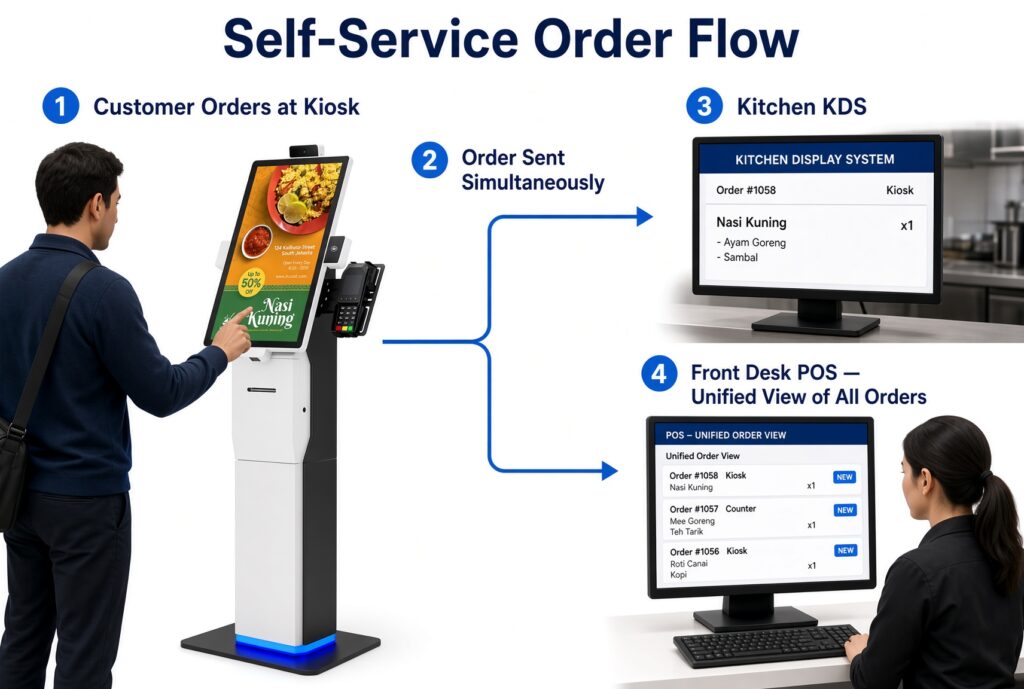
Example of a connected restaurant workflow: the customer enters an order at the kiosk, and the configured integration sends it to the kitchen and POS. The diagram illustrates the intended data flow; these connections require compatible software and testing. Possible benefits and their conditions include:
- Enhanced Customer Experience: Customers are given the choice to interact in the way they prefer—either fast and independently or with personal assistance.
- Optimized Labor: When customers adopt self-ordering, staff may be able to spend more time on assistance and order handover. Staffing changes should be based on the actual workload.
- Optional add-on offers: The application can present relevant extras if configured to do so. Measure the effect on average order value in the restaurant to assess the results.
- Unified Data Management: An approved integration can bring kiosk and counter orders into the POS. Confirm which order, payment and inventory records are actually synchronized.
A real project using the customer's POS and payment systems
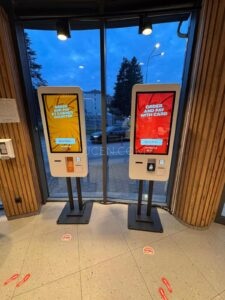
In a YJCEN restaurant kiosk project in Europe, YJCEN supplied two 27-inch floor-standing Windows kiosks with capacitive touchscreens. The customer integrated its own POS and payment systems. This illustrates how the hardware supply and the customer's software and payment setup can be organized in a real project.
For a detailed list of software, peripheral and sample-acceptance checks, see our self-ordering kiosk software and peripheral checklist.
Conclusion: Making the Right Choice for Your Business
A self-service kiosk and a staffed POS serve different users. The right choice follows the order workflow, the support customers need and the software and payment services already in use.
- Consider a kiosk when customers can complete a clear self-ordering journey and the required application, payment setup and staff assistance are in place.
- Keep the staffed POS role clear: employee-assisted orders, exceptions and business-management functions depend on the chosen POS configuration.
For an existing payment terminal, start with its dimensions and the bracket design. For the connected order workflow, confirm responsibilities with the software and payment providers and test the complete setup before rollout.
For a complete wall-mounted or floor-standing unit, explore our self-ordering kiosk. For detachable components, compare our modular self-service kiosk hardware. Send YJCEN your POS/payment terminal dimensions and intended kiosk configuration to discuss the mounting bracket.