For most businesses that need reliable, long-running digital signage, the answer is clear: a commercial display is the right investment. While the initial purchase price of a consumer TV is deceptively appealing, it is simply not engineered for the demanding requirements of a commercial environment. Using a consumer TV for digital signage might seem like a cost-saving measure initially, but it often leads to greater expenses down the line due to frequent failures, poor visual performance, and higher maintenance costs.
Commercial displays are specifically built for continuous operation, rated for 16/7 (16 hours a day, 7 days a week) or even 24/7 runtimes. They feature higher brightness levels to remain visible in bright commercial spaces, are structurally designed to support vertical (portrait) mounting, and incorporate more effective cooling systems. In contrast, consumer TVs are designed for home entertainment, typically for only a few hours of use per day, with lower brightness and virtually no reliable support for portrait mode.
This article will break down the key differences between commercial displays and consumer TVs across several core aspects. We'll also provide a clear comparison table to help you determine which option is the truly cost-effective solution for your business needs.
Quick Comparison: Commercial Display vs. Consumer TV
Should a business use a commercial display or a consumer TV?
For demanding signage use, evaluate a commercial display against the required operating hours, brightness, orientation and service terms. A consumer TV may be an option for limited, low-stakes use if its documented limits fit the task.
- Confirm the exact model's duty rating and installation orientation.
- Check content management, recovery and control requirements.
- Review commercial-use warranty terms and the cost of downtime.
- Compare the complete operating cost, not only the purchase price.
| Feature | Consumer TV | Commercial Display |
|---|---|---|
| Designed Runtime | 6-8 hours/day | 16-24 hours/day (16/7 or 24/7) |
| Brightness (Nits) | 250-350 nits | 400-700 nits (Indoor), 700-5000 nits (Outdoor) |
| Screen Orientation | Landscape only | Supports Landscape & Portrait |
| Cooling System | Basic passive cooling | Enhanced cooling system, some with fans |
| Content Management | Requires external player, no remote management | Built-in Android/Windows OS for CMS |
| Warranty Policy | 1-year limited, voided by commercial use | 3+ years commercial, covers long runtimes |
| Total Cost of Ownership (TCO) | Low initial cost, high long-term maintenance | High initial cost, low long-term maintenance |
Why a TV's Low Price is Deceptive: The Hidden Costs of Digital Signage
The most significant lure of using a consumer TV for digital signage is its low upfront cost. However, this "saving" is often short-lived. In a business context, the Total Cost of Ownership (TCO) is far more critical than the initial price tag.
Shorter Lifespan and Frequent Replacements
Components in a consumer TV, like the power supply board and LCD panel, are designed for a few hours of intermittent use per day. When you force it to run for 16+ hours daily, these components prematurely age. Overheating is the primary culprit, accelerating the decay of electronic components and leading to dark spots on the screen, brightness degradation, or complete failure. This means you could be replacing the TV within a year or even a few months, quickly negating any initial savings.
High Failure Rates and Business Interruption
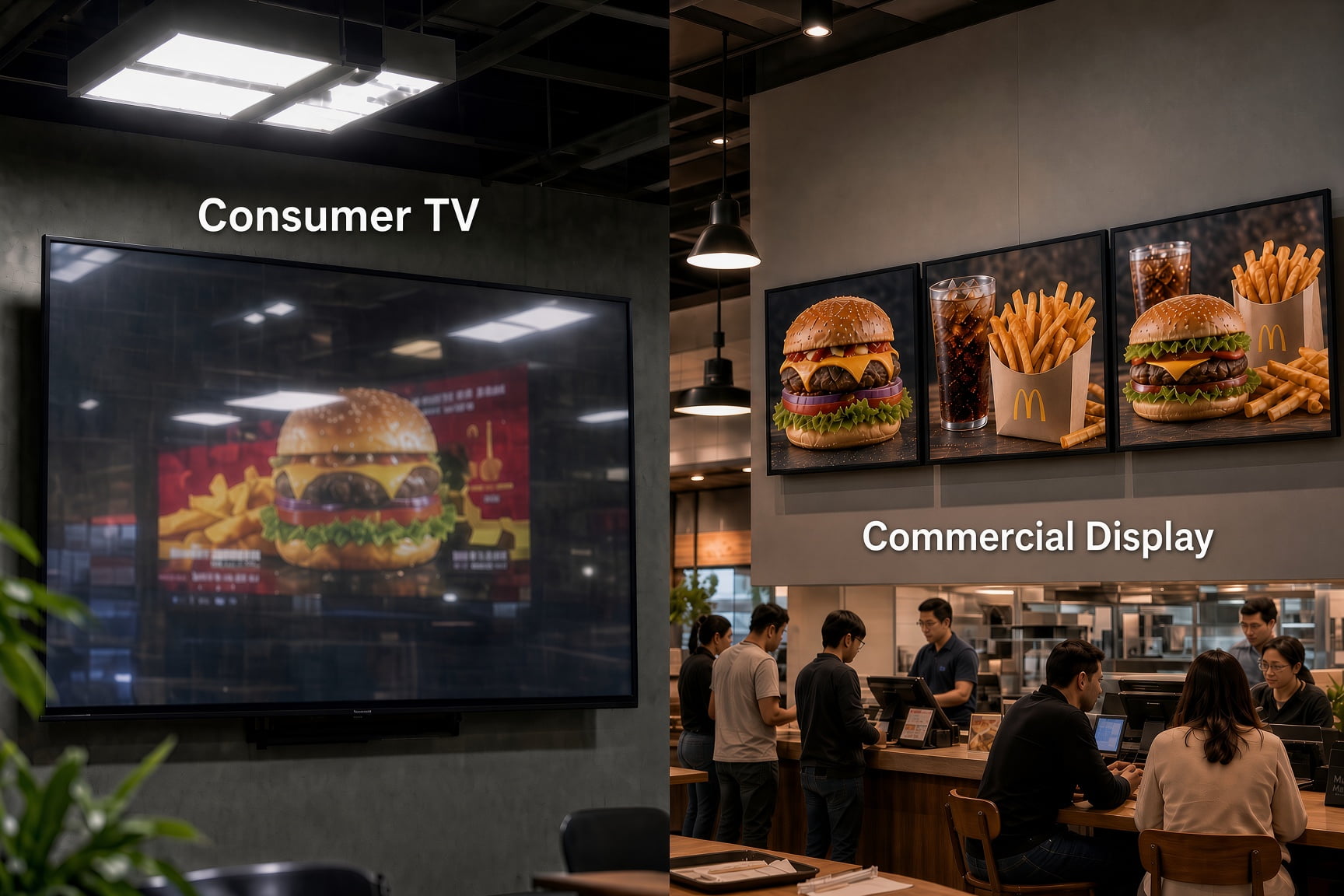
Imagine the screen displaying your restaurant's menu going black during the lunch rush, or the display promoting a sale in your retail store suffering from permanent burn-in (image retention). This isn't just a repair cost; it's a direct hit to your brand image and sales opportunities. Consumer TVs are highly susceptible to burn-in when displaying static images (like a logo or menu) for extended periods. Commercial displays, however, use anti-burn-in technologies to ensure the screen remains pristine.
Extra Costs from Functional Limitations
Consumer TVs lack the professional features required for commercial applications. You'll need to purchase an external media player for each TV to run your content, adding hardware costs and wiring complexity. Managing multiple screens becomes a nightmare, as you have no way to control them centrally.
The Core Advantages of a 24/7 Commercial Display
A commercial display is the professional's choice for digital signage because it is engineered from the ground up to meet every demand of a business environment. Choosing one means choosing stability and efficiency.
Built for Continuous Operation (16/7 and 24/7)
The label "24/7 commercial display" signifies that it is built with industrial-grade components, from the power supply to the capacitors, all fortified to handle the stress and heat of non-stop operation. This is crucial for venues like airports, transit hubs, hotel lobbies, and 24-hour fast-food restaurants. You can set it and forget it, knowing it was built for the job.
Superior Brightness and Anti-Glare Screens
Commercial environments are typically much brighter than a living room, with daylight from windows and intensive indoor lighting. A consumer TV's 250-350 nits of brightness will appear washed out and difficult to read in such conditions. Indoor commercial displays start at 400-700 nits, ensuring content remains vibrant and legible under any lighting. Furthermore, they often feature an anti-glare coating to minimize reflections and improve the viewing experience.
Flexible Installation: Portrait and Landscape Modes
Many digital signage applications, such as fashion advertisements, menu boards, and wayfinding directories, require a vertical (portrait) display. A consumer TV is designed only for horizontal (landscape) use. Forcing it into a vertical orientation severely compromises its cooling efficiency, causing heat to pool at the new bottom edge and leading to malfunctions and screen damage. The internal structure and cooling systems of commercial displays are specifically designed to support both orientations, ensuring stable operation in any configuration.
Simplified Management & Professional-Grade Warranty
Beyond the robust hardware, commercial displays offer software and service advantages that consumer TVs simply cannot match.
Remote Centralized Control
This is one of the most significant differentiators. Commercial displays, on the other hand, often come with a built-in Android or Windows operating system, allowing them to run a Content Management System (CMS) directly or be managed through enterprise software. This lets you remotely update content, power screens on/off, and monitor their status across the network. From a single computer in your office, you can manage hundreds of screens in different locations. You can:
- Remotely upload and schedule new content.
- Assign different playlists to different screens.
- Set automatic on/off times to save energy.
- Monitor the operational status of each screen in real-time, receiving alerts before a failure occurs.
This centralized management capability dramatically reduces operational and maintenance labor costs, especially for chain stores and large enterprises.
A True Commercial-Grade Warranty
When you use a consumer TV for business purposes, its 1-year manufacturer warranty is typically voided. This means if anything goes wrong, you are on your own for all repair and replacement costs. Commercial displays come with a 3-year or longer on-site commercial warranty that explicitly covers 16/7 or 24/7 operation. This means if a screen fails within the warranty period, a technician will be sent to your location, giving you complete peace of mind.
The Verdict: Should You Ever Use a Consumer TV?
Although the advantages of commercial displays are overwhelming, a consumer TV might be a temporary option in a few, very specific scenarios:
- Extremely Tight Budgets and Low-Stakes Use: If you just want a screen in an office breakroom to play internal notices for a few hours a day and reliability is not a top concern.
- Very Short-Term, Temporary Events: For example, a temporary screen for a two-day trade show or event that will only be powered on for 8 hours per day.
However, these are the exceptions. For any digital signage application that impacts customer experience, brand image, or core business operations—such as in retail stores, restaurants, corporate lobbies, or control rooms—the answer to the commercial display vs consumer TV for digital signage debate is always the former. A commercial display is a strategic investment in your future, and its reliability, superior performance, and low long-term cost will far outweigh the money saved upfront on a cheaper TV.
Ready to find a professional display solution for your business? Explore our extensive range of [Indoor Digital Signage] products to find the perfect fit.
For a more detailed analysis of the lifespan of commercial displays, please read our in-depth article digital signage lifespan and maintenance.