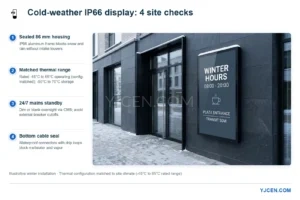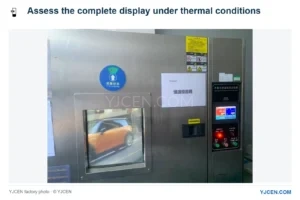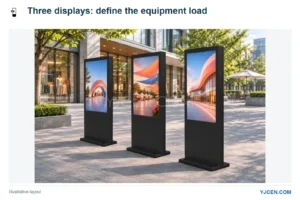
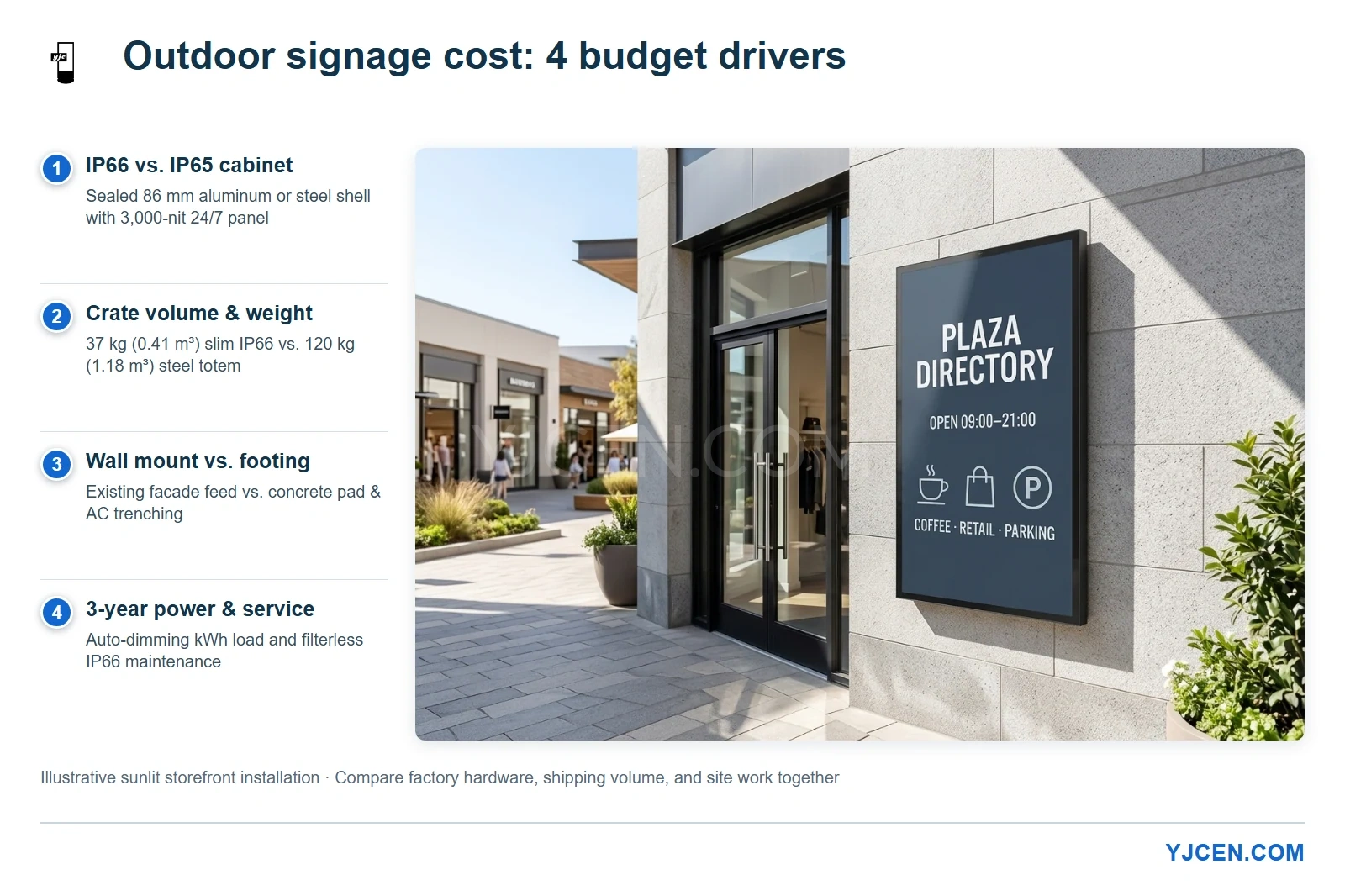
Illustrative sunlit storefront installation showing the four primary cost drivers of an outdoor digital signage project: weatherproof enclosure engineering, packed crate volume and weight, facade wall mounting versus concrete footings and AC trenching, and multi-year power and service costs.
The screen price on a factory quotation is rarely your full outdoor digital signage cost. Once you factor in weatherproof enclosure engineering, international crate volume, concrete footings or wall rigging, dedicated outdoor power, and three-year electricity draw, site work and logistics often rival the hardware itself. Comparing IP66 weatherproof outdoor digital signage units against heavier steel totems or mobile battery boards before locking in your layout prevents the biggest budget surprises.
The Five Buckets That Make Up Total Outdoor Digital Signage Cost
Every commercial outdoor LCD rollout splits into five distinct budget buckets: display hardware, international freight and rigging, civil and electrical site work, software and connectivity, and multi-year operating expenses. Separating factory hardware items from local contractor scope on day one stops two quotes from looking artificially far apart.
Indoor signage budgets mostly track screen diagonal, mount, and media player. Outdoor deployments add sealed weatherproofing, 3,000-nit high-brightness backlights, thermal control, heavy crating, and exterior electrical work that indoor quotes never include.
| Budget Bucket | Primary Cost Drivers | Typical Payee | Most Common Hidden Overrun |
|---|---|---|---|
| 1. Display hardware & build | Screen size (32″–98″), IP66 sealed aluminum vs. IP65 steel, single vs. double-sided, touch, Windows vs. Android, 4G module | Display manufacturer (YJCEN) | Upgrading from standard Android to Windows plus interactive touch after quoting |
| 2. Freight, crating & rigging | Packed crate volume (m³), unit net weight (26–135+ kg), air vs. sea LCL, liftgate truck, crane or two-person crew | Freight forwarder / local rigger | Ordering 120 kg freestanding totems without budgeting liftgate delivery and rigging gear |
| 3. Civil & electrical site work | Concrete foundation pouring, anchor bolts, underground AC power trenching, Cat6/conduit runs, structural wall reinforcement | Local civil & electrical contractor | Cutting pavement to trench AC power and data to an island plaza location |
| 4. Software, data & permits | Third-party CMS subscriptions, Windows OS licenses, 4G SIM data plans, local municipal exterior signage permits | Software vendor / local authority | Assuming commercial hardware includes third-party CMS licenses or city permit fees |
| 5. 3-year operation & service | 24/7 high-brightness electricity draw, ambient dimming schedule, filter cleaning (vented IP65) vs. filterless IP66, spare parts | Facility owner / integrator | Ignoring air-filter service visits on vented enclosures in dusty or roadside zones |
Keep your general indoor and multi-category quote checklist separate from outdoor civil planning. On mixed rollouts covering both indoor and exterior screens, pair these outdoor site costs with a shared digital signage project budget comparison sheet so every vendor quotes on identical terms.
Why Two 55-Inch 3,000-Nit Outdoor Screens Create Wildly Different Budgets
Choosing the enclosure architecture changes shipping volume by nearly 3× and shifts installation from a two-person wall hang to concrete footing and crane rigging, even when screen size and 3,000-nit brightness stay identical. At YJCEN, our 55-inch slim IP66 display (YJC-550-OD09-A) weighs 37 kg in a 0.41 m³ crate, while our 55-inch IP65 floor-standing totem (YJC-550-OD-F) weighs 120 kg in a 1.18 m³ crate.
Buyers frequently compare outdoor quotes by screen diagonal alone, then get shocked when sea freight, liftgate fees, and site labor blow past the estimate. Comparing four verified YJCEN outdoor form factors shows how mechanical format drives downstream cost.
| Outdoor Form Factor (YJCEN Reference) | Protection & Shell | Net Weight | Packed Crate Volume | Max Power & OS | Site Civil & Rigging Impact |
|---|---|---|---|---|---|
| 55″ Slim Wall / Pole (YJC-550-OD09-A) | IP66 sealed 86 mm aluminum, IK10 glass, 4K UHD | 37 kg | 1470 × 1030 × 270 mm (0.41 m³) | 230 W max; Android 11 built-in (Windows optional) | Two-person VESA 400×400 wall hang; uses existing facade AC feed |
| 55″ IP65 Wall-Mounted (YJC-550-OD-W) | IP65 198 mm cold-rolled steel, anti-reflective glass, FHD | 92 kg | 1570 × 1130 × 350 mm (0.62 m³) | 290 W max; Android 11 built-in (Windows optional) | Reinforced masonry/structural wall load required; heavier lift crew |
| 55″ IP65 Freestanding Totem (YJC-550-OD-F) | IP65 125 mm cold-rolled steel, fan cooling, FHD | 120 kg | 2140 × 1000 × 550 mm (1.18 m³) | 290 W max; Android 11 built-in (Windows optional) | Concrete pad, four Ø20 mm anchor bolts (800×400 mm base), underground AC trenching |
| 43″ Sunlight Battery A-Board (2,000 / 2,500 nit) | IP65 mobile enclosure, 6-inch lockable casters, FHD | Mobile wheeled frame | Compact upright crate (1235 × 584 × 485 mm unit) | 24 V 78 Ah LiFePO4 battery (up to 11–14 hrs at max brightness) | Zero trenching, zero concrete, zero permits for fixed footings; roll out and lock |
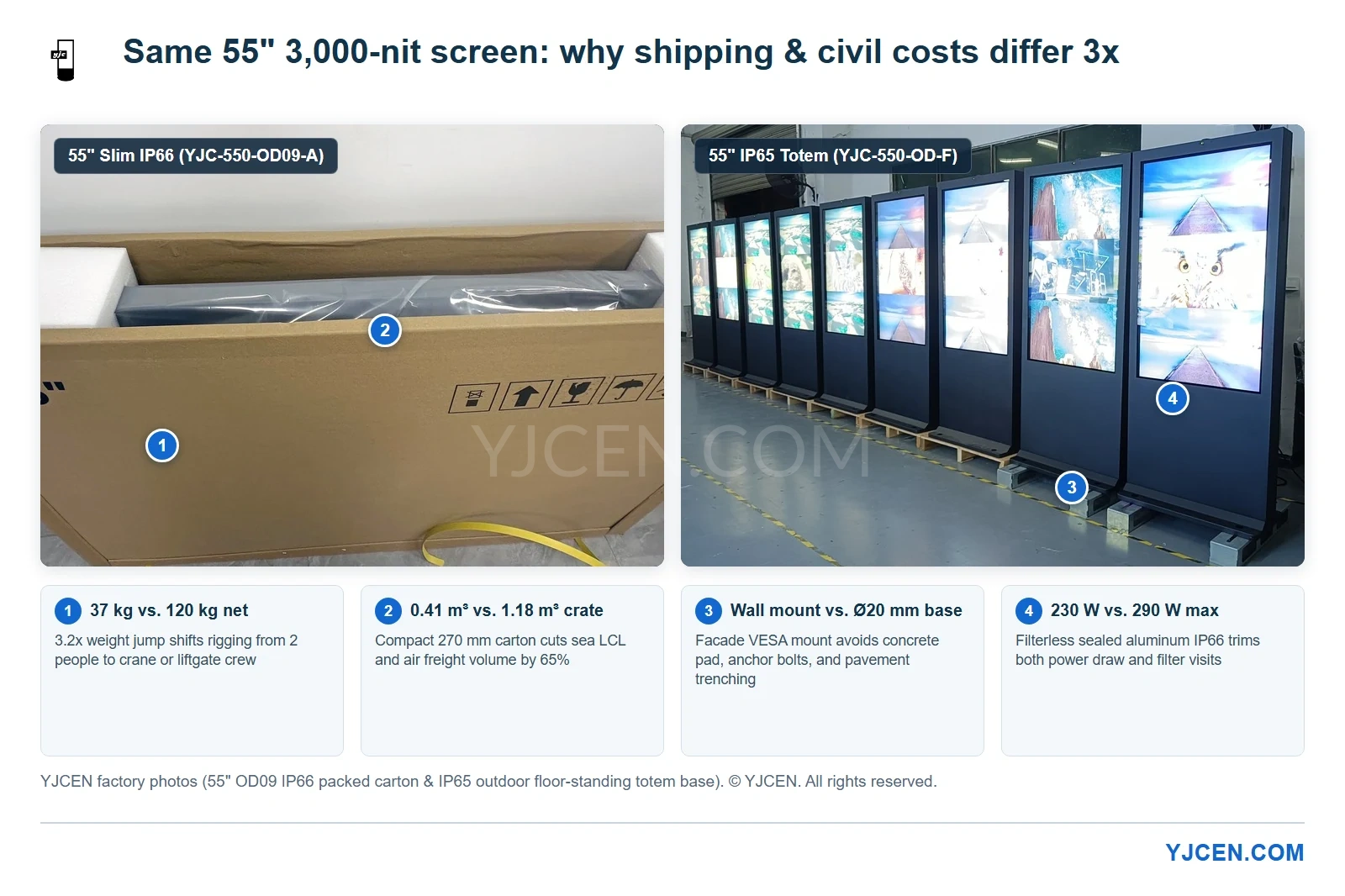
Two delivered YJCEN 55-inch outdoor projects illustrate that budget spread in practice. For the two 55-inch slim IP66 entrance displays installed in the UK, the integrator chose standard black non-touch Android YJC-550-OD09-A units mounted directly on exposed metal wall cladding, eliminating concrete footings, Windows licensing, and touch hardware cost.
By contrast, the ten 55-inch outdoor wayfinding kiosks deployed in Marrakech required IP65 floor-standing totems anchored on open public plazas, upgraded with interactive touchscreens and Windows OS to run the city’s navigation software. Same 55-inch diagonal and 3,000-nit brightness, yet completely different freight, foundation, electrical, and hardware budgets.
Hardware Specifications That Move Your Factory Quote the Most
Six specification choices drive almost all unit-price variance on an outdoor LCD factory quote: diagonal size, single- vs. double-sided format, IP66 sealed vs. IP65 vented construction, interactive touch, Android vs. Windows computing, and extreme-climate thermal configuration. Locking these six choices before asking for quotations keeps pricing transparent and comparable.
- Screen diagonal and panel tier: Moving from 43 inches (YJC-430-OD09-A, 26 kg, FHD) to 55 inches (YJC-550-OD09-A, 37 kg, 4K UHD) or 75 inches (YJC-750-OD09-A, 70 kg, 4K UHD) scales the high-brightness panel, LED backlight array, IK10 front glass, power supply, and crate footprint together.
- Single-sided vs. double-sided totems: YJCEN’s IP65 floor-standing series supports single- and double-sided builds from 32 to 98 inches. Doubling the panels doubles optical brightness hardware, internal thermal load, and structural weight, so only specify double-sided units where heavy two-way foot traffic justifies the extra spend.
- IP66 sealed aluminum vs. IP65 steel: YJCEN’s OD09 IP66 digital signage display line uses a fully enclosed 86 mm aluminum cabinet backed by third-party EN 60529 test report BKC23114331KS (IP6X dust protection and IPX6 100 L/min water jets). That louver-free build resists wind-driven rain and removes external dust filters, while IP65 steel enclosures scale up to 98 inches for oversized wall or totem projects.
- Built-in Android vs. Windows and touch: Standard YJCEN outdoor units ship with built-in Android 11 (RK3568 quad-core, 2 GB DDR, 32 GB eMMC, Wi-Fi/LAN, HDMI IN, USB). Switching to Windows or adding capacitive touch for interactive wayfinding adds hardware cost and may add separate OS or third-party CMS licensing on the buyer’s side.
- Cellular 4G and extreme-climate thermal builds: Optional 3G/4G modules save Ethernet trenching cost on remote streets at a modest hardware adder plus SIM data fees. Sites dropping well below freezing also require matching the thermal configuration to the local record winter low (covered in our cold-weather outdoor digital signage guide).
Civil, Freight, and Electrical Site Work: Where Budgets Usually Slip
Site preparation and logistics routinely add 30% to 100%+ on top of the display hardware price for freestanding outdoor deployments, whereas facade wall-mounted installs keep site work minimal. Estimating freight volume, foundation anchoring, and AC power routing upfront prevents last-minute contractor change orders.
Concrete footings and anchor bolts for freestanding totems
Freestanding displays must resist wind loads and public contact through an engineered base. Across YJCEN’s single-sided IP65 totem line, moving from 55 inches (YJC-550-OD-F, 120 kg, 800 × 400 mm base, four Ø20 mm mounting holes) to 65 inches (YJC-650-OD-F, 135 kg, 924 × 450 mm base, six Ø20 mm mounting holes) enlarges the anchor pattern, concrete pad size, and lifting equipment requirement.
Underground AC trenching vs. wall feeds vs. battery power
Every mains-powered YJCEN outdoor unit runs on AC 100–240 V, 50/60 Hz and requires a dedicated, weatherproof circuit with a local disconnect. If you can mount a 37 kg slim IP66 screen on an exterior retail wall with power just inside the cladding, electrical work may take half a day.
Trenching across paved concrete or asphalt to feed a freestanding parking-lot totem requires saw-cutting, conduit burial, reinstatement, and electrical inspection. For forecourts, pop-up promotions, or rented storefronts where pavement cutting costs more than the display itself, YJCEN’s 43-inch IP65 LiFePO4 battery A-board (24 V, 78 Ah; up to 14 hours at 2,000 nits or 11 hours at 2,500 nits) eliminates fixed civil and electrical work altogether.
International shipping volume (m³) and last-mile liftgate
Ocean LCL freight and air cargo charge by whichever is higher between gross weight and volumetric dimensions. Because a 55-inch freestanding totem crate (1.18 m³) occupies nearly three times the container space of a 55-inch slim IP66 crate (0.41 m³), choosing wall-mounted IP66 hardware where a structural wall exists cuts freight and local unloading cost immediately.
Estimating 3-Year Power and Operating Cost From Real Model Specs
Running a 3,000-nit outdoor screen 24/7 does not consume listed maximum power all day because YJCEN’s built-in ambient light sensor dims the backlight automatically after sunset. Use listed maximum wattage to size your electrical circuit, then apply a realistic operating duty factor to budget multi-year electricity cost.
All six OD09 IP66 models and OD-F IP65 totems use commercial panels rated for 24/7 operation and a 50,000-hour backlight lifecycle (roughly 5.7 years of continuous 24/7 runtime). The table below pairs YJCEN’s verbatim datasheet maximum power and physical specs with an illustrative annual energy range so your team can plug in your local utility rate.
| YJCEN Model | Size & Series | Net Weight | Listed Max Power | Est. Annual Energy (Illustrative 60% Avg Load, 24/7)* | Structural / Mounting Spec |
|---|---|---|---|---|---|
| YJC-430-OD09-A | 43″ IP66 Slim | 26 kg | 165 W | ~867 kWh / year | VESA 400 × 400 mm |
| YJC-550-OD09-A | 55″ IP66 Slim | 37 kg | 230 W | ~1,209 kWh / year | VESA 400 × 400 mm |
| YJC-650-OD09-A | 65″ IP66 Slim | 50 kg | 385 W | ~2,024 kWh / year | VESA 600 × 600 mm |
| YJC-750-OD09-A | 75″ IP66 Slim | 70 kg | 450 W | ~2,365 kWh / year | VESA 600 × 600 mm |
| YJC-550-OD-F | 55″ IP65 Totem | 120 kg | 290 W | ~1,524 kWh / year | Base 800 × 400 mm (4 × Ø20 mm holes) |
| YJC-650-OD-F | 65″ IP65 Totem | 135 kg | 400 W | ~2,102 kWh / year | Base 924 × 450 mm (6 × Ø20 mm holes) |
*Illustrative calculation only: Max Power (kW) × 0.60 × 8,760 hours/year. Actual electricity consumption depends on daylight hours, content brightness, automatic light-sensor dimming curve, and overnight blanking schedule. Multiply kWh by your local commercial kWh tariff; see our outdoor digital signage power consumption guide for multi-screen circuit sizing.
Do not forget maintenance labor in a three-year budget. Filterless sealed IP66 aluminum cabinets require only periodic glass cleaning and cable-seal inspection, whereas vented outdoor cabinets require scheduled dust-filter checks in roadside or coastal zones.
Five Ways to Lower Total Outdoor Cost Without Sacrificing Reliability
Smart budget optimization removes unnecessary civil work, over-specified options, and premature failure risk rather than downgrading brightness or weather sealing. These five engineering trade-offs protect both upfront budget and three-year uptime.
- Use wall-mounted IP66 instead of a freestanding totem whenever a solid facade exists: Switching from a 120 kg totem to a 37 kg YJC-550-OD09-A cuts crate volume by 65% and avoids pouring concrete or trenching pavement.
- Avoid consumer TVs in DIY outdoor boxes: A consumer television inside a low-cost weather box lacks 3,000-nit sunlight readability, isotropic blackening resistance, and 24/7 thermal control, turning a cheap upfront purchase into a full replacement within one summer.
- Stick to standard Android and non-touch when content is passive: If you only broadcast menus, promotions, or schedules, built-in Android 11 avoids Windows OS license fees and capacitive touch glass upgrades.
- Right-size single-sided vs. double-sided and screen diagonal: Match screen size to real viewing distance rather than defaulting to 75″ or double-sided totems everywhere. A 55″ unit at 230 W max draws nearly half the power and shipping weight of a 75″ unit at 450 W max.
- Validate one sample unit before locking a multi-site rollout: YJCEN supports 1-unit sample orders (approximately 3–7 working days for standard builds; 15–20 working days for custom builds) and pre-installs and tests your Android or Windows CMS software before shipment. Every outdoor display completes our 8-hour rain test, 72-hour burn-in aging, and full functional and sheet-metal inspection, backed by ISO 9001, CE, RoHS, FCC, and ETL certifications and a 3-year warranty.
Frequently Asked Questions
Why is outdoor digital signage so much more expensive than indoor signage?
Outdoor units require 3,000-nit panels, IP65 or IP66 sealed enclosures, thermal controls, and protective glass. Beyond hardware, exterior projects also add heavier freight crating, structural mounting or concrete footings, and weatherproof AC power installation that indoor screens do not need.
Does the factory hardware quote include installation, concrete work, and CMS software?
No, factory quotes cover the display hardware, standard accessories, and agreed shipping terms only. Local civil footings, electrical trenching, municipal permits, third-party CMS subscriptions, and Windows software licenses are budgeted separately through local contractors and software providers.
How can I reduce outdoor digital signage installation cost on a leased storefront?
Choose a slim wall-mounted IP66 screen or a 43-inch IP65 battery A-board instead. Mounting a 37 kg slim unit on an existing wall near indoor power, or rolling out a rechargeable LiFePO4 battery display, eliminates pavement cutting and fixed foundation permits.
Request an Itemized Outdoor Hardware Quote in 24 Hours
Ready to compare exact factory pricing for your outdoor rollout? Send YJCEN your target screen size (32″–98″), mounting type (slim IP66 wall/pole, IP65 wall, freestanding totem, or 43″ IP65 battery A-board), quantity (from 1 sample unit upward), and whether you need Android or Windows plus touch.
Our engineering team responds within 24 hours with an itemized hardware quotation, exact crate weight and volume for your freight forwarder, dimensional drawings for your site contractor, and optional software pre-installation testing on your sample unit.