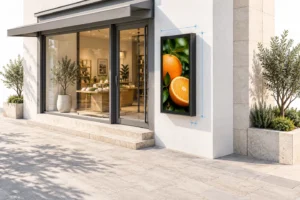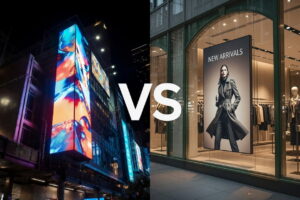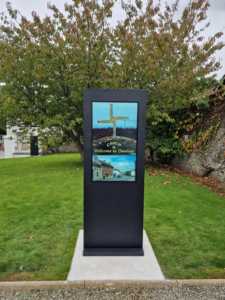
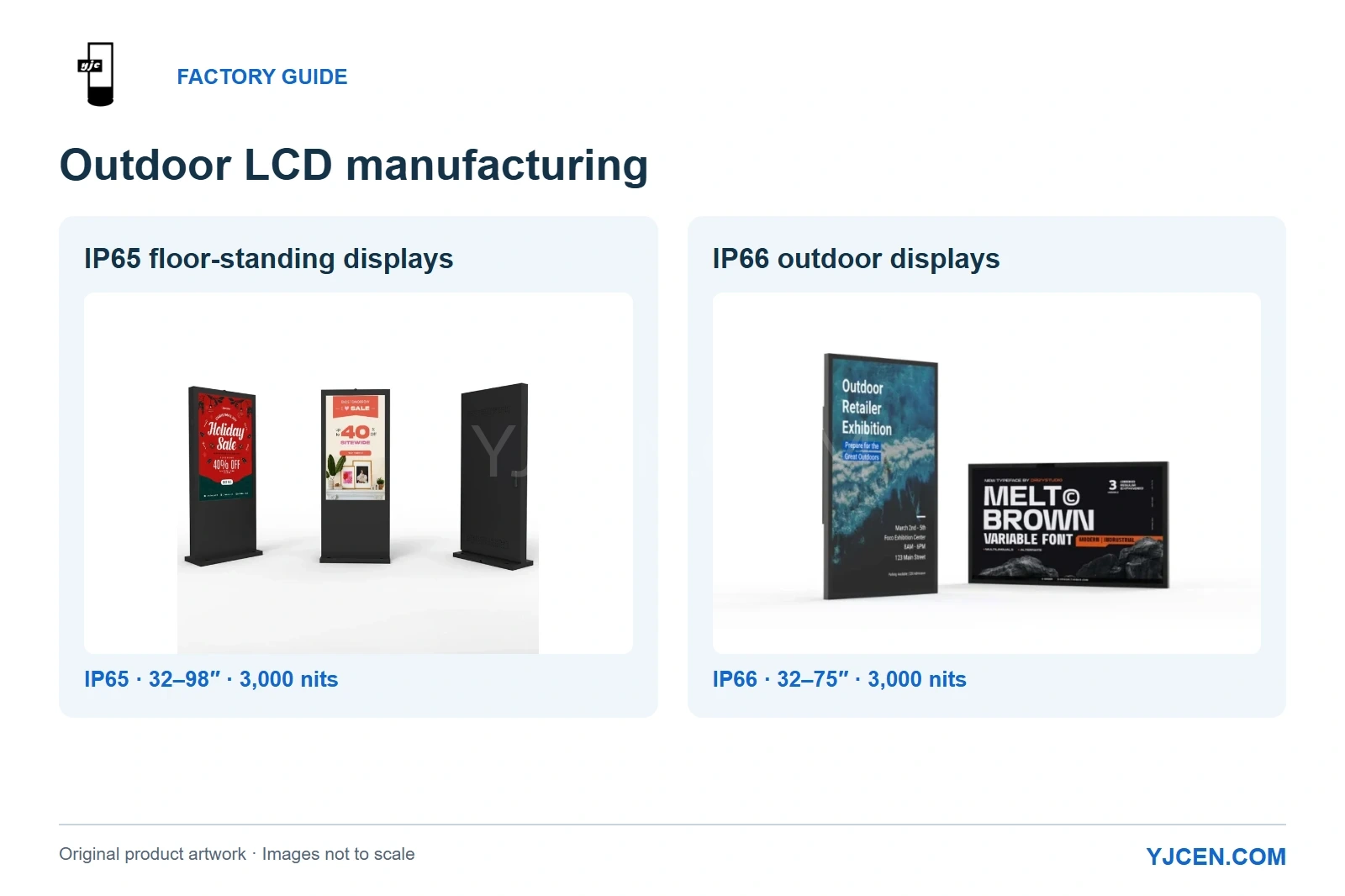
The IP65 range uses a fixed floor-standing enclosure. The IP66 range supports portrait and landscape layouts; select the format around the installation.
Choose outdoor LCD display manufacturers by their ability to match the product format, protection rating and production process to your site. YJCEN’s IP65 Outdoor Digital Kiosk and IP66 Outdoor Digital Signage illustrate two different hardware approaches. This guide explains how to assess a factory’s engineering, testing and delivery capabilities across those requirements, from a freestanding information point to a display integrated with a building or mounting structure.
1. Can the manufacturer engineer the complete outdoor display?
For integrators and brand owners, the purchasing decision concerns a finished unit: the LCD panel, front glass, enclosure, power supply, controller and thermal-management arrangement. These components need to fit the installation and work together as a system.
YJCEN was founded in 2012 and manufactures commercial LCD displays and kiosk hardware in a factory covering more than 5,000 m². Our OEM/ODM manufacturing capabilities include enclosure customization, screen and motherboard selection, hardware integration and private-label supply.
Use the project constraint to decide which factory capability matters most:
| Project requirement | Capability to prioritize | Practical outcome |
|---|---|---|
| Exposed exterior installation | Suitable enclosure protection, thermal configuration and model-specific documentation | An outdoor configuration matched to the location |
| A screen fitted into an existing structure | Enclosure dimensions, mounting geometry, cable routing and maintenance access | A build that fits the available space and can be serviced |
| An existing signage application | Operating-system selection, motherboard interfaces and application testing | A sample evaluated with the intended software |
| A private-label rollout | Branding, enclosure appearance and an approved production specification | Repeat orders based on the same agreed configuration |
Match the product format to the installation
YJCEN’s IP65 outdoor floor-standing range combines a fixed totem enclosure, 3,000-nit brightness and anti-glare tempered glass, with screen sizes from 32 to 98 inches. It suits a planned freestanding display position where information needs to face a pedestrian route, entrance or open space.
The IP66 range offers 32–75-inch displays with 3,000-nit brightness and portrait or landscape orientation. It provides another starting point for projects specifying IP66 protection and a separate mounting arrangement.
Choose the enclosure format and protection requirement together. A freestanding totem needs a suitable base and anchoring plan; a building-mounted screen needs a suitable bracket and supporting structure.
Start with an existing model when it fits the project. Customization is most useful when it solves a measurable constraint, such as insufficient mounting space, a required connection or a different enclosure format.
2. Can the enclosure fit the site and remain serviceable?
Screen diagonal alone does not define installation fit. The enclosure footprint, equipment weight, fixing pattern and access for cables and maintenance determine how the display integrates with a wall, pedestal or custom structure.
Two 55-inch YJCEN models show why nominal screen size is not enough for installation planning:
| Mechanical specification | IP65 floor-standing model | IP66 display model |
|---|---|---|
| Model | YJC-550-OD-F | YJC-550-OD09-A |
| Body dimensions, H × W × D | 1990 × 800 × 125 mm | 1262 × 732.8 × 86 mm |
| Net weight | 120 kg | 37 kg |
| Installation reference | Base and fixing positions in the totem drawing | 400 × 400 mm VESA pattern, plus the selected mounting arrangement |
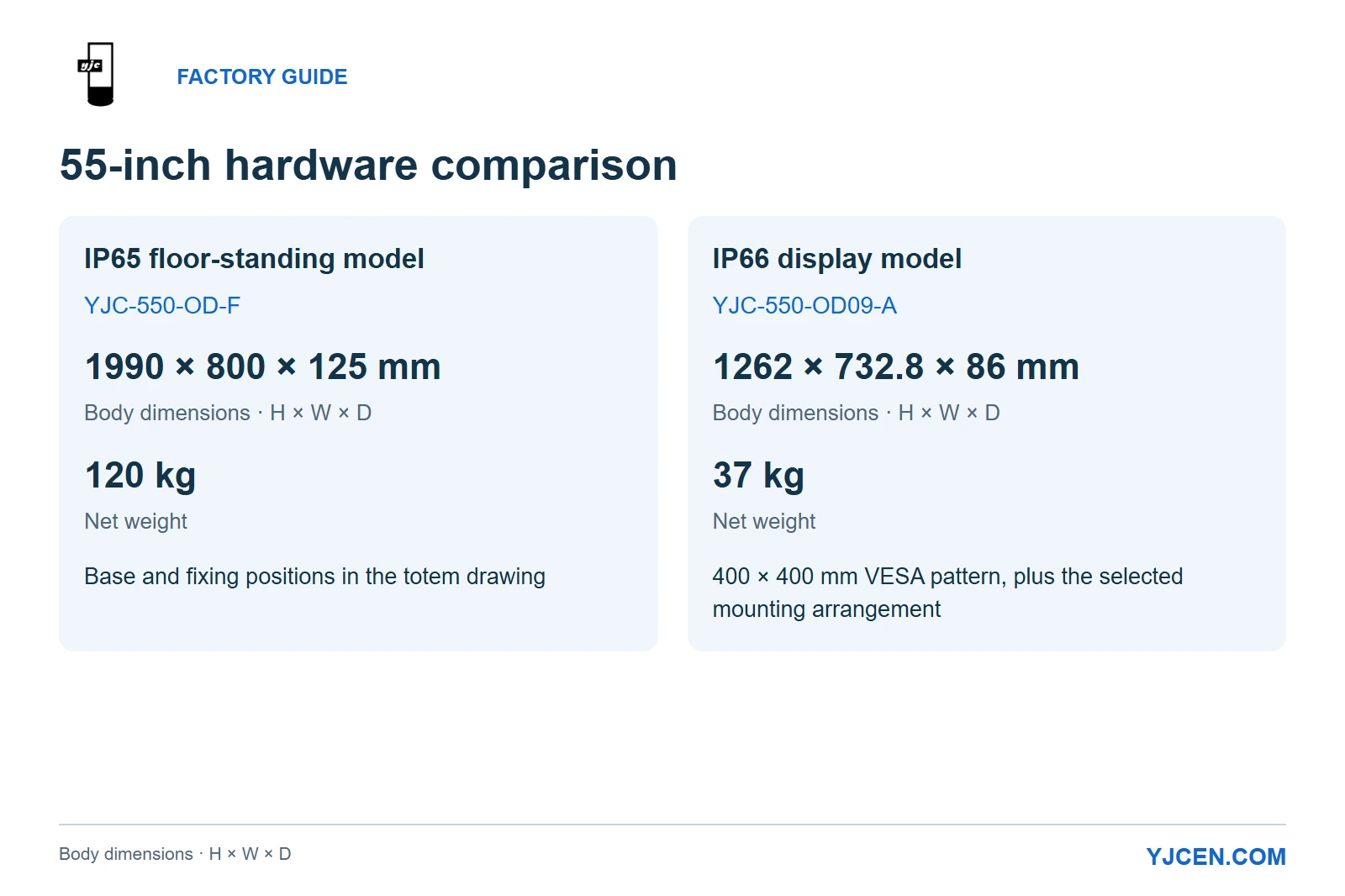
These dimensions and weights come from the respective model datasheets. For the totem, plan ground fixing, handling and service access; for the IP66 display, match the bracket and supporting structure to the unit’s weight and fixing pattern.
The difference reflects two enclosure formats, rather than a direct measure of protection quality. In both cases, use the selected configuration’s drawing to develop the installation.
For a custom enclosure, settle mounting, cable entry and service access before finalizing the appearance. A shallower body or relocated connector can change the space available for internal components and maintenance.
YJCEN accepts drawings, reference products or a list of required changes for feasibility review. For software-led projects, Android or Windows can be selected around the intended application, and customer-provided software can be pre-installed and tested on the hardware.
If you are still choosing brightness, screen size or installation format, our outdoor digital signage selection guide covers those decisions in more detail.
3. What evidence supports weather protection and temperature management?
Evaluate outdoor protection through both model-specific testing and the factory’s production checks. The first documents the tested design; the second shows how assembled equipment is inspected before dispatch.
Match the IP report to the product
IEC 60529 defines the classification of enclosure protection expressed by IP codes. The useful evidence is a report that identifies the model, test method and results.
YJCEN’s YJC-550-OD09-A was tested by Shenzhen BKC Testing Co., Ltd. Report BKC23114331KS, issued on 17 November 2023, records passing IP6X dust and IPX6 water-jet tests to EN 60529:1991+A1:2000+A2:2013, with no dust or water ingress recorded after the respective tests.
The report is available in the IP66 product page’s test-report section, linking the YJC-550-OD09-A model to its recorded dust and water-jet test results.
Look at what happens after the factory rain test
YJCEN’s documented 8-hour factory rain-testing process includes complete assembly, continuous water exposure, an internal inspection for water ingress, and subsequent aging and functional tests.
The internal inspection connects the external water exposure to the condition inside the enclosure. This eight-hour procedure is a factory production check, separate from the standardized IPX6 test and its test duration.
Select the thermal configuration for the location
Our IP66 display range specifies 3,000-nit brightness and an operating temperature range of −45°C to +65°C with the appropriate thermal configuration. The product includes internal temperature controls and overheating protection.
Provide expected ambient temperatures, sunlight exposure and the proposed mounting position when defining the configuration. These details help the factory evaluate the thermal arrangement together with the enclosure and installation space.
4. How does the factory maintain consistency after sample approval?
A sample establishes what you approve. Batch controls establish how production units are checked against the required build.
YJCEN’s five-stage quality inspection process connects incoming inspection, first-article approval, assembly checks, aging and final inspection:
| Production stage | YJCEN process | Purchasing relevance |
|---|---|---|
| Incoming materials | Inspect materials before production | Quality checks begin before assembly |
| First article | Production-supervisor sign-off for each batch | The batch has an approved reference |
| In-process inspection | Checks during assembly | Assembly issues can be addressed before final inspection |
| Aging | A 72-hour aging test under our company testing process | Equipment is operated for an extended period before shipment |
| Final inspection | Check the product, accessories and packaging | Dispatch inspection includes the items the installation team receives |
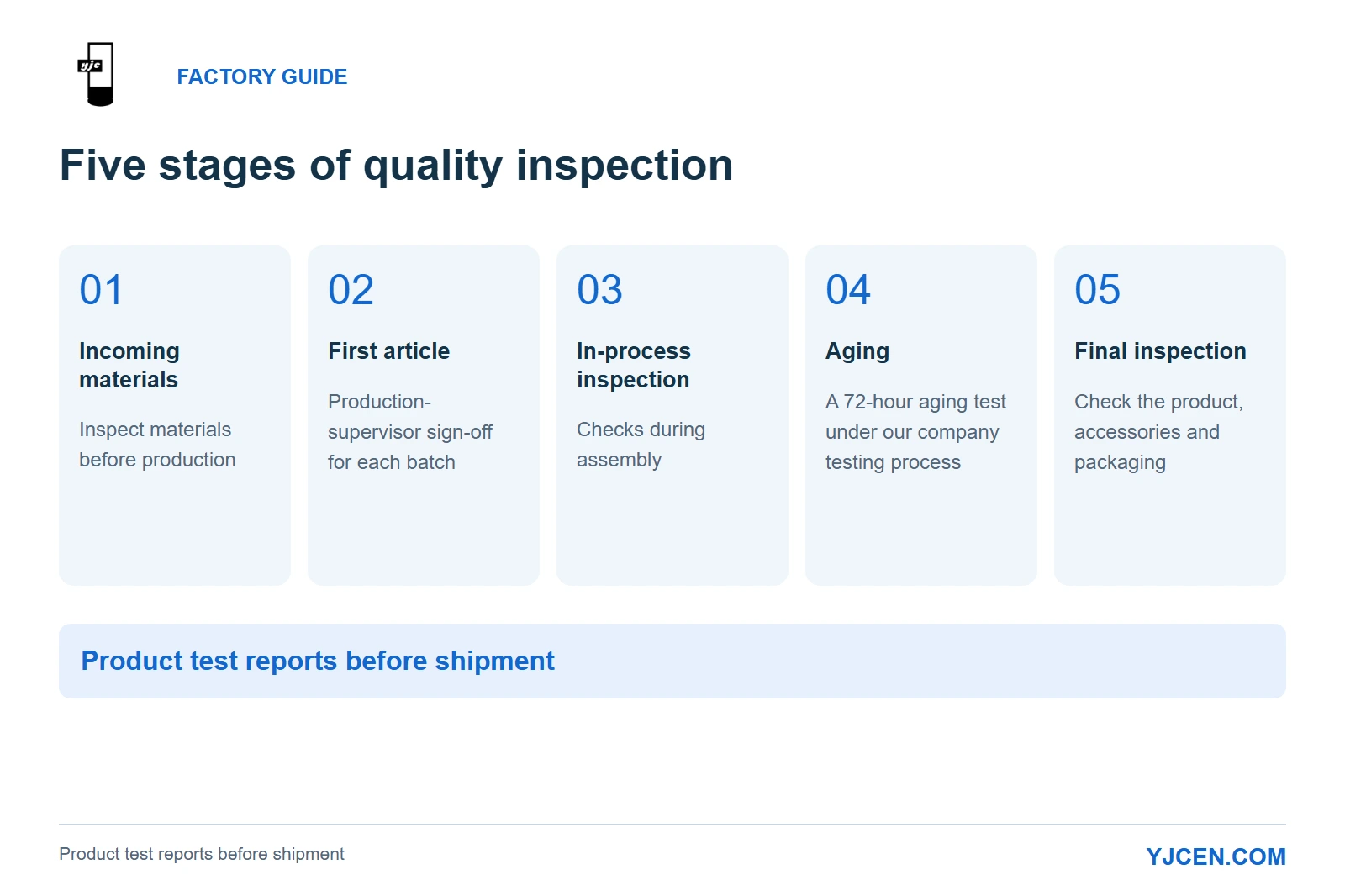
Our production checks also include full-function testing and sheet-metal inspection, with product test reports provided before shipment. For repeat orders, use the approved configuration and drawings as the purchasing reference, and identify any requested changes explicitly.
ISO’s explanation of ISO 9001 places documented processes and performance evaluation within quality management. YJCEN’s ISO 9001-certified quality system supports this process discipline, while the model-specific report addresses the particular protection characteristic tested.
5. Does the manufacturer have a relevant installation example?
Choose project evidence that resembles your installation in exposure, mounting method and use. A comparable application helps you assess the proposed format before developing the detailed installation.
For a European live music venue, YJCEN supplied one 75-inch, IP66-rated display with 3,000-nit brightness. Installed vertically on a street-facing exterior wall, it presents event promotions as an alternative to printed posters.
This example is relevant to venues planning an exposed, wall-mounted digital poster. Use the project photographs to understand the application, the selected model’s drawings to plan the physical fit, and its technical documentation to evaluate the specified performance.
6. How should you compare quotations, lead times and support?
Compare the same configuration and scope across quotations. Separate display hardware, mounting equipment, computing configuration, customization, freight and on-site work so that price differences can be traced to what each offer includes.
YJCEN offers samples from one unit. Published dispatch guidance is approximately 3–7 working days for standard models and 15–20 working days for customized units; sample timing is specified for the selected product. Allow separately for freight transit and site preparation.
Our products carry a three-year warranty, excluding user-caused damage and faults caused by improper installation. Partners in Europe and North America can provide on-site installation and repair, with labor and travel expenses quoted separately according to project requirements; these services are unavailable in countries affected by war or conflict.
Frequently Asked Questions
Can YJCEN supply outdoor displays under our own brand?
Yes. We support logo, color and label customization, as well as supply without YJCEN markings. An NDA is available on request.
Can we test our existing signage application before a rollout?
Yes. YJCEN can pre-install and test customer-provided applications on the selected Android or Windows hardware. Include the application and interface requirements in the sample brief; software licensing remains separate from hardware supply.
What is the minimum sample quantity?
Samples are available from one unit. Specify the screen size, enclosure arrangement and operating system so the sample represents the configuration you intend to purchase.
Send Your Outdoor Display Project Brief
To receive a configuration review and quotation, send:
- Screen size, quantity and destination country.
- Site photos, sunlight and rain exposure, and expected ambient temperatures.
- Mounting method, available space and any enclosure or bracket drawings.
- Operating system, application and interface requirements.
- Branding requirements, target installation date and required technical documents.
YJCEN can review the hardware requirements, identify the necessary customization and prepare a quotation. Use the sample stage to approve physical fit, playback and finished appearance before moving into production.