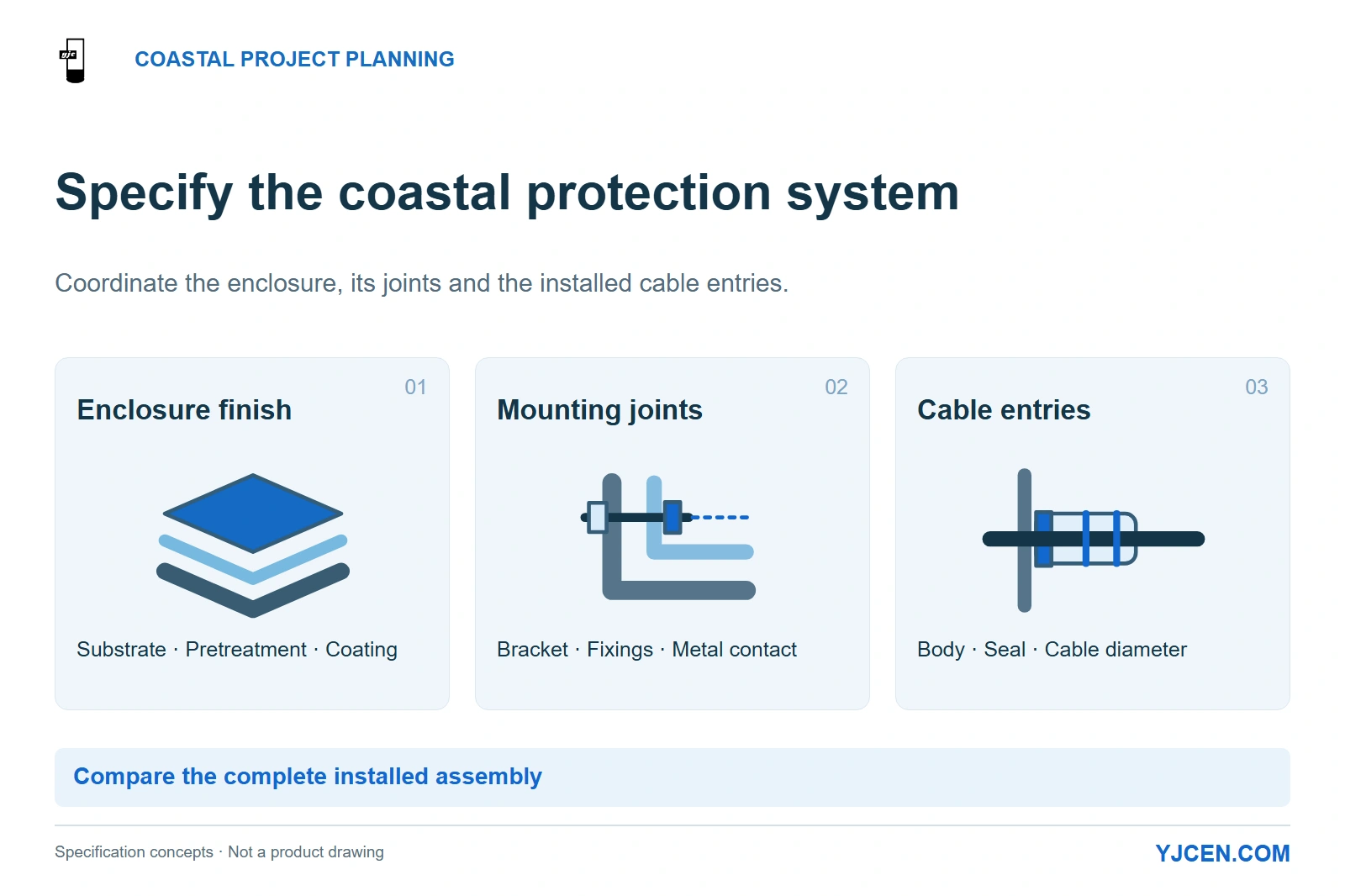
Specify the enclosure finish, mounting joints and cable entries together. The diagrams show specification concepts, not a product drawing or test result.
A coastal outdoor LCD RFQ should name the exposure, enclosure finish, exposed fasteners, cable-entry materials, corrosion acceptance criteria and maintenance responsibilities alongside the IP rating. For projects using YJCEN IP66 Outdoor Digital Signage, specify the display and its mounting assembly together. A protected cabinet still connects to brackets, fixings and site cables; those interfaces need a coordinated specification so competing quotations cover the same installation.
For a seaside display, specify the protective system across the enclosure, its joints and the installed cable entries. This gives an integrator a useful basis for comparing hardware, installation work and ongoing service costs.
1. What Does the Coastal Location Add to an IP Requirement?
Use the required IP rating to define protection against dust and water ingress, then describe how salt reaches the installation. A sheltered waterfront entrance and an exposed harbor walkway need different attention to deposits, cleaning access and exposed connections.
YJCEN’s IP66 range combines a corrosion-resistant enclosure finish with a UV-resistant coating. For a coastal quotation, carry those features into a component schedule that also names the mounting hardware and cable-entry arrangement; otherwise, two prices can include very different amounts of protection outside the cabinet.
| Site condition | Put this in the RFQ | What it changes |
|---|---|---|
| Sheltered entrance near the sea | Canopy position, open sides, prevailing sea-facing direction and photographs | Identify surfaces that collect windborne deposits but receive little natural rinsing. |
| Open waterfront or harbor walkway | Exposure direction, observed sea spray and mounting location | Include the rear, underside, bracket and exposed fixings in the materials and maintenance plan. |
| Display built into a surround | Rear clearance, access opening and cable route | Keep joints and cable entries reachable for inspection and cleaning. |
| Area cleaned by a site contractor | Cleaning method, products used and surfaces cleaned | Agree a cleaning procedure compatible with the glass, coating, seals and connections. |
Distance from the shoreline is useful context, but it does not fully describe the exposure. ISO 9223 identifies airborne salinity, temperature and humidity, and sulfur dioxide pollution as key atmospheric corrosion factors. Include the actual site conditions instead of assigning a corrosion category from distance alone.
Choose the location before finalizing the enclosure and bracket. If the proposed position traps deposits behind a decorative surround or makes cleaning require dismantling, change the mounting detail while the project is still on the drawing board.
2. Which Coating, Fastener and Cable-Entry Details Matter?
Match the finish to the enclosure material
The 55-inch YJCEN YJC-550-OD09-A uses an aluminum shell. That makes aluminum pretreatment, the proposed finish and the connections to the mounting assembly the relevant procurement questions; copying a steel-cabinet coating specification into this RFQ would describe a different substrate.
For this configuration, separate the cabinet finish from the bracket and fixing specification. Carry the selected material and finish through the exposed edges, attachment points and cable-entry hardware so that a change of bracket does not silently change the coastal installation package.
| Component | Fields to include | How to compare proposals |
|---|---|---|
| Cabinet finish | Base material, pretreatment, coating system, proposed dry-film thickness and finish | Compare a defined coating system applied to the stated substrate, rather than color or the word “marine.” |
| Bracket or supporting frame | Material, finish, exposed edges and attachment details | Include the support assembly in the quoted coastal specification. |
| Exposed fasteners | Material grade, finish, washers and contact with adjacent metals | Compare the complete joint, including its exposure and material compatibility. |
| Cable glands or sealed cable entries | Entry type, body material, seal material, cable diameter range and unused-entry closures | Match the entry assembly to the actual cables and enclosure interface. |
| Gaskets and service closures | Seal material, cleaning compatibility and replacement procedure | Keep closures serviceable through the planned maintenance routine. |
| Installation damage | Approved repair method and responsibility for damaged finishes | Include treatment of scratches or exposed metal in installation handover. |
Specify the joint, not just “stainless screws”
At an aluminum cabinet connection, the fastener grade is only part of the decision. The bracket material, contact detail and retained moisture also affect the joint.
The Australian Stainless Steel Development Association’s explanation of galvanic corrosion identifies electrical contact, different metal potentials and a conductive liquid as the conditions for this mechanism. Salt increases the liquid’s conductivity, making wet coastal connections a relevant design concern.
Specify a compatible fixing assembly and its joint detail, including isolation where appropriate to the design. Keep any isolation detail coordinated with the fixing loads and electrical bonding requirements; a site substitution of washers or bolts changes more than appearance.
Compare salt-spray results on the same basis
When salt-spray testing is part of the purchase requirement, put the test method, specimen, finish, preparation, duration and acceptance criteria on one line of the comparison sheet. State whether the specimen is a coated panel, a fastener or an assembled connection, and whether it includes an intentional scribe through the coating.
ISO 9227 defines salt-spray test procedures but leaves product-specific exposure periods and result interpretation to the relevant specifications. It also cautions against using these tests to predict long-term corrosion resistance. Treat the duration as a laboratory test condition, rather than converting it into years beside the sea.
For example, if the buyer’s concern is coating breakdown around a fixing hole, require the proposed evidence to address that detail. A smooth coated-panel result answers a different question from the behavior of an assembled joint.
3. How Should Corrosion Coverage Be Written Into the Quotation?
Separate appearance, serviceability and operation in the warranty schedule. This gives the purchaser a clearer remedy than one broad phrase such as “outdoor warranty.”
Use the following items as negotiation fields for the named coastal site:
- Appearance: staining, discoloration, coating blistering or peeling, and the agreed treatment for each.
- Serviceability: seized fasteners, damaged closures or corrosion that prevents normal maintenance.
- Operation: corrosion-related failure affecting the display or its connections.
- Responsibility: factory-supplied parts, installer-supplied mounting hardware and damage introduced during installation.
- Remedy and cost: replacement parts, refinishing, return shipping, removal, reinstallation and site attendance.
- Conditions: the accepted exposure, cleaning procedure, maintenance records and the applicable coverage term.
A display can still show content while a corroded fixing makes removal difficult. Include serviceability explicitly if the installation relies on planned access to the rear or removal from a bracket.
For an OEM project, carry the agreed coastal schedule into both the supplier quotation and the integrator’s customer offer. That keeps the promised remedy aligned with the parts and labor actually purchased.
4. What Maintenance Should Be Planned Before Installation?
Give the operator access to the surfaces that need cleaning, especially the underside, rear connections and mounting assembly. A clean front glass does not tell the operator what is happening behind the cabinet.
For exposed stainless components, ASSDA’s coastal-corrosion guidance emphasizes removing salt deposits through regular cleaning. Specify the display’s cleaning procedure separately for its coating, glass and seals, using compatible materials and the equipment manufacturer’s instructions.
Make the service routine practical:
- Photograph the installation at handover. Record the finish, fixings and cable entries so later changes have a clear reference.
- Assign cleaning to a named party. Include the reachable rear and underside surfaces in that party’s scope.
- Set the interval around deposit buildup. Inspect after significant salt exposure and adjust the routine using what the operator actually observes.
- Act on changes in the joint or finish. Deal with coating damage, persistent deposits and deteriorating fixings before they complicate removal or resealing.
When routine access needs a lift, a closure permit or removal of a surround, include that cost in the installation choice. Moving the display to a serviceable position can be more useful than choosing a finish that the operator cannot maintain.
5. Copy This Coastal Outdoor LCD RFQ Into Your Project Email
Complete the exposure and materials fields before comparing prices. Set the screen visibility and thermal requirements for the chosen position, then close the power, playback and delivery items with a final outdoor LCD buying checklist pass.
6. Coastal Outdoor LCD FAQ
Does IP66 alone establish salt-spray corrosion resistance?
No. Specify the coating, exposed hardware and corrosion acceptance requirements alongside ingress protection.
Can an aluminum enclosure be used in a coastal display project?
Yes, with a finish and joint design matched to the exposure. For the aluminum-shell YJC-550-OD09-A, include the support assembly and cable entries in the coastal specification.
Can salt-spray test hours be converted into years of outdoor service?
No. Record the test conditions and acceptance criteria, and assess the intended coastal environment separately.
Should brackets and fasteners be included in the coastal quotation?
Yes. Name their materials, finishes and connection details so the quoted package covers the installed assembly.
Does a canopy remove the need to plan salt-deposit cleaning?
No. Include sheltered rear and underside surfaces in the cleaning scope and provide access to them.
Should the RFQ distinguish cosmetic corrosion from a functional failure?
Yes. Agree appearance, serviceability and operating-failure remedies separately, including the associated site costs.
Send Your Coastal Site Plan and RFQ
Send the mounting drawing, site photographs, exposure description and completed coastal RFQ for custom display configuration and mechanical-fit discussion. Include who supplies the bracket and who maintains the installation so the enclosure, mounting assembly and service scope can be priced together.