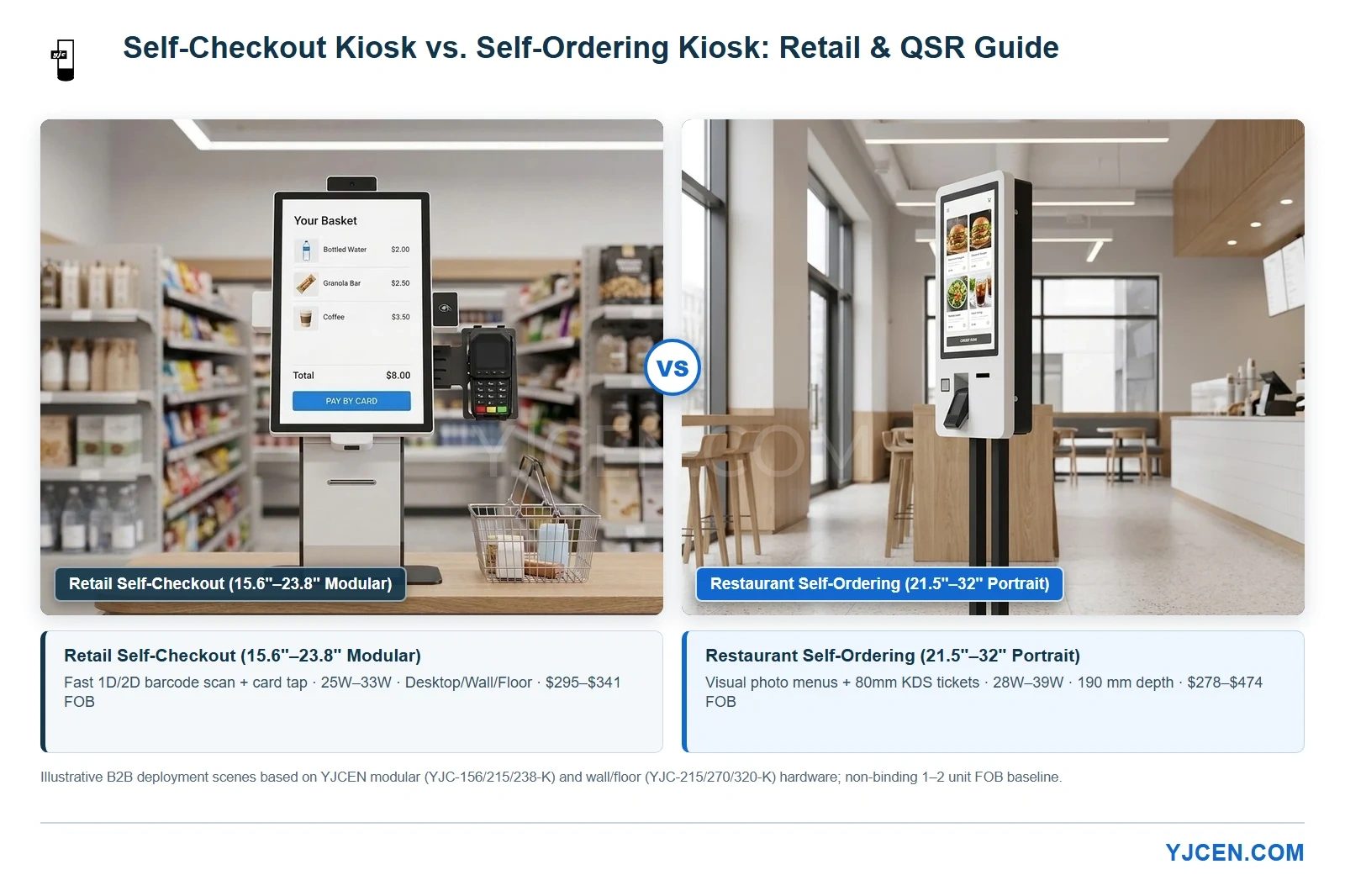
Choose a retail self-checkout kiosk when shoppers scan barcoded items and pay in under 60 seconds on a compact 15.6″–23.8″ countertop or lane terminal, and choose a self-ordering kiosk when guests browse photo menus and customize orders on a 21.5″–32″ portrait screen. YJCEN builds both modular self-checkout kiosks ($295–$341 FOB Shenzhen) and restaurant self-ordering kiosks ($278–$474 FOB Shenzhen) on open Android or Windows hardware with zero SaaS lock-in.
How Do Self-Checkout Kiosks and Self-Ordering Kiosks Differ in Workflow and Hardware?
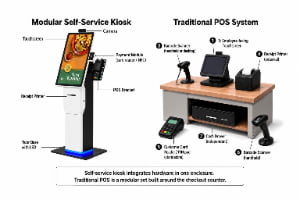
A self-checkout kiosk centers on rapid physical barcode scanning, item bagging, and cashless payment, whereas a self-ordering kiosk centers on large-format menu browsing, multi-step modifiers, and kitchen ticket routing. That workflow split drives screen size, module layout, enclosure depth, and daily maintenance access before software enters the project.
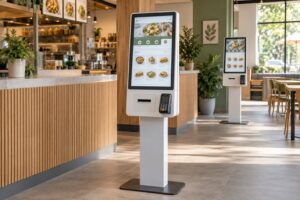
In convenience stores, pharmacies, bakeries, and express retail lanes, shoppers already hold physical products. A compact 15.6″ to 23.8″ screen confirms scanned SKUs, loyalty discounts, and payment prompts while leaving counter room for a basket, card reader, or external USB barcode scanner.
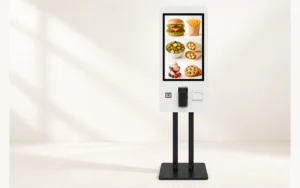
In quick-service restaurants and fast-casual chains, guests hold nothing while building an order. A 21.5″, 27″, or 32″ portrait display shows category tabs, food photography, add-on combos, and the live basket together, then sends the paid order directly to the kitchen display system (KDS).
| Engineering Dimension | Retail Self-Checkout Kiosk (Express / Cashless) | Restaurant Self-Ordering Kiosk (QSR / Cafe) |
|---|---|---|
| Primary customer action | Scan physical 1D/2D product barcodes, tap loyalty QR, pay and bag | Browse photo menus, select modifiers/combos, pay and collect order slip |
| Recommended screen size | 15.6″, 21.5″, or 23.8″ FHD (1920×1080) capacitive touch | 21.5″, 27″, or 32″ FHD (1920×1080) portrait capacitive touch |
| Matched YJCEN series | YJC-156-K / YJC-215-K / YJC-238-K Modular Self-Checkout & POS Kiosks | YJC-215-K / YJC-270-K / YJC-320-K Restaurant Self-Ordering Kiosks |
| Physical architecture | Detachable screen, Type-C edge modules (scanner/camera/reader), side POS bracket, B-pillar printer box | Flat 190 mm cold-rolled steel cabinet with flush recessed 2D scanner and full front service door |
| Mounting format | Desktop stand (340×330 mm base), wall-mount (242.3 mm D), or floor stand (540×370 mm base) | Freestanding floor stand (1675–1898.6 mm H) or slim 190 mm wall-mount |
| Scanner duty | High-frequency primary input (edge 2D module + optional external USB handheld/omni scanner) | Secondary input for coupons, loyalty QR codes, and mobile wallets |
| 80 mm thermal printer duty | Itemized tax receipt and barcode exit pass | Order pickup number ticket and itemized customer receipt |
| Hardware FOB reference (1–2 units) | $295–$341 USD FOB Shenzhen (non-binding baseline) | $278–$474 USD FOB Shenzhen (non-binding baseline) |
| Typical overseas deployed total | $1,400–$3,800 USD per station | $1,500–$4,500 USD per station |
Cashless Express Self-Checkout vs. Full Grocery Bagging Lanes
YJCEN’s modular 15.6″–23.8″ self-checkout hardware fits express retail, pharmacies, campus stores, and convenience stores processing 1 to 15 barcoded items via card, NFC, or QR. Full supermarket lanes handling 40-item weekly carts require conveyor belts, calibrated security bagging scales, EAS deactivators, and cash recyclers.
Standard YJCEN display-factory kiosks ship without built-in bill acceptors or security bagging scales. Buyers who need an external barcode gun or counter USB scale connect third-party peripherals through the kiosk’s external USB ports, while heavy cash-and-belt supermarket lanes require dedicated grocery-lane hardware.
Which Screen Size, Enclosure Depth, and Wattage Fit Your Store Floor?
Compact retail counters perform best with YJCEN’s 15.6″ to 23.8″ modular units drawing 25W to 33W max on a 340×330 mm desktop footprint, whereas busy dining lobbies perform best with 27″ or 32″ portrait kiosks at 190 mm cabinet depth drawing 35W to 39W max. Matching exact CAD dimensions prevents aisle bottlenecks during store rollout.
Both YJCEN families run on built-in AC 100–240V (50/60Hz) power with cold-rolled steel construction, a 300-nit 178°/178° wide-viewing-angle FHD (1920×1080) panel rated for 50,000 backlight hours, and 6H thermally toughened anti-scratch capacitive glass. On the wall-mount and floor-standing restaurant series (YJC-215-K, YJC-270-K, YJC-320-K), both the touchscreen and LED-illuminated 2D scanner sit recessed flush inside the front bezel for rapid wipe-down cleaning.
| YJCEN Model | Series & Format | Dimensions (H × W × D) | Net Weight | Max Power (AC 100–240V) | Best-Fit Store Zone |
|---|---|---|---|---|---|
| YJC-156-K | Modular (Desktop / Wall / Floor) | Desktop: 694.71 × 238.54 mm (340×330 mm base) Wall: 755.71 × 238.34 × 242.3 mm Floor: 1512.91 mm H (540×370 mm base) |
By mount configuration (per CAD) | 25W | Tight retail counters, pharmacy pickup, small cafes |
| YJC-215-K (Modular) | Modular (Desktop / Wall / Floor) | Desktop: 758.96 × 308.7 mm (340×330 mm base) Wall: 819.84 × 308.7 × 242.3 mm Floor: 1570.8 mm H (540×370 mm base) |
By mount configuration (per CAD) | 28W | Convenience stores, express retail checkout, multi-store fleets |
| YJC-238-K | Modular (Desktop / Wall / Floor) | Desktop: 808.83 × 340.37 mm (340×330 mm base) Wall: 869.83 × 340.28 × 242.3 mm Floor: 1627.05 mm H (540×370 mm base) |
By mount configuration (per CAD) | 33W | Specialty retail checkout with loyalty upsell prompts |
| YJC-215-K (Wall / Floor) | Self-Ordering (Wall / Floor) | Wall: 950 × 400 × 190 mm Floor: 1675 × 400 × 190 mm |
17 kg (wall) 22 kg (floor) |
28W | Narrow QSR walls, coffee shops, small lobby queues |
| YJC-270-K | Self-Ordering (Wall / Floor) | Wall: 1075 × 462 × 190 mm Floor: 1800 × 462 × 190 mm |
22 kg (wall) 27 kg (floor) |
35W | Mainstream QSR and fast-casual chains (sweet spot for combo menus) |
| YJC-320-K | Self-Ordering (Wall / Floor) | Wall: 1175 × 520 × 190 mm Floor: 1898.6 × 520 × 190 mm |
26 kg (wall) 27 kg (floor) |
39W | High-traffic food courts, cinema concessions, flagship QSR lobbies |
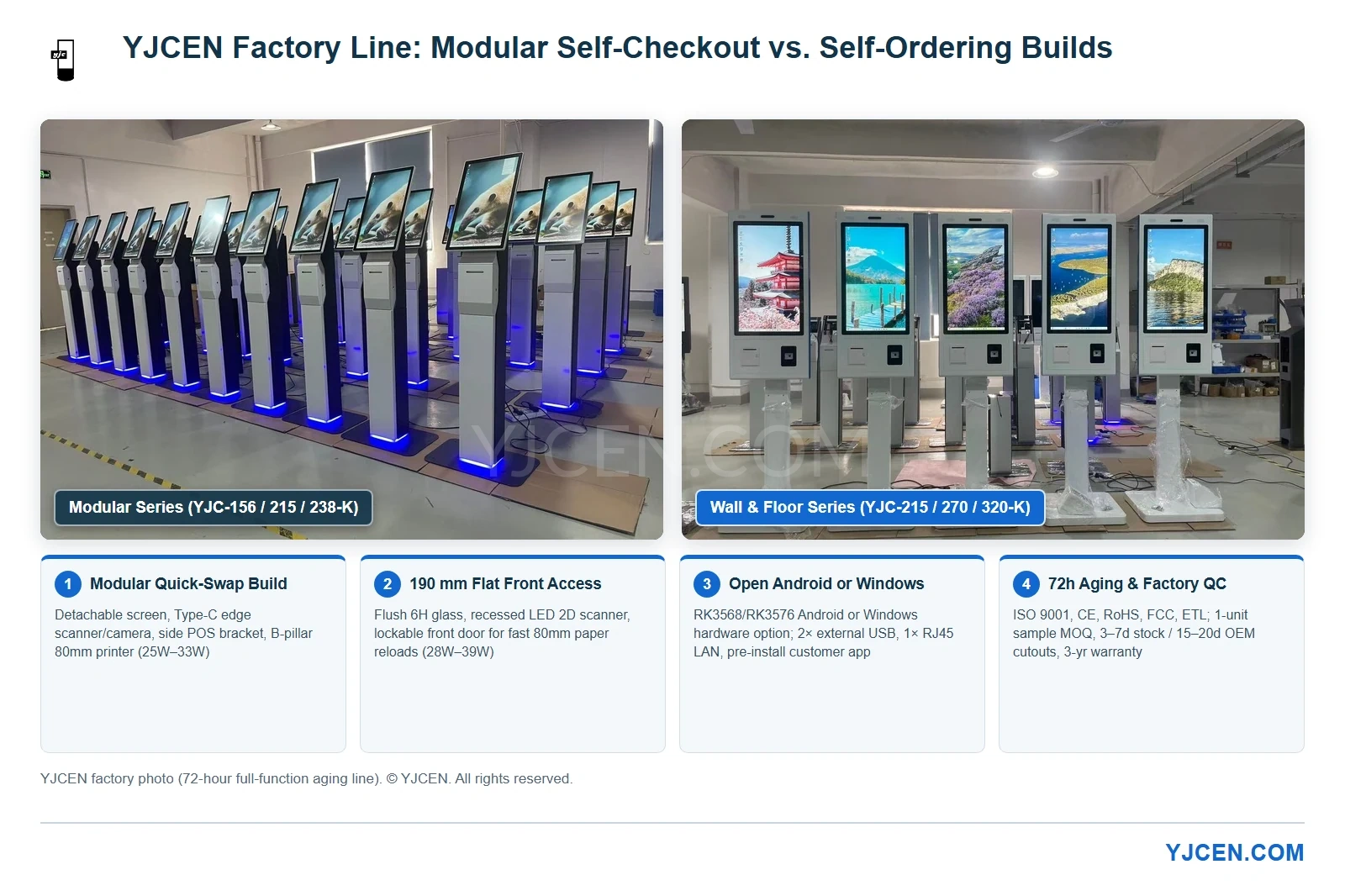
In a North Macedonia restaurant chain deployment, staff POS terminals and kitchen pass-through trays left zero counter space for tablets. Deploying two freestanding 27-inch Windows capacitive kiosks from YJCEN moved guests into a dedicated lobby lane where category tabs, food photos, modifiers, and live baskets sat side by side on the chain’s own POS software.
How Do Scanner, 80mm Printer, POS Bracket, and OS Choices Change Between Retail and QSR?
Retail self-checkout stresses the barcode scanner and external payment terminal mount, whereas restaurant self-ordering stresses the 80mm thermal receipt printer and multi-touch responsiveness. Specifying the matching peripheral layout and operating system prevents peak-hour queues and field service bottlenecks.
- Barcode and QR scanning ergonomics: The restaurant wall/floor series embeds a flush LED-lit 2D QR/barcode scanner ideal for phone loyalty codes and vouchers. The modular series uses an external Type-C edge 2D scanner module; for retail lanes scanning curved cans or bulky multi-packs, plug an external USB handheld or omnidirectional counter scanner into the kiosk’s two external USB ports.
- 80mm thermal printer service access: YJCEN’s wall and floor restaurant models open via a lockable tool-free front access door so staff reload 80mm paper rolls or service internals without lifting a 22–27 kg cabinet off the wall. On the modular YJC-156-K / YJC-215-K / YJC-238-K series, the B-pillar printer box, scanner, camera, and POS host detach individually for fast store-level swaps.
- Card reader and NFC bracket scope: Every YJCEN unit includes a standard POS bracket (×1), with custom OEM steel brackets or cutouts for Ingenico, Verifone, PAX, or Nayax terminals produced in roughly 15–20 business days from MOQ 1. YJCEN supplies open hardware only; your POS vendor or acquirer supplies the ordering/checkout application, payment gateway, and PCI compliance.
- Android vs. Windows compute: Standard units run Android 11 on a quad-core 2.0 GHz RK3568 processor (32GB eMMC, customizable RAM/storage, optional RK3576, two external USB ports, one RJ45 Ethernet port, Wi-Fi, built-in and Bluetooth speaker), with YJCEN’s free cloud CMS (unlimited accounts) available for idle attract-screen loops outside your POS app. Choose the Windows-ready hardware option when your retail ERP, fiscal printer driver, or local POS stack requires Windows; the customer supplies the Windows OS license, and YJCEN can pre-install and bench-test your APK or Windows build before shipping.
If you are still deciding how many manned registers to keep alongside self-service units, review our breakdown of self-service kiosks vs. POS systems before setting lane counts.
When Should You Choose Modular Self-Checkout vs. Restaurant Self-Ordering Hardware?
Select YJCEN’s modular self-checkout series (15.6″–23.8″, $295–$341 FOB) when shoppers scan physical barcoded SKUs at tight counters or multi-store retail fleets need fast module swaps. Select YJCEN’s restaurant self-ordering series (21.5″–32″, $278–$474 FOB) when visual menu upsells, slim 190 mm lobby placement, and high-volume 80mm kitchen ticketing drive store throughput.
Choose Modular Self-Checkout Kiosk Hardware (YJC-156-K / YJC-215-K / YJC-238-K) When:
- Shoppers bring 1–15 physical barcoded items to a compact counter or express island in convenience stores, pharmacies, bakeries, or specialty retail.
- You need desktop, wall, or small-base pedestal mounting alongside a basket shelf or external USB handheld scanner.
- You run 10+ stores without field technicians and want detachable printer, scanner, camera, and host modules for quick swap-outs.
- You want open Android or Windows hardware running your existing retail POS rather than locked subscription terminals.
Choose Restaurant Self-Ordering Kiosk Hardware (YJC-215-K / YJC-270-K / YJC-320-K) When:
- Guests customize meals, drinks, and combo upsells from photo-heavy menus where 27″ or 32″ portrait visibility lifts ticket size.
- Front counters are packed with pickup shelves and kitchen trays, requiring 190 mm wall-mount or floor-standing lobby units.
- Every paid order prints an 80mm pickup slip and fires digital tickets straight to the kitchen display system.
- You need a flat wipe-clean front bezel and tool-free front door for rapid lunch-rush paper reloads, plus white-label OEM branding.
What Do Self-Checkout vs. Self-Ordering Kiosks Actually Cost? (FOB Shenzhen vs. Installed Total)
Factory-direct YJCEN kiosk hardware runs $295–$341 FOB Shenzhen for modular self-checkout units and $278–$474 FOB Shenzhen for restaurant self-ordering units, typically representing 15% to 30% of a fully deployed overseas station ($1,400–$4,500 total). Separating hardware FOB from freight, payment terminals, software, and site labor keeps multi-store budgets accurate.
| Cost Component | Modular Self-Checkout Station (15.6″–23.8″) | Restaurant Self-Ordering Station (21.5″–32″) | Who Supplies It |
|---|---|---|---|
| Kiosk hardware (1–2 unit FOB Shenzhen reference)* | $295–$341 USD | $278–$474 USD | YJCEN factory direct (3–7d stock; 15–20d OEM) |
| International freight, duties & local delivery | $120–$350 USD (air vs. sea LCL) | $150–$450 USD (heavier 22–27 kg crate) | Freight forwarder / buyer broker |
| Payment terminal hardware & acquiring setup | $200–$600 USD + processing fees | $200–$600 USD + processing fees | Local PSP / acquirer (Ingenico, PAX, Verifone, Adyen, Stripe) |
| Checkout / ordering software & POS/KDS license | $0 if reusing existing POS license, or $50–$180/mo SaaS | $0 if reusing existing POS license, or $70–$250/mo QSR SaaS | Buyer / software vendor (YJCEN charges $0 SaaS fee) |
| Site electrical, RJ45 Ethernet drop & mounting | $250–$900 USD per lane | $300–$1,100 USD per unit (wall anchor or floor bolt) | Local electrician / AV installer |
| Typical overseas deployed Year-1 total | $1,400–$3,800 USD per station | $1,500–$4,500 USD per station | Combined hardware + local integration |
*Pricing boundary: Factory FOB figures are non-binding 1–2 unit standard-configuration references from YJCEN’s catalog. Custom enclosures, dual-sided frames, custom payment cutouts, Windows hardware upgrades (OS license customer-supplied), custom colors, and multi-store volume orders are quoted individually against drawings and quantity. For multi-year software and maintenance modeling, see our self-service kiosk cost and budget guide.
Which Field Commissioning Checks Prevent Self-Checkout and Ordering Pilot Failures?
Testing five hardware integration points on a 1-unit YJCEN sample catches over 80% of live store bottlenecks before scaling to 20 locations: external USB barcode ergonomics, 80mm thermal paper feed, payment terminal bracket fit, wired RJ45 Ethernet stability, and Android-versus-Windows driver compatibility.
- Problem: Shoppers struggle to scan curved cans or glossy pouches on a fixed 2D scanner.
Fix: Fixed 2D modules read flat barcodes and phone screens cleanly, while irregular retail packaging needs flexible scan angles. Connect an external USB handheld or omnidirectional counter scanner to one of the kiosk’s external USB ports during pilot testing. - Problem: The 80mm thermal printer stops mid-rush or feeds blank receipts.
Fix: Check that the thermal paper roll sits with the heat-sensitive coated side facing the print head, as reversed rolls cause most blank prints. Inspect paper-sensor dust through the front service door and match your app’s ESC/POS port assignment to the printer interface. - Problem: A third-party card reader does not fit the standard POS bracket or strains its cable.
Fix: Share your exact payment terminal model and dimensional drawing before building the pilot unit. YJCEN fabricates a custom steel adapter plate with concealed cable routing during OEM assembly (~15–20 business days) so shoppers cannot pull the cable loose. - Problem: Kiosks drop payment or KDS sync during peak dining Wi-Fi traffic.
Fix: Route a dedicated Cat6 cable into the kiosk’s RJ45 Ethernet port instead of sharing guest store Wi-Fi, reserving Wi-Fi only as a backup link. - Problem: Legacy Windows POS or fiscal receipt drivers fail to run on Android hardware.
Fix: Select Android RK3568/RK3576 only for native Android 11+ or Chromium WebView apps. Order YJCEN’s Windows hardware option whenever your store relies on Windows-only payment middleware or fiscal drivers, and send your software image for YJCEN’s 72-hour factory aging and functional bench test.
Frequently Asked Questions
Can one YJCEN kiosk run both self-checkout and self-ordering software?
Yes. Every YJCEN Android or Windows kiosk supports both self-checkout and self-ordering workflows. Hardware ergonomics still favor 15.6″–23.8″ modular units for compact barcoded retail checkout and 27″–32″ portrait units for visual restaurant ordering.
Does YJCEN supply self-checkout or restaurant ordering software and payment processing?
No. YJCEN supplies open commercial hardware only with zero monthly POS or ordering SaaS fees. You deploy your own checkout/ordering software and local payment terminal, and YJCEN (ISO 9001, CE, RoHS, FCC, ETL) can pre-install and test your build before shipment.
Can YJCEN kiosks accept cash or weigh produce for large supermarkets?
No. Standard YJCEN models are cashless card, NFC, and QR terminals without bill recyclers. Buyers needing a counter USB scale or barcode gun can attach one via external USB ports, while heavy cash-and-belt supermarket lanes require dedicated grocery-lane systems.
What is the minimum order quantity and lead time for a custom payment cutout pilot?
Sample MOQ is 1 unit, shipping in 3–7 days standard or 15–20 days OEM. Every YJCEN kiosk carries a 3-year warranty, undergoes 72-hour factory aging and full-function QC, and supports white-label manufacturing under NDA.
Request Kiosk CAD Drawings, Sample Testing & Factory Quote
Planning a retail self-checkout lane or restaurant self-ordering rollout? Send our engineering team four details: target workflow (retail checkout vs. QSR ordering), preferred screen size (15.6″–32″), OS (Android or Windows), and payment terminal model. We reply within 24 hours with CAD drawings, spec sheets, and an itemized FOB quote.