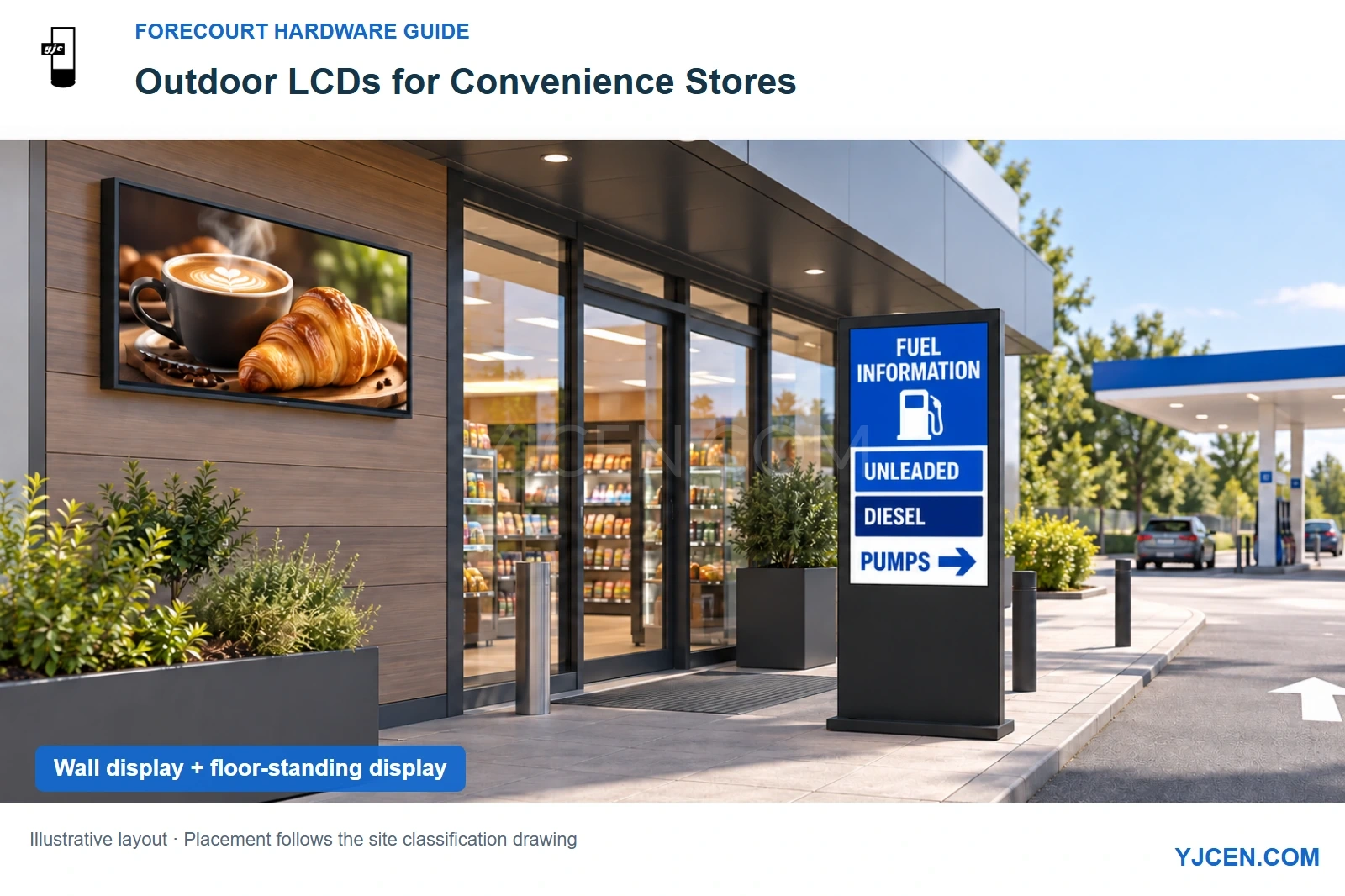
The wall-mounted display promotes convenience-store offers. The floor-standing display provides fuel information and directs drivers toward the pumps.
Quick Answer for Estimators & Engineers:
A gas-station outdoor LCD quote is not a fuel-price LED order. Separate the exposure class (canopy shade vs island sun), enclosure/IP continuity, mount, and brightness class as RFQ lines — and name whether the job is commercial LCD messaging or a LED price board before you mix BOMs.
1. Canopy vs. Island / Forecourt Exposure Classes
Do not quote forecourt hardware under a generic “outdoor” line item. Physical site placement dictates the required thermal management and panel configuration:
- Under-Canopy / Soffit Exposure:
Screens mounted below station canopies or tight to the C-store entrance avoid direct top-down rainfall and high overhead solar loads. However, they face continuous ambient outdoor humidity, diesel exhaust grime, ambient temperature swings, and wind-blown rain. - Open Forecourt / Pump Island Exposure:
Pedestals on fuel islands or entry bypass lanes take direct solar radiation from morning to sunset, reflected heat off dark asphalt, and lateral rain exposure from any direction.
Lock canopy vs island on the site drawing before sizing thermal paths — then run the outdoor LCD display buying checklist as a final BOM pass.
2. Commercial LCD vs. Fuel-Price LED — When Each Belongs
Do not cross-quote fuel-price pylons and customer-facing multimedia screens. They use completely different display systems:
| Hardware Field | Fuel-Price Pylon / Monolith | Forecourt Commercial LCD |
|---|---|---|
| Display Engine | Discrete or 7-segment LED character modules | High-resolution TFT commercial LCD panel |
| Delivered Content | Static numeric pricing (Unleaded / Diesel) | High-definition promotional video, retail upsell, EV charge status |
| Viewing Range | Long-distance roadside approach (vehicles at speed) | Close-to-medium interaction (pump bay, driver door, foot traffic) |
| Protective Layer | Open fascia or light acrylic shield | Toughened, vandal-resistant cover glass (anti-reflective / bonded) |
| Control Interface | Dedicated pump POS interface / price-pulse unit | Standard network media player, industrial SoC, or digital CMS |
If the station brand owner asks for menu promos, video loops, or C-store cross-selling at the pump, it is an LCD line item. Price digits remain a separate LED sub-system.
3. IP, Enclosure, and Washdown Adjacency RFQ Lines
Forecourt displays face rain, airborne dust, water mist and splashes from nearby cleaning activities. Match the enclosure protection and installation position to these conditions.
- Washdown Perimeter vs. Ambient Moisture:
Screens adjacent to service drives, vacuum islands, or wash bays encounter water mist and splashes. Use the installation exposure when reviewing the required IP65 vs IP67 outdoor protection rating. - Enclosure Metallurgy & Finish:
Specify the enclosure material and finish for the site’s exposure, including road salt, exhaust deposits and the cleaning products used by the operator. - Car Wash Adjacency:
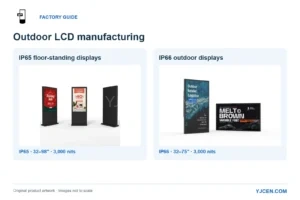
When mounting panels near drive-through wash entries or manual wash bays, specify protective sealing built for unattended car wash digital signage conditions. - IP66 Enclosure Protection:
YJCEN’s IP66 Outdoor Digital Signage provides dust-tight protection and resistance to powerful water jets. It suits outdoor customer areas exposed to rain, water mist and splashes.
4. Brightness Class Without Guessing Nit Floors
Avoid guessing specific nit numbers on the initial RFQ unless the panel model is locked. Instead, specify the ambient exposure class:
- Shaded / Canopy Class:
Mounted under continuous canopy cover. Requires sufficient daylight visibility to overcome ambient forecourt glare without driving up thermal dissipation requirements. - Direct Solar / Open Island Class:
Unshielded locations need high-brightness displays with reflection control to keep content readable. High-temperature LCD panels and appropriately sized thermal management address the separate challenge of solar heat buildup. - Thermal Matching:
Cooling hardware (filtered direct ventilation, closed-loop heat exchanger, or integrated AC) must match the chosen brightness class and local summer ambient ceiling.
Confirm exact cd/m² values and cooling configurations on the selected model during FAE review.
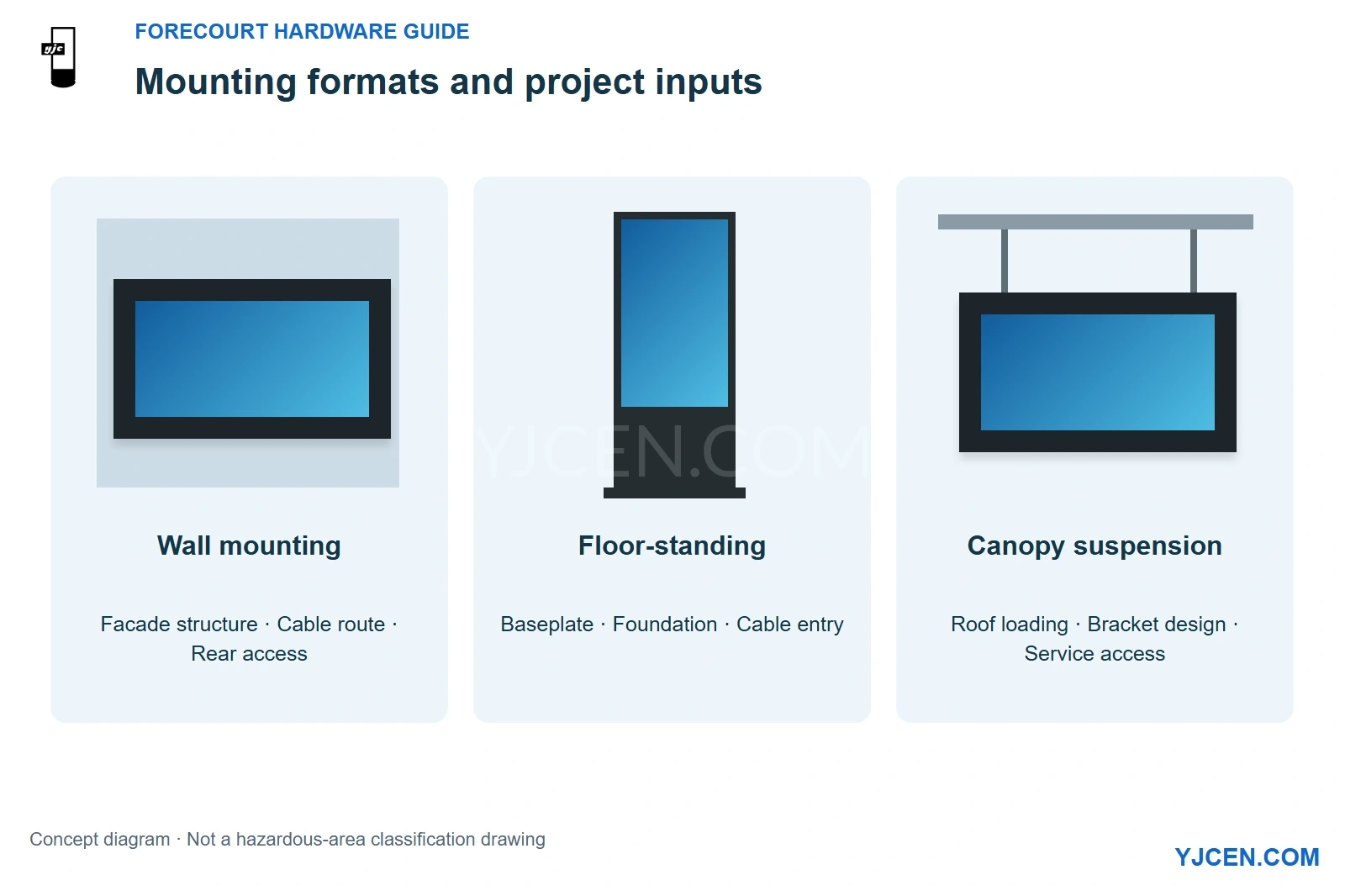
5. Mounting Topologies: Wall vs. Totem vs. Canopy Soffit
Forecourt mounts must account for mechanical clearance, wind drag, and site vehicle traffic.
- Canopy Soffit Suspended:
Ceiling-hung or truss-clamped. Check structural roof loading, vibration damping under canopy wind uplift, and service access hatches before committing. - C-Store Perimeter Wall Mounts:
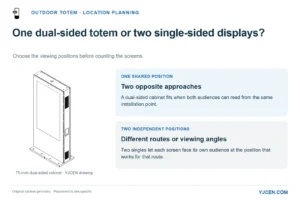
Direct architectural anchor on building facades using an outdoor wall-mounted display frame. - Island Totems & Free-Standing Pedestals:
Bolted to raised concrete dispenser plinths. Confirm internal conduit access for power/data lines and verify baseplate anchor bolt patterns on an outdoor floor-standing display base.
6. Power, Night Dimming, and CMS Boundaries
Clarify system boundaries between the physical display hardware and the station retail network before ordering:
- Automatic Night Dimming:
Stations run 24 hours. A screen driven at daylight luminance blinds approaching drivers. Mandate integrated ambient light sensors that automatically lower backlight output after sunset. - Electrical Protection:
Dispenser pump motors, air compressors, and car wash drives introduce switching spikes onto the forecourt power loop. Require built-in surge suppression on internal industrial power supply units (PSUs). - Demarcation Line for Media & Network:
Identify whether the display enclosure includes a pre-integrated player (SoC / IPC) or requires a field-supplied media player. Confirm cellular modem needs and who manages remote out-of-band power cycles.
7. RFQ Paste Checklist for System Integrators
Copy and paste this hardware block directly into your sourcing request or BOM document:
8. Frequently Asked Questions (FAQ)
Can we put an indoor screen into a weatherproof housing on an island?
For direct-sun installations, choose a complete outdoor display designed for the combined solar and internal heat load. An indoor screen inside a weatherproof box needs an engineered cooling solution; the enclosure alone does not establish outdoor thermal performance.
Can an LCD screen replace our roadside fuel-price sign?
No. Price pylons require high-contrast numeric LED characters designed for long-distance driver recognition from moving vehicles. Commercial LCD displays are built for graphic messaging and retail video at pedestrian and fueling-bay viewing distances.
What protection do IP65 and IP66 provide near wash areas?
IP65 provides dust-tight protection and resistance to water jets; IP66 provides dust-tight protection and resistance to powerful water jets. YJCEN’s IP66 outdoor displays are a suitable choice for customer-facing areas exposed to rain, water mist and splashes near wash facilities.
Can we mount a standard commercial LCD directly next to a fuel dispenser?
Install standard commercial LCDs in locations identified as non-hazardous on the site’s classification drawing. Equipment within a classified hazardous area must be approved for that area’s classification and meet the applicable local requirements.
Need Custom Mounting or Non-Standard Forecourt Enclosures?
Send your forecourt site drawings and plinth specs to our engineering team for custom mechanical fit validation.