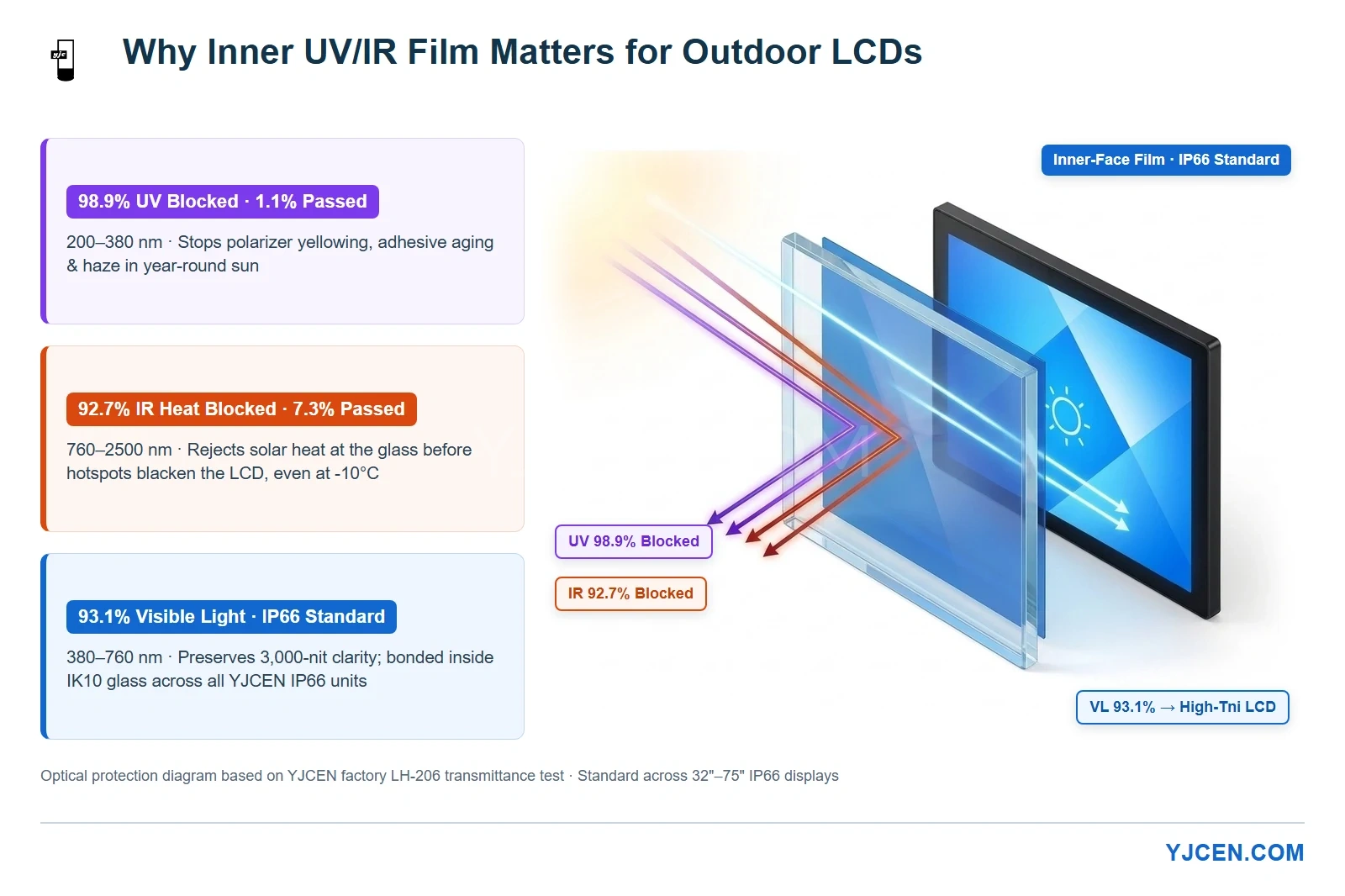
Freezing outdoor air does not protect an unshielded LCD panel from direct sunlight. Even at -10°C on a snowy plaza, concentrated solar infrared radiation and internal backlight heat can push local cell temperatures high enough to trigger dark thermal blackening or permanent amber yellowing. YJCEN builds every IP66 weatherproof outdoor digital signage unit with high-Tni hardware, smart thermal protection, and factory-standard inner-face UV/IR film verified on an LH-206 meter at 1.1% UV and 7.3% IR transmittance.
Why Direct Sunlight Scorches or Yellows an Outdoor LCD Even at -10°C
System integrators often assume thermal screen failure is strictly a summer desert problem. In field deployments across ski resorts, alpine transit hubs, and unshaded northern storefronts, screens frequently develop a dark circular spot or yellow-brown scorch zone in the middle of winter while ambient thermometers read -10°C.
Ambient air temperature measures the air around the housing, not the localized temperature trapped between the front glass, the LCD polarizers, and the LED backlight cavity. Under clear winter skies, four heat and radiation loads stack onto the screen face at the same time:
- Direct solar infrared radiation (760–2500 nm): Standard clear tempered glass lets most solar infrared energy pass straight through to the dark LCD front polarizer and cell stack, converting directly into localized surface heat.
- Low winter sun angles and snow reflection: High summer sun often misses vertical facades under shallow roof edges, whereas low winter sun strikes vertical screens nearly head-on. Fresh snow also bounces strong reflected sunlight back up onto the lower and central panel area.
- Continuous 3,000-nit backlight self-heating: A sunlight-readable 3,000-nit LCD runs dense LED arrays at high drive current to stay legible against glare, adding steady internal heat right behind the glass cavity.
- Solar ultraviolet degradation (200–380 nm): Sustained UV radiation breaks down optical adhesives, polarizers, and diffuser layers over months of exposure, turning clear whites into uneven amber yellowing and hazy patches.
When trapped localized heat pushes part of the liquid-crystal layer above its nematic-to-isotropic clearing threshold (Tni), the liquid crystals lose alignment and that zone turns smoky black. Temporary isotropic clearing may fade once the display cools, but repeated overheating or sustained UV exposure causes permanent polarizer scorching and yellow discoloration.
| Radiation or Load Source | Primary Effect on an Unshielded Outdoor LCD | Visible Field Symptom |
|---|---|---|
| Solar IR (760–2500 nm) | Passes through bare glass and creates a greenhouse hotspot on the LCD cell | Dark smoky-black isotropic patch at the sunniest screen zone |
| Solar UV (200–380 nm) | Photochemically degrades polarizers, optical adhesives, and backlight films | Progressive amber yellowing, faded contrast, and permanent scorch rings |
| 3,000-nit backlight load | Generates continuous heat behind the liquid-crystal panel in bright daylight | Amplifies solar hotspots when internal airflow or dimming lags behind |
| Winter snow glare & low sun | Delivers head-on direct beam plus upward reflected irradiance onto vertical glass | Triggers heat-type blackening or yellowing even in -10°C outside air |
Sub-zero air still creates real cold-start and moisture risks overnight, which we cover separately in our guide on cold-weather outdoor digital signage startup and condensation control. Protecting a winter-sun site means solving both nighttime cold soak and daytime solar-radiation heat together.
YJCEN’s Three-Layer Solar Protection Inside Every IP66 Display
Stopping sunlight blackening and yellowing requires controlling heat before it reaches the LCD cell, raising internal hardware heat tolerance, and actively managing thermal peaks inside the enclosure. YJCEN engineers all three layers into its sealed IP66 outdoor display platform rather than relying on panel brightness alone.
Layer 1: High-temperature internal hardware stack
Every core assembly inside YJCEN’s IP66 displays is selected for sustained high-temperature commercial operation rather than indoor display duty:
- High-Tni commercial LCD panel: Built to hold liquid-crystal alignment at substantially higher surface temperatures than standard indoor TFT modules before isotropic clearing occurs.
- High-temperature LED backlight: Engineered to sustain 3,000-nit daytime output under direct sun without rapid phosphor shift or premature yellowing.
- Industrial-grade motherboard and power supply: Rated for continuous 24/7 commercial duty across demanding thermal cycles instead of consumer TV power boards.
- High-temperature internal electronic wiring: Prevents insulation stiffening, contact drift, and connector fatigue inside warm sealed enclosures over multi-year deployments.
Layer 2: Intelligent multi-stage thermal control and protection
Passive material tolerance alone is not enough when midday direct sun hits a dark facade for hours. YJCEN’s sealed 86 mm aluminum IP66 cabinets (YJC-320-OD09-A through YJC-750-OD09-A) run an automated three-stage thermal protection sequence:
- Automatic brightness reduction: When internal sensors detect rising cabinet temperatures, the controller automatically steps down backlight brightness to lower self-generated LED heat while keeping content visible.
- Internal circulation cooling fans: Sealed internal circulation fans ramp up to pull heat away from the LCD cell and backlight assembly toward the aluminum chassis wall for exterior dissipation. Unlike vented IP65 cabinets that draw outside air through dust filters, the IP66 housing keeps this circulation completely sealed from blowing snow, rain, and grit.
- Automatic backlight thermal cutoff: If extreme solar loading drives internal cabinet temperature past the safe threshold, the controller forces the backlight off temporarily until internal temperatures fall back within the normal operating range. That brief protective shutdown prevents permanent polarizer scorching and extends panel service life.
For broader site mounting clearances and airflow planning across summer heatwaves, pair these cabinet protections with our engineering guide on how to keep outdoor digital signage cool.
Layer 3: Standard custom UV/IR film laminated on the inner face of the glass
Blocking solar heat and UV at the front glass stops the problem at the source before energy ever enters the LCD cavity. YJCEN laminates a custom UV/IR blocking film directly onto the inner surface of the IK10 tempered front glass.
This custom UV/IR film is standard across the entire YJCEN IP66 series (32″ through 75″), not a paid special-order upgrade. Placing the optical film on the inside of the sealed glass carries two practical field advantages:
- Zero exterior weathering or scraper damage: Rain, windblown grit, ice, graffiti solvents, and glass-cleaning squeegees touch only the exterior tempered glass, never peeling or scratching the optical layer.
- Lower cavity heat load from minute one: Rejecting incoming infrared energy at the front glass reduces peak internal temperatures, easing workload on the LED backlight, power supply, and internal circulation fans year-round.
Verified LH-206 Optical Transmittance Readings: Blocking UV & IR Without Dimming
Buyers often hesitate to add solar-control films because dark automotive-style window tints cut visible light sharply and waste a 3,000-nit backlight. To prove selective spectral filtering without sacrificing daytime readability, YJCEN measures the laminated front glass assembly directly on an LH-206 Optical Transmittance Meter.
| Spectral Band (LH-206 Meter) | Measured Transmittance | Energy Blocked | Engineering Impact on Outdoor LCD |
|---|---|---|---|
| UV (200–380 nm) | 1.1% | 98.9% | Blocks nearly all UV radiation that causes polarizer yellowing and optical adhesive aging |
| VL Visible Light (380–760 nm) | 93.1% | 6.9% | Preserves 3,000-nit screen brightness, crisp white balance, and sunlight readability |
| IR Infrared (760–2500 nm) | 7.3% | 92.7% | Rejects over 92% of solar infrared heat before it reaches the LCD cell and backlight |
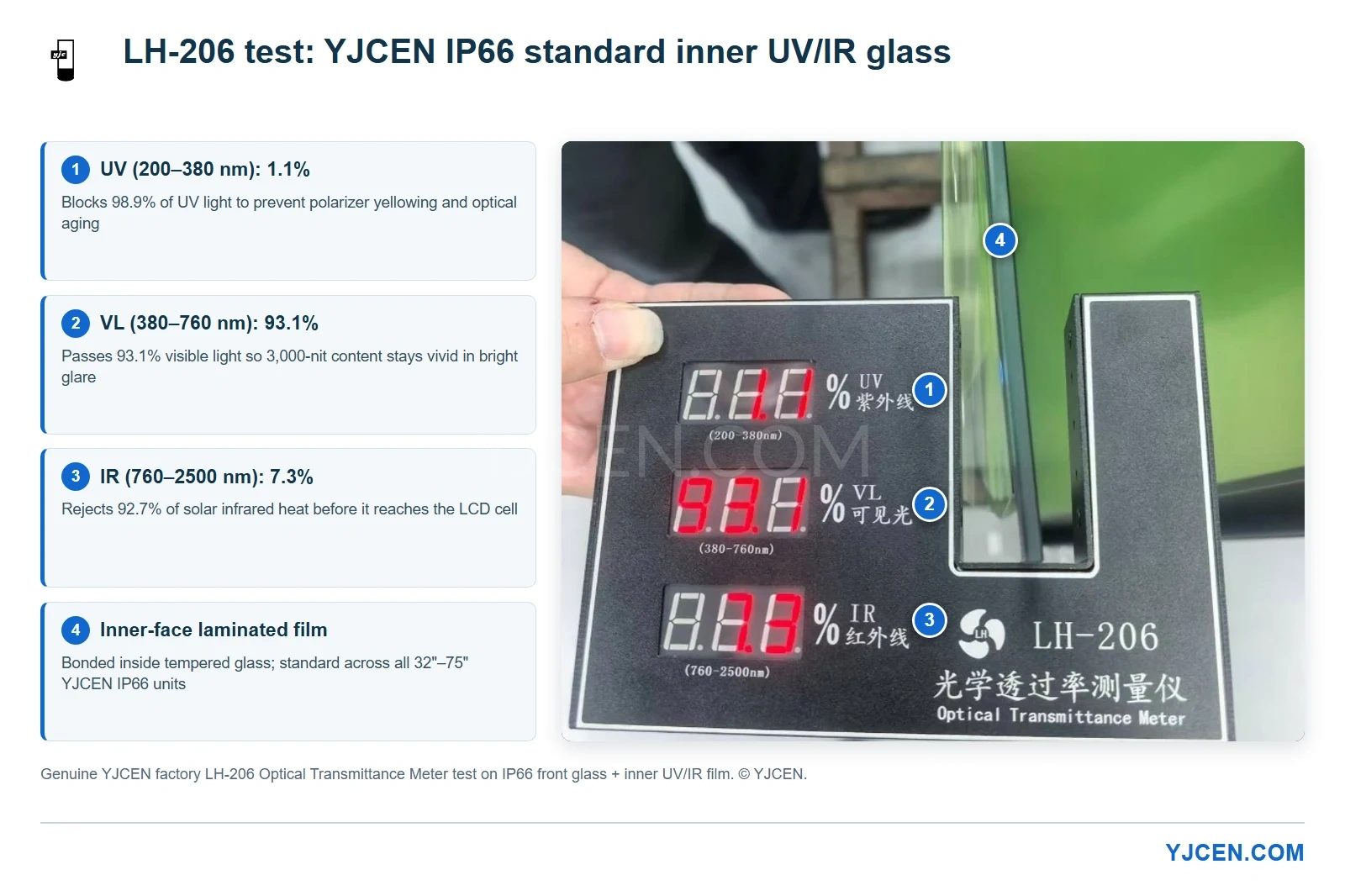
Those three live meter readings highlight why optical selectivity matters. Cutting 98.9% of UV and 92.7% of solar IR while still passing 93.1% of visible light keeps the display sharply readable in noon glare without forcing the backlight to burn extra wattage just to overcome a dark tint.
Specifying Sunlight-Readable Outdoor Displays for Direct-Sun and High-Glare Sites
When reviewing project quotes for unshaded facades, verify the full optical and thermal specification instead of comparing nit ratings alone. A 3,000-nit screen without verified IR/UV rejection and thermal cutoff protection can still blacken on a bright winter or summer afternoon.
| Site Exposure Profile | Primary Solar & Thermal Risk | Recommended Hardware & Site Specification |
|---|---|---|
| Alpine resorts & snowy transit plazas (-10°C to -45°C) | Head-on low winter sun plus bright snow reflection driving local cell hotspots, alongside sub-zero night cold soak | YJCEN IP66 OD09-A series with standard inner UV/IR film (UV 1.1% / IR 7.3%), climate-matched thermal build (rated -45°C to 65°C operating), and 24/7 unswitched AC power |
| Unshaded south- or west-facing retail walls | Long afternoon direct solar load, polarized-sunglasses viewing, and driving rain without canopy cover | Slim 86 mm sealed IP66 aluminum housing (32″–75″, 3,000 nits, polarized-sunglasses readable, ambient light sensor), similar to the two 55-inch IP66 entrance displays installed in the UK |
| High-UV equatorial or desert commercial plazas | Sustained high-index UV yellowing plus peak midday IR load exceeding 45°C ambient air | Sealed IP66 display with standard inner UV/IR film, high-Tni panel, automatic dimming/thermal cutoff, and clean rear clearance for chassis heat dissipation |
| Deep sheltered canopies or semi-outdoor walkways | Indirect glare, humid mist, and drifting rain without prolonged direct sunbeams | Match enclosure class to real rain exposure using our IP65 vs. IP66 outdoor digital signage selection guide |
Across all six sizes in YJCEN’s IP66 outdoor lcd display range (YJC-320-OD09-A 32″, YJC-430-OD09-A 43″, YJC-490-OD09-A 49″, YJC-550-OD09-A 55″, YJC-650-OD09-A 65″, and YJC-750-OD09-A 75″), the inner-face UV/IR film, high-Tni panel stack, 3,000-nit auto-dimming backlight, IK10 tempered glass, and smart thermal protection come built in as standard. Every unit undergoes a 72-hour factory aging test and waterproof rain inspection before shipping, carries ISO 9001, CE, RoHS, FCC, and ETL certifications, and is backed by a 3-year warranty.
Four quick checks before finalizing a direct-sun outdoor display order
- Record facade orientation and sun hours: Note whether the wall faces south, southwest, or west and whether nearby snow, pale concrete, or glass walls reflect additional sunlight onto the screen.
- Request spectral transmittance data, not vague “UV glass” claims: Ask suppliers for measured UV, visible-light, and IR percentages so you know heat rejection is real and visible brightness is not choked down.
- Confirm inner-face film placement and sealed IP66 construction: Verify the solar film sits inside the tempered front glass cavity and that the chassis relies on sealed internal circulation rather than exposed dust filters on stormy or snowy facades.
- Enable ambient light sensing and leave chassis breathing room: Keep the automatic light sensor active so brightness tracks daylight naturally, and avoid burying the 86 mm aluminum cabinet inside a tight zero-clearance masonry recess that traps chassis heat.
Frequently Asked Questions
Why can an outdoor LCD scorch or blacken in direct sun at -10°C?
Direct solar infrared and backlight heat trap inside the glass cavity despite freezing air. Low-angle winter sunlight and snow reflection strike vertical screens head-on, pushing localized LCD cell temperatures past the clearing threshold even when outside thermometers read -10°C.
Does inner UV/IR blocking film dim a 3,000-nit outdoor display?
No, YJCEN’s LH-206 meter confirms 93.1% visible light passes cleanly through the glass. Because the custom film selectively blocks 98.9% of UV (1.1% transmittance) and 92.7% of IR (7.3% transmittance), a 3,000-nit screen stays vivid and crisp in full midday sun.
Is the custom UV/IR film an optional upgrade on YJCEN IP66 displays?
No, inner-face custom UV/IR film is standard across every YJCEN IP66 outdoor display. Every 32-inch to 75-inch OD09-A model ships with the inner laminated film, high-Tni panel architecture, and smart thermal dimming and cutoff protection included by default.
Validate Solar Protection on a Project Sample
Planning an unshaded storefront, alpine resort plaza, or south-facing transit screen? Share your installation city, facade direction, screen size (32″–75″), and preferred Android or Windows player setup. YJCEN supports 1-unit sample orders, responds to engineering inquiries within 24 hours, pre-installs and tests your CMS software before dispatch, and ships standard IP66 units in 3–7 working days (custom builds in 15–20 working days).