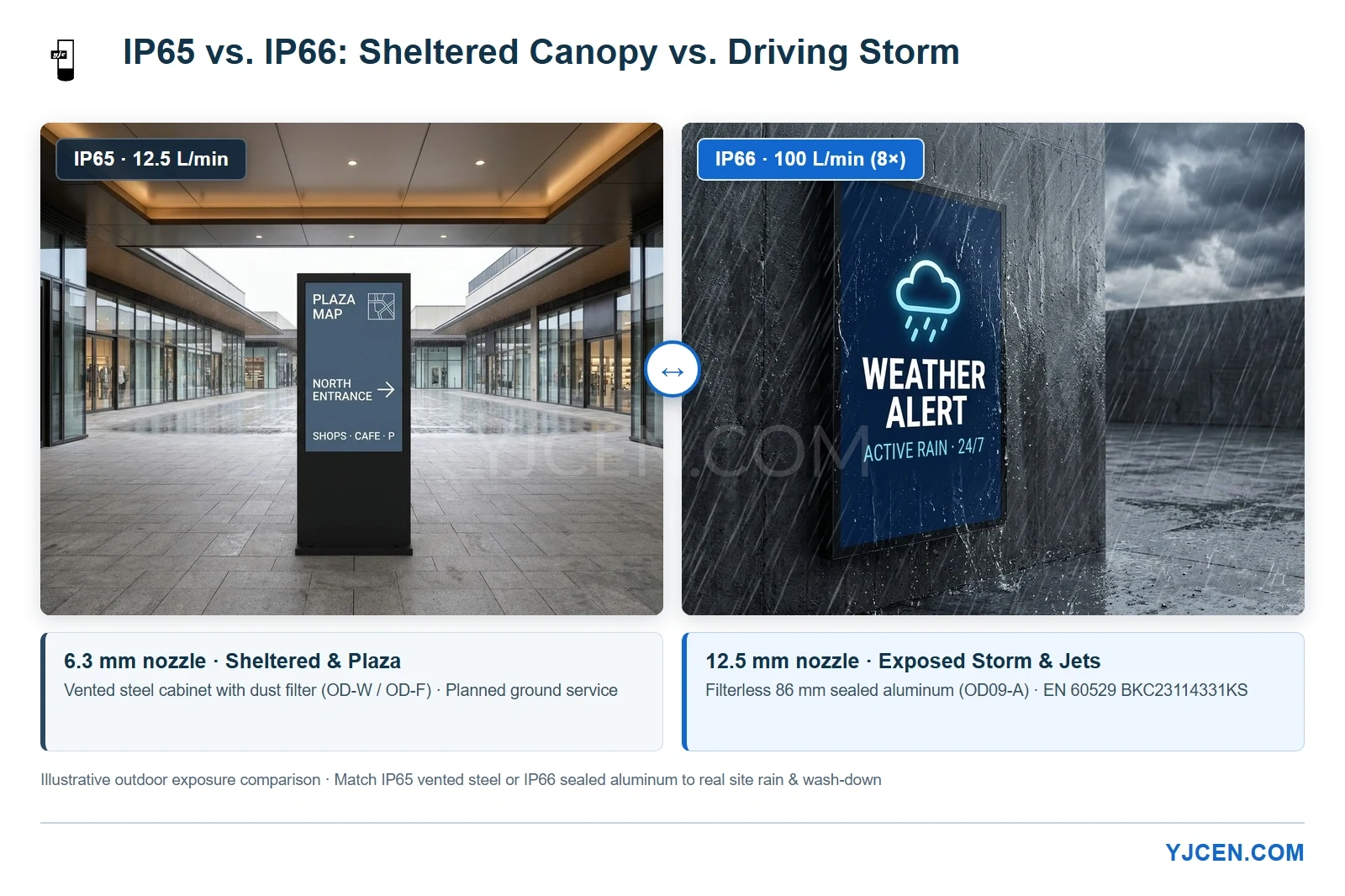
Choose IP65 for sheltered outdoor walls, paved plazas, and freestanding totems with light rain and scheduled filter access; choose IP66 for exposed facades, wind-driven storms, dusty industrial yards, and hose-cleaned walkways. Under EN 60529, IP66 enclosures resist 8× higher water volume per minute than IP65 (100 L/min vs. 12.5 L/min) and eliminate external air-intake filters. Specifying sealed IP66 weatherproof outdoor digital signage over vented IP65 steel cabinets comes down to real site exposure, wash-down pressure, and maintenance access.
IP65 vs. IP66 Under EN 60529: Why the Second Digit Means 8× More Water
Both IP65 and IP66 share the same dust-tight first digit (6), meaning zero fine dust enters the housing during an 8-hour vacuum talcum chamber test. The entire practical difference sits in the second digit: IPX5 tests low-pressure 12.5 L/min water jets through a 6.3 mm nozzle, whereas IPX6 blasts powerful 100 L/min jets through a 12.5 mm nozzle from 2.5 to 3 meters away.
In Shenzhen BKC Testing Co., Ltd. EN 60529 report BKC23114331KS (conducted on YJCEN’s 55-inch YJC-550-OD09-A at 45°C and 93% relative humidity), the sealed OD09 housing passed both the 8-hour IP6X dust chamber test and the 100 ± 5 L/min IPX6 jet test with zero internal ingress. That 8× jump in water flow rate matters whenever heavy wind pushes rain horizontally into seams or site crews hose down sidewalks near mounted screens.
| EN 60529 Parameter | IP65 (Dust-Tight + Water Jets) | IP66 (Dust-Tight + Powerful Water Jets) | Field Meaning for Outdoor LCDs |
|---|---|---|---|
| Dust protection (first digit 6) | 1 mm probe (1 N) + 75 μm talcum, 2 kg/m³, 8 h, ≤ 2 kPa | Identical IP6X test (BKC23114331KS verified PASS) | Both ratings block fine airborne dust when seals remain intact |
| Water nozzle diameter | 6.3 mm | 12.5 mm | Wider stream impacts glass joints, locks, and seams simultaneously |
| Water delivery rate | 12.5 L/min | 100 ± 5 L/min (8× higher flow) | Handles driving storm sheets and direct walkway wash-downs |
| Nozzle distance & duration | 2.5–3 m, 1 min/m² (min. 3 min) | 2.5–3 m, 1 min/m² (min. 3 min; ~120 mm core) | Neither rating covers close-range pressure washers (<1 m) |
| Temporary immersion (IP67) | Not covered | Not covered | Flood-prone ground zones require elevated mounting, not IP66 alone |
Do not confuse IP66 with IP67 temporary submersion. If your site sits in a flood-risk underpass or needs to understand how immersion testing differs from water-jet ratings, check our dedicated IP65 vs. IP66 vs. IP67 outdoor protection breakdown before finalizing mounting height.
Inside the Enclosure: Vented IP65 Steel Cabinets vs. Sealed IP66 Aluminum
Generic electrical-box articles miss the biggest hardware difference between IP65 and IP66 commercial displays: cooling airflow architecture. Most IP65 outdoor LCD cabinets cool high-brightness 3,000-nit panels by pulling outside air through louvered intakes, pleated dust filters, and multi-fan banks, while YJCEN’s IP66 OD09-A series seals the entire 86 mm aluminum shell with zero external air-intake filters.
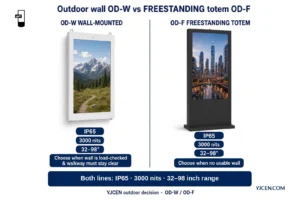
At YJCEN, our 55-inch IP65 cold-rolled steel wall cabinet (YJC-550-OD-W, 198 mm deep, 92 kg net) and IP65 floor-standing totem (YJC-550-OD-F, 125 mm deep, 120 kg net) use smart fan control, baffled intake/exhaust paths, and keyed hinged service doors so technicians can open the chassis and clean or replace intake filters on site. By contrast, our 55-inch IP66 YJC-550-OD09-A (86 mm deep, 37 kg net, IK10 tempered glass) removes intake louvers altogether, cutting filter service visits and blocking salt mist, pollen, and cement dust from ever crossing an air screen.
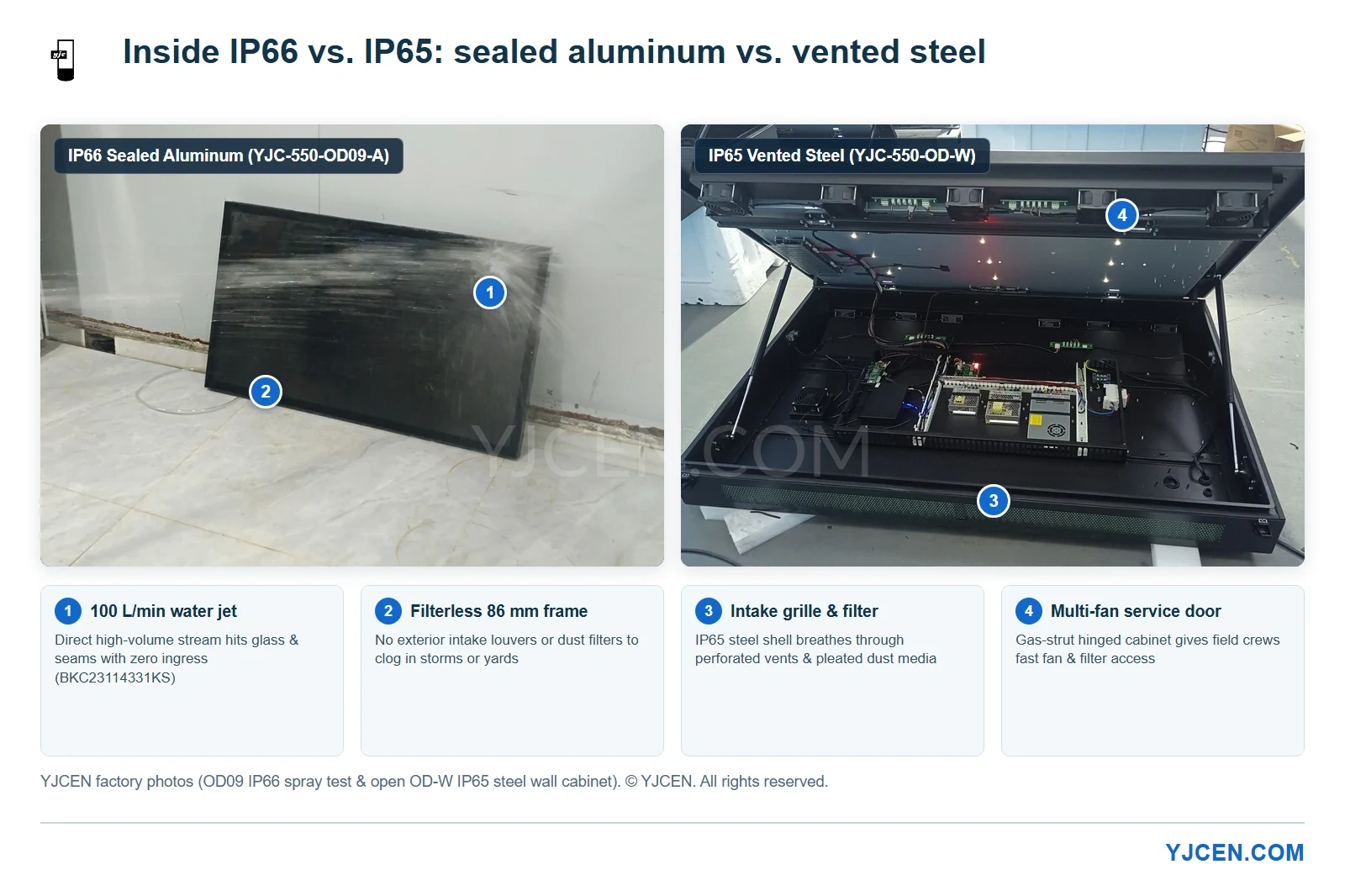
That internal trade-off explains why IP65 is not “cheap” and IP66 is not always mandatory. Vented IP65 cold-rolled steel excels in freestanding plaza totems, double-sided kiosks, and large 86–98 inch formats where ground-level service crews already inspect sites periodically. Filterless sealed IP66 aluminum wins on exposed walls, drive-thru lanes, high-mounted poles, and dusty industrial plants where ladder access for filter maintenance is costly or unsafe.
Site Exposure Matrix: Canopy Overhangs, Wash-Down Zones, and Open Facades
A roof canopy blocks vertical rain, not horizontal wind-driven mist, overnight condensation, airborne dust, or 3,000-nit daylight glare. Treating an open-sided canopy as an “indoor” environment is one of the fastest ways to kill a standard 350–500 nit indoor screen within its first wet season.
Match the display’s ingress architecture to the real exposure around all four sides of the screen rather than just looking straight up at the ceiling:
| Site Exposure Tier | Real Weather & Cleaning Risk | Minimum Protection Needed | Recommended YJCEN Hardware Path |
|---|---|---|---|
| 1. Inside closed storefront glass | Dry climate-controlled room; intense direct solar glare through glass | Non-waterproof indoor high-brightness | Window-facing digital signage (32″–86″, 3,000 nits, mounted inside glass only) |
| 2. Deep covered walkway or paved plaza | Light angled rain, dust, morning dampness; no high-pressure hosing; easy ground maintenance | IP65 outdoor enclosure | Outdoor wall-mounted digital signage displays (OD-W), outdoor floor-standing digital signage kiosks (OD-F), or 43″ IP65 battery A-board |
| 3. Shallow open canopy or sidewalk wash-down | Wind-driven rain reaching the screen face; janitorial hose spray; airborne road grit | IP66 recommended (IP65 only if shielded from spray) | Sealed IP66 outdoor digital signage (OD09-A, 32″–75″, filterless 86 mm aluminum) |
| 4. Exposed wall, drive-thru, coastal or dusty yard | Unshielded storm sheets, high humidity, heavy industrial dust, elevated mounting | IP66 mandatory | YJC-320 to YJC-750-OD09-A IP66 wall/pole series or 55″ IP66 drive-thru menu boards |
Pay close attention to portable sandwich boards under canopies as well. YJCEN’s 43-inch high-brightness outdoor battery A-board carries an IP65 rating and 2,000/2,500-nit sunlight readability, whereas standard indoor portable battery A-boards are not waterproof and must stay dry inside lobbies or covered indoor corridors.
Matching YJCEN IP65 and IP66 Models to Real Deployments
Comparing verbatim 2026 YJCEN datasheets across 55-inch 3,000-nit units shows how IP65 and IP66 enclosures differ in weight, depth, cooling, and operating humidity right out of the factory:
| YJCEN Reference Model | Rating & Cooling Architecture | Shell, Depth & Net Weight | Key Rated Operating Specs | Best-Fit Project Profile |
|---|---|---|---|---|
| YJC-550-OD09-A (32″–75″ series) | IP66 sealed, filterless (no external air filters); EN 60529 BKC23114331KS | 86 mm aluminum, IK10 glass, 37 kg | 4K UHD, 3,000 nits, 230 W max, 24/7, tested at 45°C / 93% RH | Exposed facades, poles, drive-thru lanes, dusty yards, low-maintenance sites |
| YJC-550-OD-W (32″–98″ series) | IP65 smart fan cooling with baffled vents & keyed service door | Cold-rolled steel, 198 mm, 92 kg | FHD, 3,000 nits, 290 W max, -45°C to 65°C, 10%–80% RH | Covered exterior walls, heavy-duty anti-vandal enclosures, 86″–98″ sizes |
| YJC-550-OD-F (32″–98″ series) | IP65 fan cooling (rear inlet/outlet) with keyed access & bolted steel base | Cold-rolled steel, 125 mm, 120 kg | FHD, 3,000 nits, 290 W max, -45°C to 65°C, 10%–80% RH | Paved public plazas, commercial wayfinding totems, freestanding street signage |
| 43″ Outdoor Battery A-Board | IP65 weatherproof portable steel chassis, LiFePO4 battery | Wheeled A-frame, 52 kg | 43″ FHD, 2,000/2,500 nits, 24 V 78 Ah (up to 14 h at 2,000 nits) | Daily roll-out curbside retail and covered patios without AC trenching |
Real YJCEN installations illustrate this exact division of labor. At our 24/7 concrete plant deployment in Ireland, heavy cement dust, damp air, and outdoor temperature swings made a filterless 55-inch YJC-550-OD09-A IP66 display the only practical choice because vented dust filters would clog rapidly. Similarly, a UK building supply retailer mounted two 55-inch IP66 units directly on exposed metal cladding without any canopy, whereas our Marrakech public plaza project deployed ten 55-inch IP65 freestanding totems anchored on open paved squares with ground-level service access.
Before leaving our Shenzhen plant, every YJCEN outdoor waterproof unit goes through our dedicated 8-hour continuous rain test, internal moisture inspection, and 72-hour aging run. Because switching from a 37 kg IP66 slim display to a 120 kg IP65 steel totem also changes crate volume and concrete footing budgets by nearly 3×, review our outdoor digital signage cost breakdown before locking in cabinet format.
Common Spec Mistakes That Break Waterproofing After Delivery
Even a certified IP66 display will fail in the field if installation teams treat the enclosure rating as an indestructible force field. Watch for four mistakes that routinely cause water ingress on otherwise solid outdoor hardware:
- Accepting a front-only IP rating on exposed walls: Some suppliers quote “IP65 front” panels that leave rear power inlets, fans, or media bays exposed. Confirm that the IP65 or IP66 rating covers the complete assembled display, including rear covers and connector bays.
- Aiming high-pressure power washers within 1 meter: EN 60529 IPX6 validates 100 L/min streams at 2.5 to 3 meters, not commercial 150-bar pressure wands held inches from glass gaskets. Clean outdoor displays with low-pressure water, soft microfiber cloths, and non-abrasive neutral cleaners.
- Leaving bottom cable entries unsealed without drip loops: Water runs down external AC and Cat6 jackets straight into the connector bay when cables enter from above or lack drip loops. Route outdoor cabling upward into bottom waterproof connectors with a downward drip loop below the chassis.
- Forgetting intake filter schedules on IP65 vented units: Clogged air filters on OD-W or OD-F steel cabinets choke cooling fans, raise internal panel temperatures, and force premature backlight thermal throttling. If your client has no quarterly maintenance plan, specify filterless IP66 instead.
Frequently Asked Questions
Is IP65 enough for an outdoor digital signage display?
Yes, for sheltered walls or paved plazas without high-pressure wash-downs or heavy wind-driven storms. YJCEN’s IP65 cold-rolled steel wall (OD-W) and floor-standing (OD-F) displays handle normal outdoor rain and airborne dust reliably when ground-level filter maintenance is planned. Upgrade to IP66 when sites face driving horizontal storms, heavy industrial dust, or walkway hosing.
Can I install an indoor display under an outdoor canopy?
No, because open canopies do not block wind-driven mist, morning condensation, dust, or daylight glare. Standard 350–500 nit indoor screens lack sealed electronics and turn unreadable under bright ambient sky light. Use inside-glass window displays behind sealed storefront glazing, or specify at least an IP65 outdoor display under any open-sided overhang.
Does IP66 mean an outdoor screen can be pressure-washed up close?
No, EN 60529 IPX6 tests 100 L/min jets at 2.5 to 3 meters away. Close-range commercial pressure washers exceed laboratory jet forces and can cut rubber gaskets or strip anti-glare coatings. Rinse outdoor screens gently from a safe distance and wipe the IK10 tempered glass with a soft cloth.
Get an Exposure-Matched IP65 or IP66 Specification
If you are weighing IP65 steel cabinets against sealed IP66 aluminum for an upcoming outdoor or under-canopy project, send YJCEN three quick site details: a site photo showing canopy depth or open exposure, your local rain/dust/cleaning conditions, and your target screen size and mounting orientation.
Our Shenzhen engineering team responds within 24 hours with a matched IP65 or IP66 model sheet, EN 60529 test report BKC23114331KS (for OD09 IP66 units), and dimensional drawings. Every model carries a 3-year warranty, ISO 9001/CE/RoHS/FCC/ETL compliance, Android or Windows options with customer CMS pre-install testing, a 1-unit sample MOQ, and 3–7 working-day standard lead time.