When 2500 nits is worth it
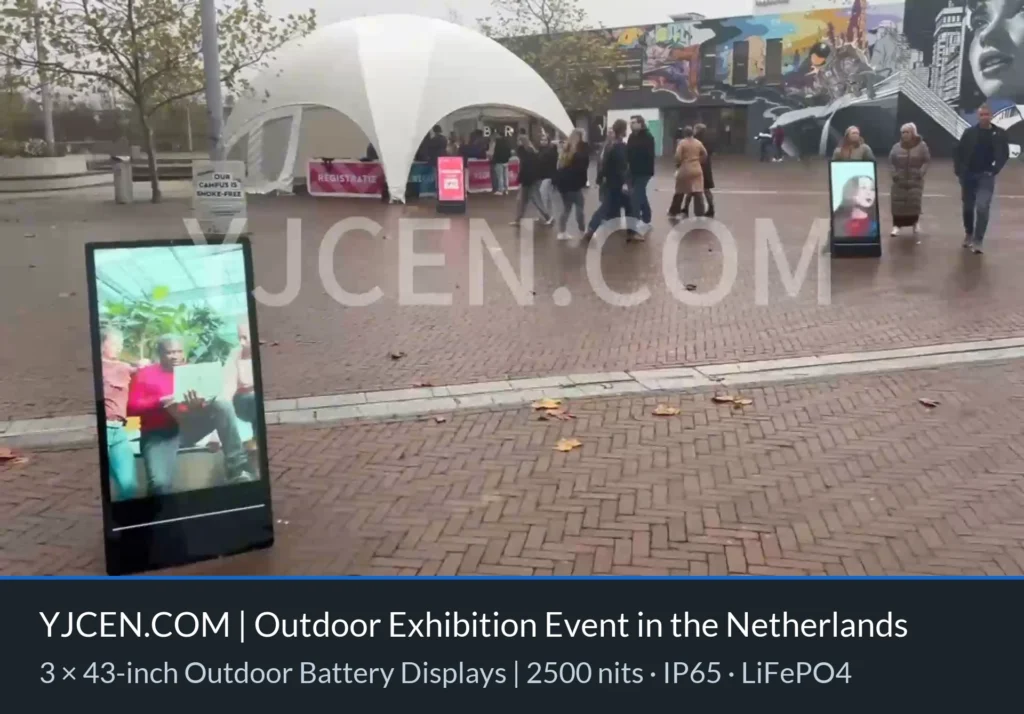
A 1,500-nit board is readable in shade, under a canopy, or on a north-facing pavement. A 2,500-nit board is for the positions where the 1,500-nit unit looks grey:
- Direct sun for most of the day — a south or west-facing pavement with no awning.
- High-reflectivity surroundings — glass façades, white paving, water.
- Content with fine detail — price lists, small print, photography.
- Markets with strong sunlight — the Middle East, southern Europe, parts of the US.
The trade-off is runtime: higher brightness draws more power from the same battery. A 2,500-nit board that runs six hours may be less useful than a 1,500-nit board that runs twelve, depending on the shift.
Ask two questions before choosing: how many hours does the board need to run, and what does the position look like at the worst hour of the day. If the answer is "all day in direct sun", 2,500 nits is the right call and the battery needs to be sized for it.
Compare with the 1500-nit model
|
1500-nit A-board |
2500-nit A-board |
| Readability in direct sun |
Marginal |
Good |
| Readability in shade |
Good |
Very good |
| Runtime on the same battery |
Longer |
Shorter |
| Power draw |
Lower |
Higher |
| Best position |
Covered, shaded, indoor |
Open pavement, direct sun |
| Price |
Lower |
Higher |
If the board moves between a shaded spot and a sunny one, the 2,500-nit unit gives more headroom; the cost is runtime and price. If the board never sees direct sun, the 1,500-nit unit is the better buy.