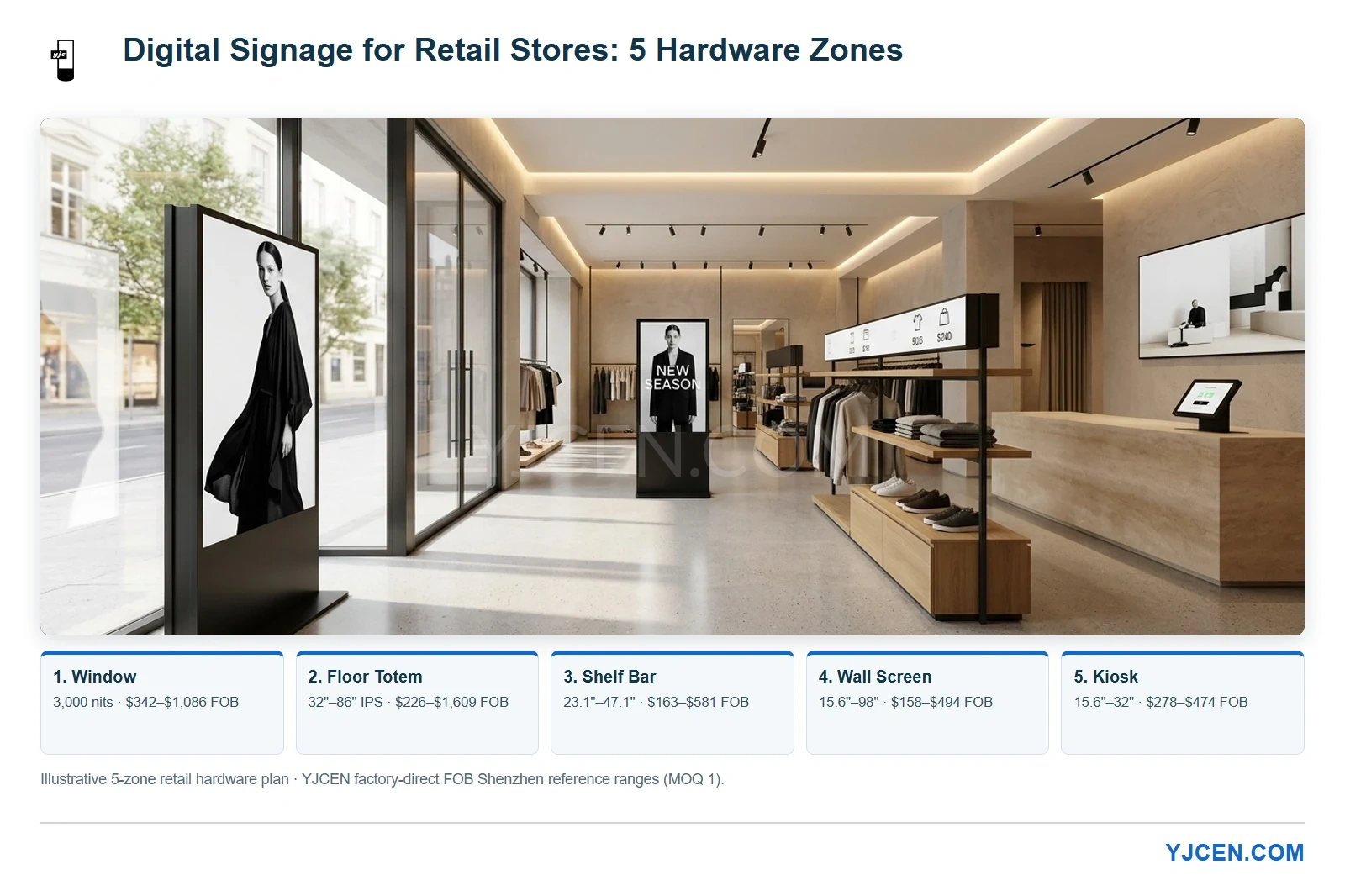
Effective digital signage for retail stores matches screen brightness, form factor, and mounting hardware to five distinct store zones rather than hanging consumer TVs everywhere. Start with 3,000-nit high-brightness storefront window displays ($342–$1,086 FOB Shenzhen) to pull street traffic inside, then pair 400-nit indoor floor totems ($226–$1,609 FOB), wall screens ($158–$494 FOB), shelf-edge stretched bars ($163–$581 FOB), and self-service kiosks ($278–$474 FOB) across interior aisles and checkout counters.
Factory-direct FOB Shenzhen ranges cover commercial hardware only (MOQ 1 unit), while overseas landed and installed retail projects typically total $1,200–$4,500 per window screen and $450–$3,800 per interior unit after freight, customs duties, local mounting, electrical drops, and any third-party POS or software integration.
Which Commercial Displays Fit Each of the 5 Retail Store Zones?
Specify retail displays by ambient daylight intensity and shopper dwell distance: storefront windows demand 3,000-nit anti-reflective panels for street visibility, central walkways need freestanding portrait totems, gondola shelves require ultra-wide bar screens that never block stock, department walls run 4K commercial IPS monitors, and checkout zones use capacitive touch kiosks.
| Retail Store Zone | Ambient Light & Viewing Distance | Recommended YJCEN Hardware | YJCEN FOB Reference (MOQ 1–2) | Typical Overseas Installed Budget |
|---|---|---|---|---|
| 1. Storefront Window / Entry | Direct daylight behind glass; 3–12 m street read | 32″–86″ Window High-Brightness (3,000 nits, indoor behind glass) or 32″–75″ IP66 Outdoor (exposed exterior) | $342–$1,086 (window) $1,050–$2,850+ (IP66 exterior) |
$1,200–$4,500 (window) $4,000–$14,000+ (IP66 exterior) |
| 2. Entrance & Main Aisles | Standard indoor lighting; 1.5–6 m walk-by | 32″–86″ Floor-Standing Totems (16:9 standard or 64″–86″ full-screen poster; 400 nits, 24/7 IPS) | $226–$1,609 per unit | $700–$3,800 deployed |
| 3. Gondola & End-Cap Shelves | Close aisle browsing; 0.5–2.5 m read | 23.1″, 35″, 47.1″ Shelf-Edge & 24.2″–69″ Stretched Bar LCD Displays | $163–$581 per bar | $350–$1,200 installed |
| 4. Department Walls & Cashwrap | Indoor spotlights; 2–5 m brand & price read | 15.6″–98″ Indoor Wall-Mounted Commercial IPS (16/7 or 24/7; FHD/4K) | $158–$494 (27″–55″ common) | $450–$1,800 per screen |
| 5. Self-Checkout & Ordering | Arm’s-length interaction; 0.4–1.0 m touch | 15.6″–32″ Modular or Self-Service Kiosks (PCAP touch, 80mm printer, 2D scanner, POS bracket) | $295–$341 (modular) $278–$474 (self-service) |
$1,400–$4,500 per station (incl. POS/software) |
The fastest way to burn a retail hardware budget is crossing environmental boundaries between Zone 1 and interior displays. A standard 350–400-nit indoor screen placed behind a sunny storefront washes out into a dark mirror by mid-morning, while mounting a shop-window screen outdoors exposes its open ventilation fans to rain and dust.
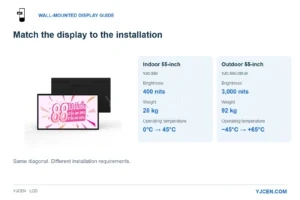
Keep window screens strictly indoors behind glazing; whenever a retail screen mounts on an uncovered exterior facade or parking-lot entrance, move to a sealed weatherproof housing such as YJCEN’s IP66 outdoor digital signage display. In a UK building supply store entrance deployment, two 55-inch IP66 3,000-nit displays mounted outside the automatic sliding doors handle open rain and car-park daylight cleanly.
Why Do Storefront Windows Require 3,000-Nit Cooling Hardware Instead of Indoor Screens?
Glass storefront windows amplify solar heat inside the narrow cavity behind the pane while reflecting 8%–15% of bright street sky light back at pedestrians. A dedicated retail window display pairs a 3,000-nit anti-reflective panel with active perimeter cooling fans and daylight dimming so promotions stay vivid at noon without overheating the LCD.
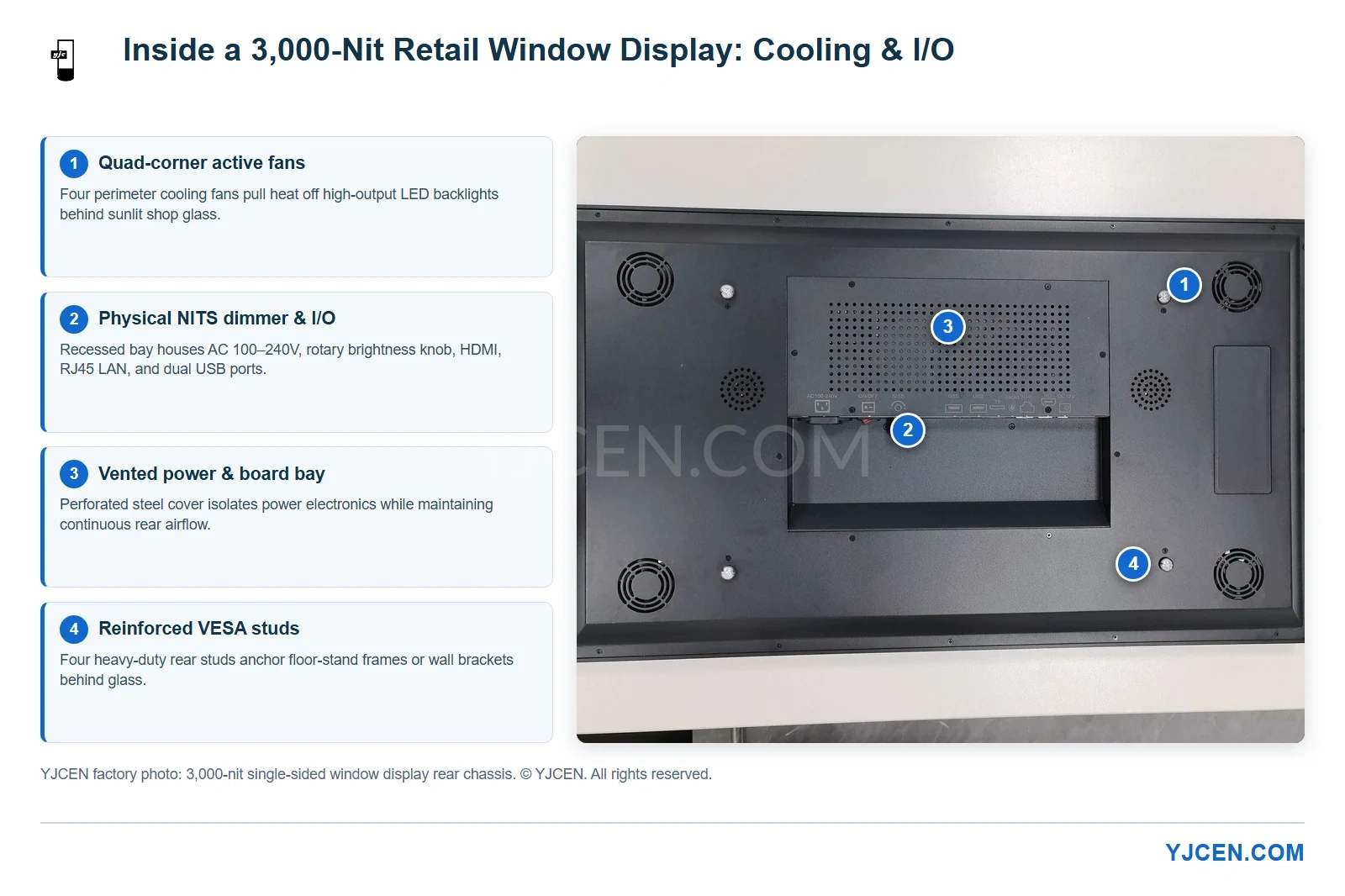
Hardware thermal layout separates real storefront displays from repurposed indoor monitors. As seen on the YJCEN 3,000-nit window rear chassis above, four perimeter cooling fans pull heat away from high-output backlights, a recessed rear bay keeps HDMI, RJ45 LAN, USB, and AC power plugs flush against glass fixtures, and a physical NITS control complements automatic ambient-light dimming.
Mounting style depends on floor depth behind the glass. Ceiling-hung single-sided or double-sided window displays (typically up to ~$1,086 FOB for double-sided hanging configurations) keep floor space clear for mannequins and window merchandise, whereas floor-standing window stands (starting near $342–$817 FOB) roll directly behind rented storefronts where ceiling drilling is prohibited.
Real European deployments show how retailers scale window brightness across formats. In an Ireland retail storefront window upgrade, 55-inch 3,000-nit CMS-networked screens replaced printed posters behind street-facing glass, while a European furniture retail chain deployed twenty 75-inch 3,000-nit floor-standing displays across storefront glazing and showroom interiors to present full-scale seasonal collections. For double-sided hanging clearances and glass heat-load rules, review our window digital signage buying guide.
How Do Shelf-Edge Stretched Bars and Floor Totems Lift In-Aisle Engagement?
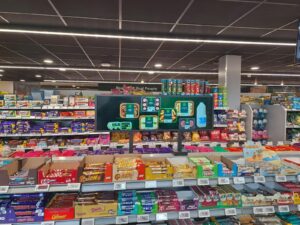
Interior retail aisles have tight sightlines and zero spare wall space, so format geometry matters more than raw diagonal size. Place indoor floor-standing digital signage displays (32″–86″, $226–$1,609 FOB) at main aisle junctions for hero campaigns, and mount slim shelf-edge stretched bar LCD screens ($163–$581 FOB) directly along gondola lips to display dynamic pricing and product comparisons.
- Shelf-edge stretched bars (23.1″, 35″, 47.1″): Standard shelf widths match YJCEN’s ultra-wide bar formats without obscuring packages above or below. In a Brazil supermarket custom shelving deployment, eight 23.1-inch shelf-edge units and two 24.2-inch top headers turned one confectionery gondola into a synchronized promotional bay. See our shelf-edge LCD sizing and fixture guide for native pixel ratios.
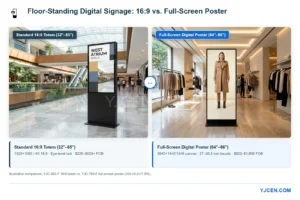
- Floor-standing totems (32″–65″ 16:9 vs. 64″–86″ full-screen): Standard 16:9 totems keep promotional text above shopping-cart height using universal portrait assets, while YJCEN’s 64″–86″ full-screen poster series fills nearly the entire vertical frame (27–30.5 mm side bezels) for life-size apparel campaigns in narrow fashion aisles.
- Wall-mounted cashwrap displays (15.6″–98″): Slim commercial IPS screens from YJCEN’s indoor wall-mounted signage lineup ($158–$494 FOB for common 27″–55″ units) deliver 178° off-angle color uniformity for behind-counter loyalty prompts, size charts, and promotional menus.
- Self-service retail kiosks (15.6″–32″): YJCEN’s self-service kiosk ($278–$474 FOB) and modular detachable series ($295–$341 FOB) supply the capacitive touchscreen, 80mm thermal printer, 2D QR/barcode scanner, and optional POS/NFC payment bracket; retailers or integrators supply the POS, endless-aisle, or checkout software, which YJCEN can pre-install and test before shipping.
What Does a Multi-Zone Retail Digital Signage Rollout Actually Cost (FOB vs. Installed)?
A complete 3-screen boutique setup runs roughly $850–$2,100 in factory-direct FOB hardware ($2,500–$7,500 installed overseas), while a 6-screen mid-size retail store totals $1,800–$4,600 FOB ($6,000–$16,000 installed). Separating hardware FOB from freight, electrical work, rigging, and third-party software prevents mid-rollout budget surprises.
| Retail Store Tier | Sample Hardware Mix | Est. YJCEN FOB Hardware | Est. Overseas Installed Total | Primary Landed-Cost Drivers |
|---|---|---|---|---|
| Small Boutique (3 Screens) | 1 × 43″–55″ 3,000-nit Window Display + 1 × 43″ Floor Totem + 1 × 32″–43″ Cashwrap Wall Screen | $850 – $2,100 | $2,500 – $7,500 | Air/sea freight, local electrical outlet behind glass, bracket install |
| Mid-Size Store (6 Screens) | 2 × 55″ Window Displays + 1 × 55″ Floor Totem + 2 × 23.1″ Shelf Bars + 1 × 21.5″ Kiosk | $1,800 – $4,600 | $6,000 – $16,000 | Window rigging or stands, shelf cable routing, buyer POS terminal & software |
| Flagship / Multi-Store Pilot (10 Screens) | 2 × 75″ Window Displays + 2 × 64″–75″ Full-Screen Totems + 4 × Shelf Bars + 2 × Kiosks | $4,200 – $9,800 | $14,000 – $35,000+ | Sea-container consolidation, custom paint/white-label, site labor & CMS rollout |
All FOB figures above are non-binding factory-direct Shenzhen hardware references based on standard configurations (MOQ 1–2 units); large 75″–98″ panels, custom enclosure colors, touch upgrades, and volume discounts are quoted per project within 24 hours. Sea consolidation on 10+ unit retail rollouts cuts per-unit freight dramatically compared with single-sample air shipments.
How Should Retail Chains Standardize Android CMS, Windows Players, and Rollout QC?
Standardize passive promotional screens (windows, walls, floor totems, shelf bars) on YJCEN’s built-in Android platform (RK3568 or RK3576) with free cloud CMS, and reserve Windows hardware for interactive kiosks or POS-linked terminals requiring legacy desktop software. Lock one 1-unit pilot sample per screen type before releasing multi-store production.
| Deployment Factor | YJCEN Android (RK3568 / RK3576) | YJCEN Windows Hardware Option | Retail Chain Selection Rule |
|---|---|---|---|
| CMS & Licensing | Includes YJCEN free cloud CMS (unlimited user accounts) + USB plug-and-play | Buyer supplies Windows OS license and third-party CMS or POS app | Use Android for passive promos & daypart playlists; Windows for ERP/POS clients |
| Pre-Ship App Testing | YJCEN can pre-install and test customer Android APK before shipping | YJCEN can pre-install and test customer Windows software on request | Verify portrait rotation, Wi-Fi/LAN auto-reconnect, and kiosk lock on sample |
| Lead Time & MOQ | MOQ 1 unit; ~3–7 business days (standard stock) | MOQ 1 unit; ~3–7 days standard, ~15–20 business days custom OEM/ODM | Approve 1 sample per store zone before ordering 10–100+ chain units |
| Factory QC & Warranty | ISO 9001; 72-hour aging, full-function & sheet-metal QC; CE/RoHS/FCC/ETL; 3-year warranty | Identical ISO 9001 QC, 72-hour aging, CE/RoHS/FCC/ETL & 3-year warranty | Match electrical compliance (ETL/FCC for North America; CE/RoHS for EU/UK) |
Retail chains expanding across regions also benefit from unbranded white-label finishes or custom brand powder-coating under NDA. Running every production batch through YJCEN’s 72-hour continuous aging test and full-function inspection catches early backlight or board defects on the factory floor rather than inside an active store on launch week.
Frequently Asked Questions
How bright should digital signage be for a retail storefront window?
Specify 3,000 nits for street-facing storefront windows exposed to daylight. Standard 350–500-nit indoor screens wash out under daytime glass reflections, whereas a 3,000-nit anti-reflective window display with automatic ambient dimming stays readable at noon and dims cleanly after dark.
Can a window high-brightness display be mounted outside a retail store?
No—window high-brightness displays install strictly indoors behind storefront glass. Their open rear cooling vents are not rainproof; for uncovered exterior walls or open entrances, specify a sealed IP66 outdoor display (32″–75″, 3,000 nits, $1,050–$2,850+ FOB) or an IP65 outdoor wall/floor unit.
How much does digital signage cost for a small retail store?
Hardware for a 3-screen boutique starts around $850–$2,100 FOB, or $2,500–$7,500 installed. Individual YJCEN commercial wall screens start near $158–$494 FOB, indoor floor totems $226–$1,609 FOB, shelf-edge bars $163–$581 FOB, and 3,000-nit window units $342–$1,086 FOB before freight and installation.
Does YJCEN include free CMS software or POS apps for retail stores?
Android models include free cloud CMS (unlimited accounts); buyers supply POS software. YJCEN supplies commercial display and kiosk hardware across Android (RK3568/RK3576) and Windows options and can pre-install and test customer-supplied retail, ordering, or POS software before shipment.
Planning a single flagship upgrade or a multi-store retail rollout? Send your store zones (window, aisle, shelf, wall, or checkout), screen sizes, Android or Windows preference, and sample or chain quantity (from MOQ 1)—YJCEN engineers respond within 24 hours with spec sheets, dimensional CADs, and factory-direct FOB pricing.