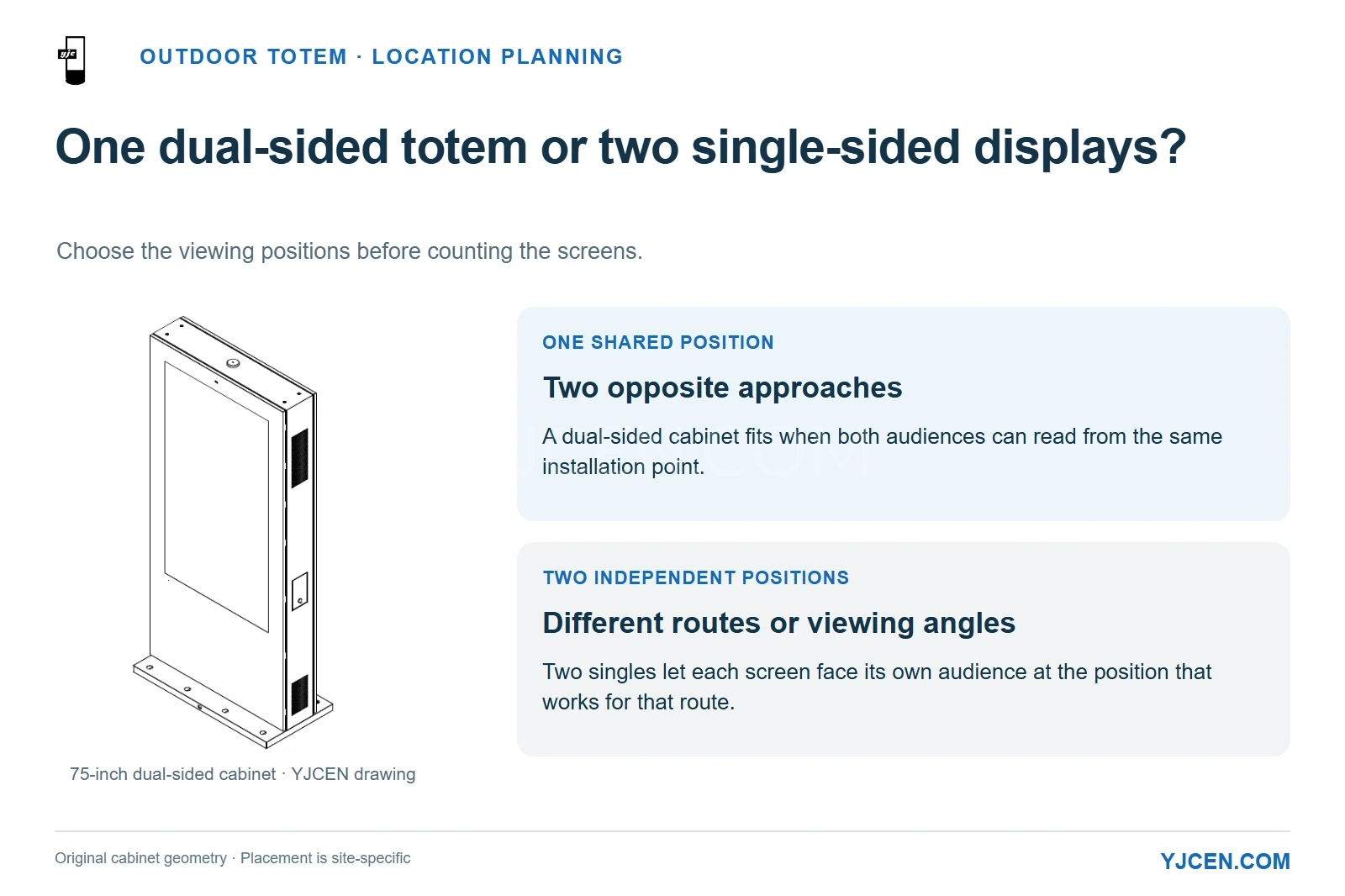
A dual-sided cabinet fits when both audiences can read from the same installation point. Two singles let each screen face its own audience at the position that works for that route.
Choose a dual-sided outdoor LCD totem when two opposing approaches can share one useful display position and technicians can service the cabinet there. Choose two single-sided units when each audience needs a different location or viewing angle.
A second face earns its place when it reaches a second useful audience. The strongest case for dual-sided signage is shared placement—not an assumed saving in power, maintenance or software.
1. Do Both Traffic Directions Benefit from the Same Position?
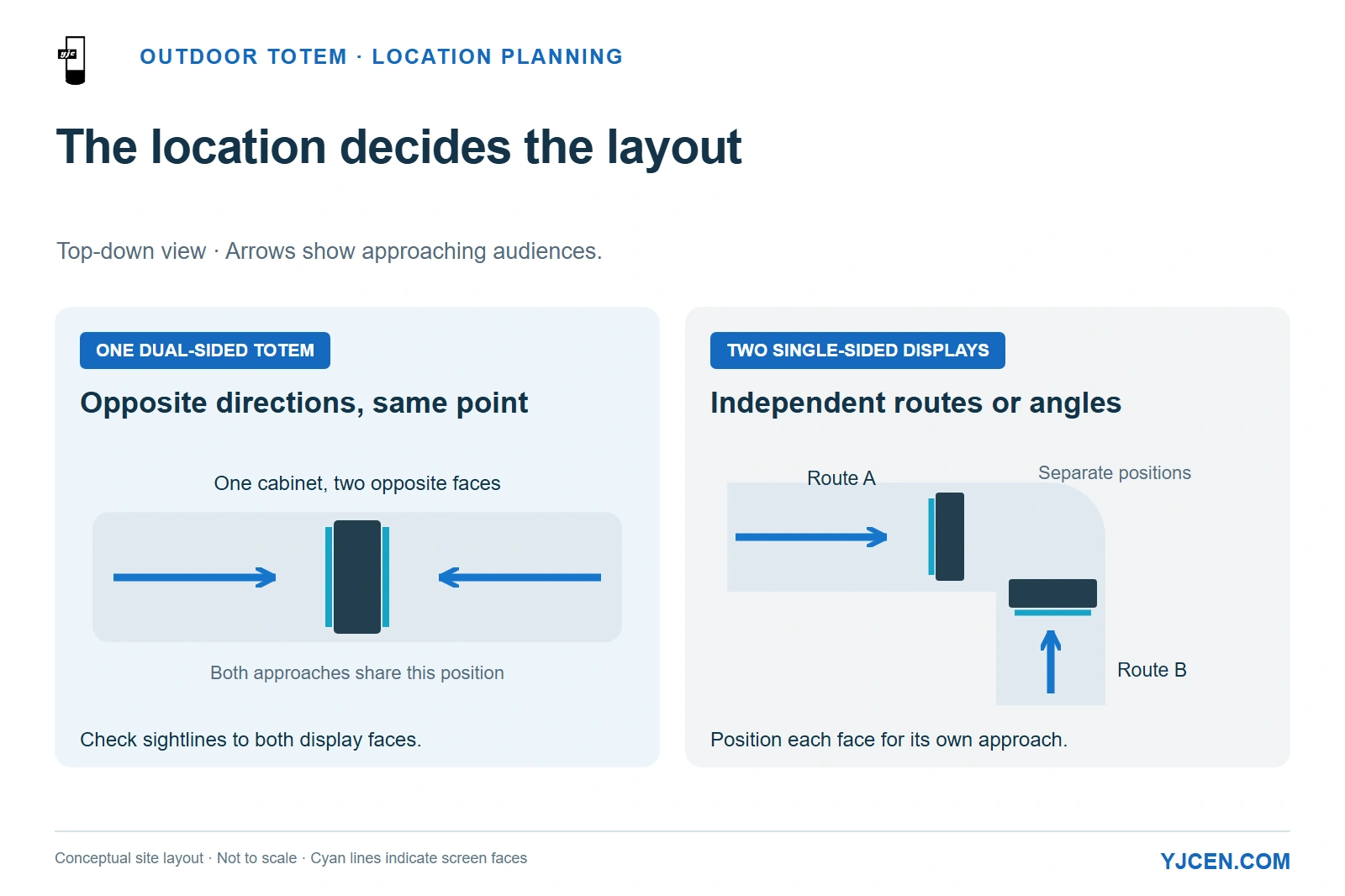
Mark the two approaches on a site plan and identify where people first need to read the message. A double-sided cabinet works well when those reading positions fall on opposite sides of the same installation point.
For example, a plaza route may carry visitors toward a venue before an event and away from it afterward. A totem between those approaches can show arrival information on one face and onward directions on the other.
Two routes meeting at a right angle create a different problem. Opposite screen faces cannot independently turn toward each route, so two single-sided units can provide better alignment even though they require separate installations.
| Site situation | Stronger starting choice | Reason |
|---|---|---|
| Opposing approaches with a shared reading point | One dual-sided totem | Both faces serve the same useful location |
| Two routes requiring different screen angles | Two singles | Each screen can face its audience |
| One approach carries the useful audience | One single | The second face adds little useful coverage |
| Entry and exit messages are needed at different points | Two singles | Each message appears where the decision happens |
| One shared position, but one face is hidden by planting or street furniture | Relocate first | A second screen does not overcome a blocked sightline |
Treat these as placement examples, not traffic forecasts. Count the approaches that actually see the screen rather than assuming that two faces double exposure.
If one audience is already served by a building facade, compare wall-mounted and freestanding digital signage before committing to another ground-mounted cabinet.
2. What Changes in Power and Thermal Planning?
Price the complete dual-sided assembly against two complete singles. Two active LCD faces need power and release heat, while the cabinet may share some equipment or use separate components for each face.
That makes the total selected configuration the useful electrical unit. A single-face rating is not the supply allowance for a dual-face installation, and a maximum input rating is not a prediction of everyday energy use.
Compare both alternatives at the same screen size, brightness requirement and operating schedule. Include the displays, players and cooling equipment within each quotation boundary so that one offer does not exclude loads included in the other.
The two faces can also experience different conditions. One may receive direct afternoon sun while the other faces a shaded walkway; the cooling design and brightness-control arrangement need to accommodate those exposures.
YJCEN’s range specifies automatic brightness adjustment, but the project still needs a defined control arrangement for two faces. Independent face control is useful where exposure differs; record whether the proposed configuration provides it rather than assuming that one sensor represents both sides.
For operating-cost comparisons, use average input under an agreed schedule:
Annual energy = average input in kW × operating hours per day × operating days per year.
Apply the same assumptions to both alternatives. A smaller number of cabinets alone does not establish an energy saving.
3. Can Technicians Reach the Equipment Without Blocking the Site?
Draw the service envelope around the cabinet before accepting the position. Include the actual access opening, technician working space, component-removal path and any temporary closure of the adjacent route.
Both screen faces need cleaning access, but internal maintenance does not necessarily require a door behind each face. The cabinet design determines whether service is from the side, front, rear or another opening.
This distinction matters near a road, queue or planted border. A cabinet may fit neatly between two routes yet become expensive to maintain if opening it requires closing one of those routes every time.
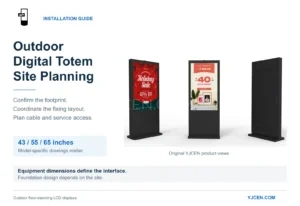
Use the selected double-sided cabinet drawing to set out the foundation interface, fixing holes and cable entry. Do not substitute a single-sided drawing.
Set out the base footprint, cable entry and service area together. The cabinet outline shows the object being installed; the surrounding access shows whether it remains usable after installation.
Two singles can make it easier to service one position while leaving the other available. With a shared cabinet, continued operation of the opposite face depends on power isolation, player architecture and access arrangements—not simply on having two panels.
4. Will the Two Faces Show the Same Content?
Specify the playback task before selecting the player arrangement. “Two screens” can mean duplicated output, separate playlists or synchronized playback, and those tasks place different demands on the system.
| Required behavior | Useful specification |
|---|---|
| Same message on both faces | Mirrored output and supported resolution for both panels |
| Arrival information on one face, exit information on the other | Independently addressable content channels |
| Different operating hours | Separate schedules and the required screen-control behavior |
| A precisely coordinated video sequence | Defined synchronization requirement and compatible playback architecture |
| One face remains useful during a fault on the other | Defined isolation and failure behavior |
Name the faces in the content system by direction or purpose, such as “Plaza Arrival” and “Car Park Exit.” This reduces the chance of sending the right message to the wrong audience.
A single player is suitable only when its outputs and software deliver the required behavior. For independent content, compare a capable multi-output arrangement with separate players, including how each is updated and serviced.
CMS licensing can be counted by player, output, screen or another provider-specific unit. Include the actual license basis in the commercial comparison rather than treating one enclosure as one software license.
5. Where Can One Dual-Sided Unit Save Cost—and Where Can It Add Cost?
A shared location can reduce duplicated civil works, cable routes and installation visits. Those savings are strongest when two separate positions would otherwise require genuinely separate work.
The shared cabinet can introduce different costs: a larger equipment envelope, heavier handling, more complex service access or restrictions on maintenance timing. Compare installed configurations, not just equipment purchase prices.
| Cost or service item | One dual-sided unit | Two single-sided units |
|---|---|---|
| Positioning | One shared location | Independent locations and angles |
| Foundations and cable routes | Potential to consolidate work | Can reuse separate existing infrastructure |
| Delivery and handling | One assembly with its own lifting requirements | Two assemblies and installation points |
| Routine access | Service concentrated at one position | Access can be arranged independently |
| Fault isolation | Depends on shared components and isolation design | More opportunity to separate equipment failures |
| Future relocation | Both faces move together | One unit can move without the other |
Select the dual-sided option when the shared position works for both audiences and its installation savings survive the service-access review. Select two singles when independent positioning or maintenance is worth more than consolidation.
Cover environmental requirements in the outdoor LCD buying checklist; compare one cabinet against two in a separate cost-and-service table.
6. RFQ Fields for a Dual-Sided Versus Two-Single Comparison
Attach a marked site drawing and request both alternatives against the same viewing task. The following fields distinguish the alternatives without prescribing unverified product features.
7. Frequently Asked Questions
Is a dual-sided outdoor LCD totem always better for two traffic directions?
No. Both directions must benefit from the same installation position and the available face orientation.
Is one single-sided display enough when only one approach matters?
Yes. A second face adds value only when another useful audience can see it.
Does a dual-sided totem consume less electricity than two singles?
No—not automatically. Compare complete-system input and operating schedules at equivalent viewing requirements.
Can the two faces show different messages?
Yes—with a playback system that supports independent content. Specify separate channels and schedules in the quotation.
Can one face keep operating while the other is serviced?
Yes—if the electrical and service design supports it. State that requirement before selecting the configuration.
Can I reuse a single-sided foundation drawing for a double-sided unit?
No—not without an engineering review. Use the selected cabinet’s loads, base geometry and fixing details for the site design.
Send Your Two-View Layout for a Configuration Proposal
YJCEN’s Outdoor Digital Kiosk range includes single- and double-sided configurations for these layouts.
Send YJCEN a site drawing showing both approaches, the intended reading positions, screen size and service access. Add the required playback behavior and quantity so we can compare one dual-sided cabinet with two single-sided units for mechanical fit and supply scope.