What does optical bonding do for an LCD display?
Optical bonding fills an interface between the LCD and cover glass or touch panel with a clear adhesive. It can reduce internal reflections, but it is separate from backlight brightness and surface treatments.
- Compare real content under the intended lighting and viewing angles.
- Inspect bond quality, readability and uniformity on the proposed sample.
- Confirm which layers are bonded and how damaged parts can be repaired.
- Do not assume every high-brightness display is optically bonded.
For a signage project, the useful question is whether bonding solves a problem at the intended location. A display behind a sunny entrance has different needs from a directory inside a shaded lobby. This guide explains what to compare, what to ask a supplier and how to review a sample before ordering.
What changes when a display is optically bonded?
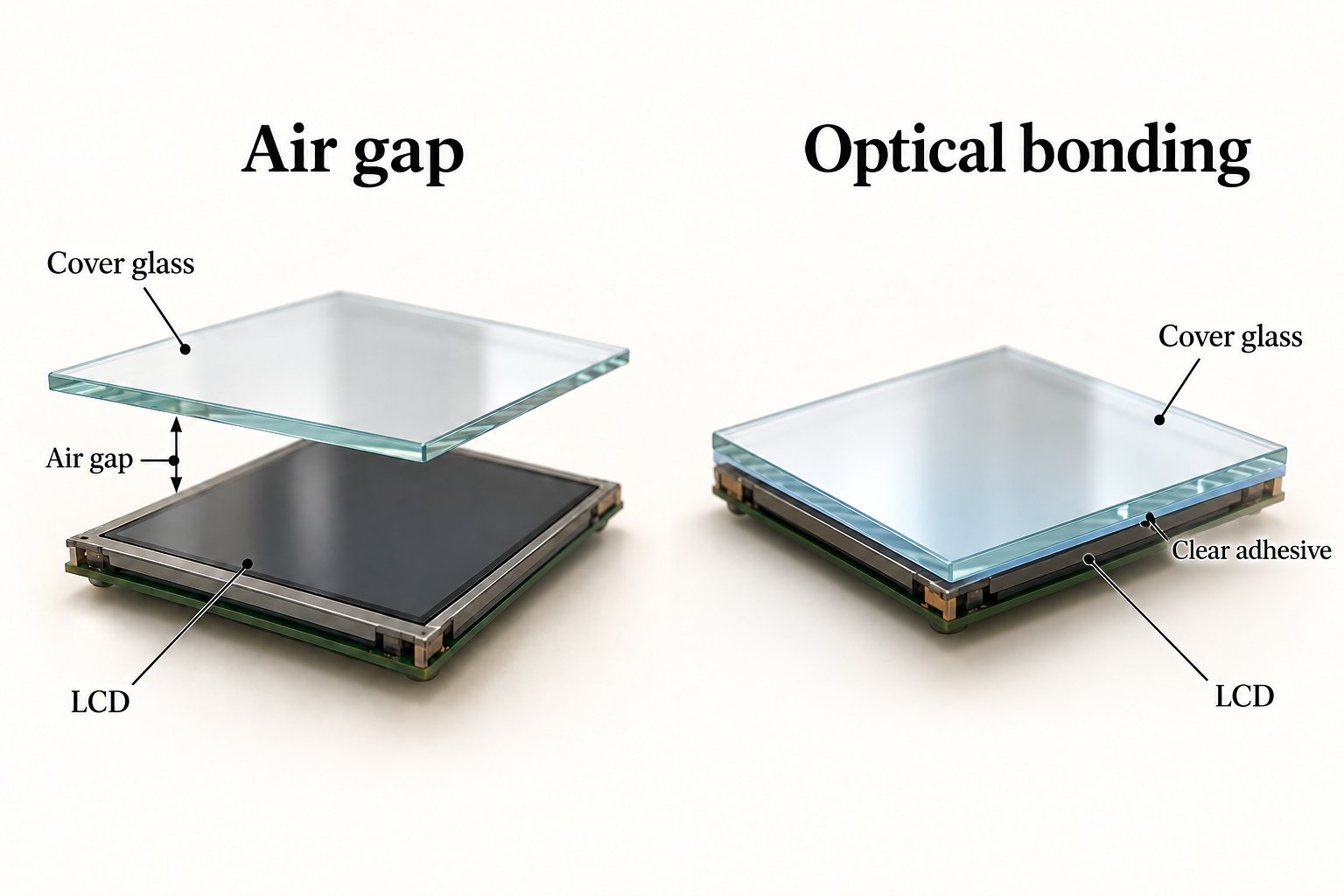
A display assembly may have an LCD, a touch sensor and a protective cover. In an air-gap construction, space remains between some of those layers. Light can reflect at the material boundaries, adding reflected light to the image that the viewer is trying to read.
Optical bonding replaces that air layer with a transparent adhesive. The adhesive and adjoining surfaces are selected to work together optically. Riverdi’s explanation of optical bonding describes this reduction in internal reflecting surfaces and the resulting improvement in outdoor readability.
The exact construction still matters. A quote should identify which layers are bonded. Bonding a touch sensor to a cover does not necessarily mean that every gap down to the LCD has been filled. Ask for a simple section drawing of the proposed assembly.
Optical bonding versus air bonding
Air bonding usually holds the layers together around the edges while retaining an air gap over the viewing area. Both methods can produce a usable display. Choose between them with the lighting, service plan and required image quality in mind.
| Decision point | Air-gap assembly | Optically bonded assembly |
|---|---|---|
| Internal reflections | Air interfaces remain in the viewing stack. | The filled interface can reduce internal reflections. |
| Construction | Ask how the gap and its edges are sealed. | Ask which layers are bonded and which adhesive is used. |
| Sample review | Check glare, image visibility and contamination inside the gap. | Check clarity, uniformity, bubbles and the edges of the bonded area. |
| Service | Confirm which parts can be replaced separately. | Confirm whether repair requires replacing a bonded module. |
| Project value | May meet the brief in controlled indoor light. | Worth evaluating when reflections limit practical readability. |
Do not compare only the bonding label. Two samples can also differ in their LCD, front glass, surface treatment and backlight settings. Those differences can make a demonstration look more convincing without showing the benefit of bonding alone.
Bonding, brightness and surface treatments do different jobs
Brightness describes the light output of the display. Optical bonding changes interfaces inside the viewing stack. Anti-reflective and anti-glare treatments address the surface: the former reduces reflection, while the latter changes how reflected light is scattered. A product may combine several of these approaches.
A bonded display does not automatically have a higher backlight rating. Likewise, more nits do not remove a reflection of a bright doorway on the front glass. Review the complete assembly from the customer’s viewing position rather than treating any one specification as a guarantee.
For an outdoor LCD display, discuss brightness, glass construction, enclosure protection and thermal design together. For a screen behind shop glass, also account for the separate window in front of the display. Bonding inside the monitor cannot remove reflections from that shop window.
When is optical bonding worth evaluating?
Start with the problem you can actually see. Is the image washed out near a window? Is a fine map hard to read at an angle? Does a touch target appear separated from the finger? These observations give the supplier something concrete to investigate.
High ambient light, close viewing and touch interaction are useful reasons to request a bonded sample. In a controlled indoor location, an air-gap construction may already meet the brief. A site trial is more useful than choosing the more complex assembly simply because it sounds premium.
Bonding can also remove a cavity where moisture or dust could collect between the bonded layers. That does not establish the protection rating of the enclosure. Cable entries, seals, ventilation and exposed connections still need their own design and verification.
Review a sample under conditions that reveal the difference
Use the content the screen will actually show. Large promotional photographs can hide problems that become obvious in small directory labels, dark backgrounds or fine lines. Include a short text slide, a dark image and a plain background in the sample playlist.

Place the sample at the intended angle and viewing distance. Check it during the difficult part of the day, when daylight or overhead lighting causes the strongest reflection. If comparing two assemblies, use matching content and equivalent settings, and record any hardware differences.
- Readability: can a visitor identify the essential message without moving to avoid glare?
- Uniformity: are there distracting bright areas, colour differences or visible marks across the viewing area?
- Bond quality: are bubbles, haze, particles or edge defects visible under agreed inspection conditions?
- Touch response: do the actual controls work at the centre, corners and edges with the intended input method?
- Repeatability: will the approved sample and production units use the same agreed materials and construction?
This is an acceptance review, not a substitute for environmental testing. If the project needs temperature, humidity or impact performance, request evidence for the supplied assembly and the relevant conditions. A general brochure claim about bonding is not a test report for your configuration.
Ask about repair before approving the construction
Clear adhesive makes the layers part of a connected assembly. If the cover is damaged later, the available repair route may differ from that of a display with separately replaceable parts. Ask which work can be done on site and which work requires a workshop.
Request the replacement module description, expected service process and spare-parts arrangement. Also clarify how the supplier assesses bubbles, edge separation or changes in clarity during the warranty period. These details make competing proposals easier to compare without guessing at future repair costs.
For a rollout across several locations, record the approved assembly revision with the screen model. Keep sample photographs and acceptance notes. A replacement that fits mechanically can still look different if the cover treatment or display construction has changed.
What to include in your display enquiry
Send the screen size, orientation, mounting method, viewing distance and a photo of the location. Describe direct sunlight, nearby windows and the operating schedule. Include sample content and state whether the screen is display-only or touch-enabled.
Then ask the supplier to confirm the layer construction, available bonding option, surface treatment and service plan for that exact configuration. Keep those answers separate from the LCD brightness and enclosure specifications so that no requirement disappears inside a broad description.
If touch is part of the brief, our capacitive versus resistive touch screen guide covers input choices. Bonding and touch sensing are separate decisions; one does not determine the other.
Common questions about optical bonding
Does every high-brightness display use optical bonding?
No. Backlight brightness and the method used to assemble the front layers are separate specifications. Ask the supplier to confirm both for the model and size being quoted.
Does optical bonding make a display waterproof?
No. Removing an internal air gap does not establish the water or dust protection of the whole product. Review the complete enclosure, installation conditions and documented protection rating separately.
Can I assume bonding is included on a product page?
Only if the configuration explicitly confirms it. To review a YJCEN display for your site, send the location and display requirements to our team. Ask us to confirm the available front-glass construction and options before you place the order.