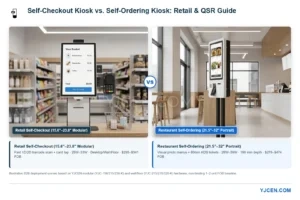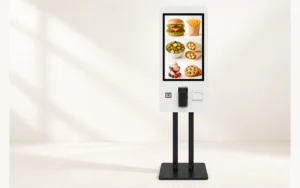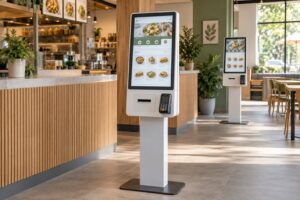
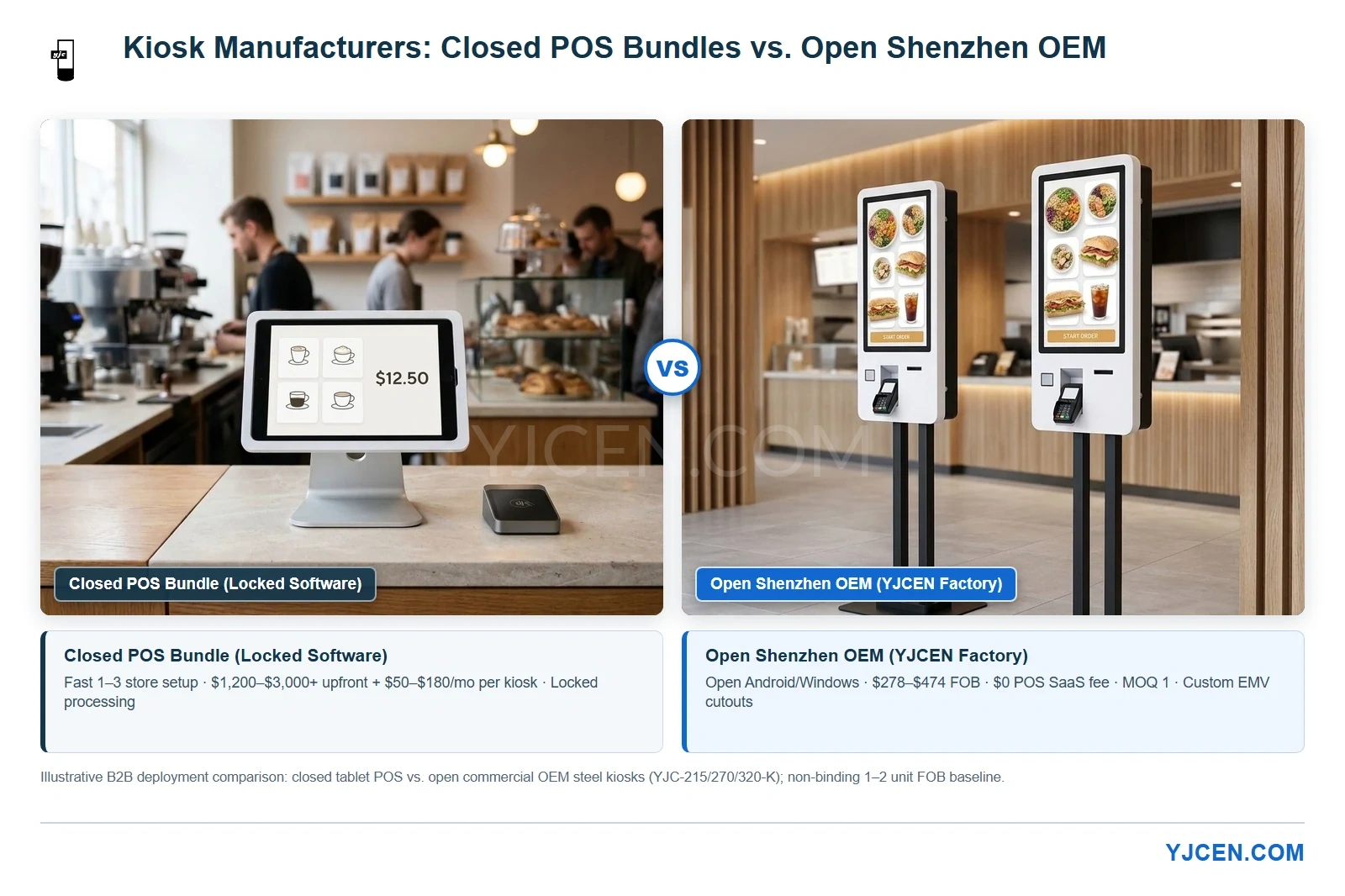
Restaurant chains and retail integrators sourcing self-service kiosks choose between three manufacturer tiers: Western closed-POS bundles ($1,200–$3,000+ upfront plus monthly per-kiosk software lock-in), regional enterprise integrators, or open-architecture Shenzhen OEM factories. YJCEN builds open Android and Windows restaurant self-ordering kiosks ($278–$474 FOB Shenzhen) and modular self-checkout kiosks ($295–$341 FOB Shenzhen) from MOQ 1 with zero recurring hardware software fees.
How Do Closed POS Vendors, Enterprise Integrators, and Open Shenzhen OEMs Compare?
Closed POS vendors sell convenience for 1 to 5 locations at the cost of hardware and payment lock-in, regional enterprise integrators add local field SLAs at higher unit pricing, and Shenzhen open OEM factories deliver unbundled commercial steel hardware at factory-direct FOB tiers for buyers who already own or license their POS stack.
Most buyer frustration comes from comparing quotes across incompatible supplier models. A quote from Toast, Square, or Clover bundles proprietary ordering software, merchant processing, and consumer-grade or semi-commercial tablet stands, whereas an OEM factory quote covers bare commercial metal hardware, touchscreen, thermal printer, scanner, and compute board without ongoing POS subscriptions.
| Evaluation Factor | Tier 1: Western Closed POS Bundles (e.g., Toast, Square, Clover) | Tier 2: Western Enterprise Integrators (e.g., Elo, KIOSK Info Systems, Olea) | Tier 3: Shenzhen Open OEM Factories (e.g., YJCEN) |
|---|---|---|---|
| Software & OS freedom | Locked to vendor POS ecosystem and approved menu apps | Open Android or Windows, often paired with integrator middleware | 100% open Android (RK3568/RK3576) or Windows-ready hardware; customer owns POS stack |
| Payment terminal freedom | Locked to vendor’s merchant processor and fee schedule | Broad EMV/NFC compatibility across regional acquirers | Standard POS bracket (×1) plus custom steel cutouts for Ingenico, Verifone, PAX, or Nayax |
| Typical upfront hardware cost | $1,200–$3,000+ per station (or hardware lease) | $2,500–$6,000+ per commercial floor station | $278–$474 FOB (21.5″–32″ ordering), $295–$341 FOB (15.6″–23.8″ modular), $221–$528+ FOB (interactive), non-binding 1–2 unit catalog baselines |
| Ongoing per-kiosk hardware fee | Typically $50–$180+/month per kiosk plus processing margin | Optional MDM/SLA support contracts ($30–$100/month) | $0 monthly POS or ordering fee from YJCEN (Android includes a free cloud CMS with unlimited accounts for idle attract screens) |
| Custom enclosure & white-label OEM | Logo sticker only; fixed vendor housing | High NRE tooling fees and higher project minimums | MOQ 1 sample; custom paint, logo/unbranded white-label, and payment cutouts under NDA (~15–20 business days) |
| Field service & warranty model | Local mail-in swap while subscription remains active | Optional on-site technician SLA in North America/Europe | 3-year factory warranty, front tool-free access or swappable modular sub-assemblies for rapid store service |
How Much Does Open OEM Kiosk Hardware Save Over Closed POS Over 3 Years?
Across a 10-kiosk restaurant or express-retail rollout, factory-direct YJCEN ordering hardware ($278–$474 FOB per unit; roughly $1,500–$4,500 per station deployed including freight, local card terminal, POS/payment integration, and installation) typically cuts 3-year total deployment spend by 55% to 62% compared with locked per-kiosk SaaS bundles when the chain already licenses its own POS software.
Single-store operators rarely notice a $100 monthly kiosk add-on fee at launch, but multi-store chains feel that recurring cost immediately. On 10 kiosks over 36 months, a $120 monthly closed-kiosk fee adds $43,200 before credit-card processing spreads even start, whereas open OEM hardware keeps total capital tied to physical units, shipping, and one-time integration.
| 10-Kiosk 3-Year Budget Line | Closed POS Bundle (10 Units) | Open Shenzhen OEM + Buyer POS (10 Units) | Key Budget Driver |
|---|---|---|---|
| Kiosk hardware (10 units) | $15,000–$28,000 | $2,780–$4,740 FOB reference* | Factory-direct cold-rolled steel 21.5″–32″ build vs. marked-up bundle |
| Air/sea freight, customs & delivery | Included in domestic list price | $2,000–$4,500 (sea LCL saves most at 10+ units) | Net weight 17–27 kg per unit; palletized sea freight lowers landed cost |
| Local EMV/NFC card readers (10 units) | Included or bundled at markup | $2,000–$6,000 (direct from local acquirer) | Buyer retains freedom to negotiate merchant processing rates |
| 36-month POS integration, OS & software | $21,600–$64,800 ($60–$180/kiosk/mo) | $5,220–$19,760 (POS integration, optional Windows OS licenses, or chain software fee) | YJCEN charges $0 hardware SaaS rent; biggest 3-year TCO gap for chains and POS ISVs |
| Site electrical, RJ45 drops & mounting | $3,000–$10,000 | $3,000–$10,000 | Identical local electrician and anchor-bolt labor |
| Estimated 3-Year 10-Unit Total | $39,600–$102,800 | $15,000–$45,000 ($1,500–$4,500/station) | 55%–62% lower 3-year spend with full hardware ownership |
*Pricing boundary: YJCEN factory FOB ranges ($278–$474 self-ordering, $295–$341 modular self-checkout, $221–$528+ interactive touch screen kiosks) are non-binding 1–2 unit catalog baselines. Custom sheet-metal enclosures, specialized payment cutouts, Windows hardware upgrades (Windows OS license supplied by the buyer), custom finishes, and volume rollouts are quoted individually against CAD drawings and quantity.
That open-hardware model works cleanly in real regional chains. In a North Macedonia restaurant chain deployment, the operator ordered two 27-inch floor-standing Windows capacitive kiosks from YJCEN and integrated its own POS and payment software directly on the terminals, freeing cramped counters while keeping menu, payment, and ticketing workflows under internal control.
Which Factory Standards and Hardware Specs Separate True Kiosk OEMs from Traders?
A genuine kiosk OEM factory owns in-house sheet-metal engineering, publishes exact model dimensions, wattage, and certification scope (ISO 9001, CE, RoHS, FCC, ETL), runs a documented 72-hour full-function aging test, and supports 1-unit sample builds with customer software pre-installation before mass production.
Trading companies often resell mismatched consumer screens inside thin generic frames and stall whenever you request a custom Verifone or Ingenico steel cutout. Auditing five concrete engineering checkpoints separates real Shenzhen manufacturers from catalog resellers before you wire a deposit.
| OEM Audit Dimension | What True Factories Prove (YJCEN Benchmark) | Trading-Company Warning Sign |
|---|---|---|
| Chassis & glass durability | Cold-rolled steel sheet, 6H thermally toughened anti-scratch capacitive glass, 300-nit 178°/178° wide-viewing-angle FHD panel (50,000-hr backlight) | Vague “metal frame” copy with no glass hardness, panel hours, or exact CAD thickness |
| Exact model specs & power | Wall/floor YJC-215/270/320-K (190 mm depth, 17–27 kg, 28W–39W max) and modular YJC-156/215/238-K (25W–33W max), built-in AC 100–240V PSU | Single generic spec sheet copied across every size with missing weight or power draw |
| Peripherals & service access | 80 mm thermal receipt printer, 2D QR/barcode scanner, POS bracket (×1), two external USB + one RJ45 Ethernet, lockable front door or detachable modular boxes | Sealed rear-only housing requiring wall dismount to clear an 80 mm paper jam |
| OS & pre-shipment staging | Android 11 RK3568/RK3576 (32GB eMMC, customizable RAM/storage) or Windows-ready hardware; pre-install and bench-test customer APK/installer from MOQ 1 | Ships blank units with zero driver verification or claims unlicensed Windows is “free” |
| QC, certifications & lead time | 72-hour aging test, full-function and sheet-metal inspection; ISO 9001, CE, RoHS, FCC, ETL; 3-year warranty; 3–7d stock / 15–20d OEM under NDA | No live aging-line video, provides no verifiable lab or NRTL certificate numbers, or forces 50-unit MOQ for brackets |
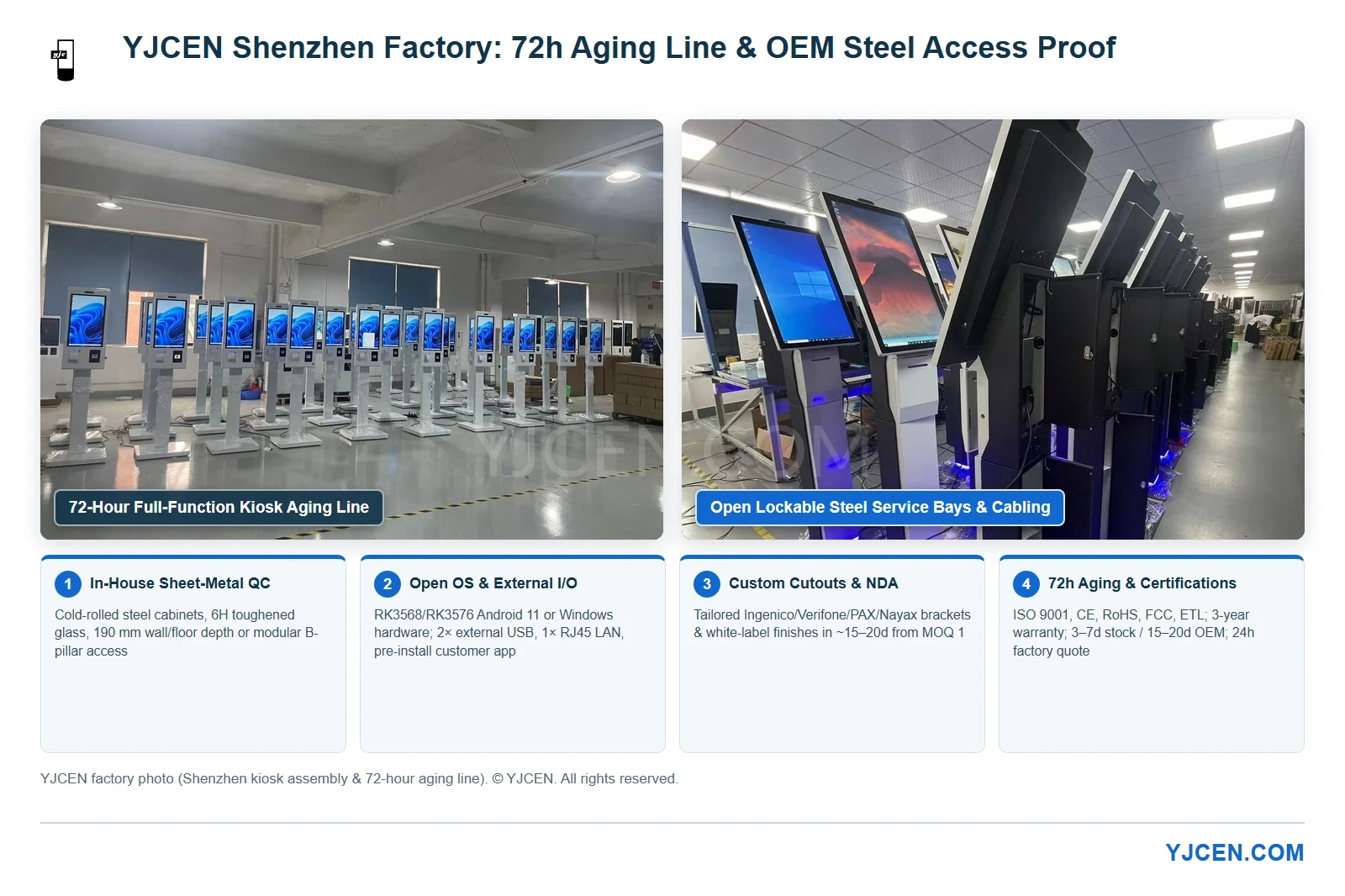
Once your shortlisted factory passes those five checkpoints, prepare exact peripheral clearances and ADA reach fields using our custom kiosk pre-CAD engineering checklist before approving production drawings.
When Should You Choose a Closed POS Vendor, Local Integrator, or Shenzhen OEM Factory?
Pick a closed POS bundle when a single-site cafe has zero IT staff and needs live ordering in 72 hours, pick a regional enterprise integrator when national SLA contracts mandate 4-hour on-site technician dispatch, and pick an open Shenzhen OEM factory like YJCEN when you own your software stack, operate 5+ locations, or resell white-label hardware.
Choose a Western Closed POS Bundle When:
- You run 1 to 3 independent outlets with no internal IT support and need software, menu management, hardware, and card processing on one phone number.
- You have not yet selected a POS system and prioritize same-week launch over 3-year hardware ownership.
- Monthly recurring fees per screen fit inside your current store margin without scaling across dozens of lanes.
Choose a Regional Enterprise Kiosk Integrator When:
- Corporate procurement mandates same-day on-site technician dispatch across multiple states or countries under a single service-level contract.
- Your deployment requires specialized heavy grocery lanes with conveyor belts, calibrated security bagging scales, and multi-denomination cash recyclers.
- Budget prioritizes turnkey local project management over direct factory unit pricing.
Choose an Open Shenzhen OEM Factory (YJCEN) When:
- You are a POS software company (ISV), system integrator, or franchise group with your own ordering, checkout, or ticketing app and refuse to pay hardware SaaS lock-in.
- You need custom payment cutouts (Ingenico, Verifone, PAX, Nayax), bespoke cabinet colors, or unbranded white-label enclosures under NDA from MOQ 1.
- You plan to scale from a 1-unit bench pilot (3–7d stock or 15–20d OEM) to 10–100+ stores at transparent $221–$528+ FOB hardware tiers.
Which 5 OEM Sourcing Red Flags Stall Kiosk Rollouts and How Do You Fix Them?
Five predictable sourcing mistakes account for nearly all delayed restaurant and retail kiosk pilots: picking trading companies without sheet-metal workshops, overlooking Windows licensing boundaries, ordering generic payment brackets, shipping untested software images, and skipping 72-hour aging proof. Addressing each point in your first RFQ prevents costly re-sampling.
- Problem: Supplier advertises factory pricing but takes 10 days to answer simple CAD bracket questions.
Fix: Request a live video walkthrough of the sheet-metal assembly floor and 72-hour aging line alongside exact model CAD drawings (such as YJCEN’s 190 mm wall/floor or modular desktop/wall/floor drawings) before paying sample fees. - Problem: Quote appears unusually cheap because it hides unlicensed Windows or omits the 80 mm printer and 2D scanner.
Fix: Demand an itemized BOM listing screen size, touch glass grade, compute board (Android RK3568/RK3576 vs. Windows-ready hardware with customer-supplied OS license), 80 mm thermal printer, 2D scanner, and POS bracket on separate lines. - Problem: Local EMV card terminal arrives on site and physically clashes with the standard kiosk bracket.
Fix: Send your exact payment terminal model number and dimensional drawing at sample stage so the OEM fabricates a tailored steel adapter plate and clean cable channel in the initial 15–20 business day build. - Problem: Pilot kiosk arrives abroad and fails peripheral handshakes with your POS app or fiscal printer driver.
Fix: Send your Android APK or Windows application installer (with your OS license setup) directly to the factory before dispatch so engineers pre-install, test the 80 mm printer and 2D scanner, and share a functional test video during 72-hour aging. - Problem: Sample passes bench review, yet mass-production units arrive with dimmer panels or swapped thermal printers.
Fix: Lock the exact approved sample BOM (panel brightness, compute board, printer model, scanner module) in your purchase order and require pre-shipment aging and function sign-off, as detailed step by step in our 7-step OEM sample approval guide.
Frequently Asked Questions
Can I order just 1 sample kiosk from YJCEN before a chain rollout?
Yes, YJCEN supports a 1-unit sample MOQ across all standard and custom OEM kiosks. Standard stock configurations ship in roughly 3–7 business days, while custom payment brackets, branded finishes, or white-label OEM builds ship in 15–20 business days under NDA.
Does YJCEN include restaurant ordering software or a Windows OS license?
No, YJCEN manufactures open commercial kiosk hardware only with zero monthly POS SaaS fees. Buyers supply their own ordering or checkout software, payment terminal, and Windows OS license when choosing Windows hardware, while YJCEN pre-installs and tests your build prior to shipment.
Which safety and quality certifications do YJCEN kiosks carry for US and EU imports?
All YJCEN kiosk models carry ISO 9001, CE, RoHS, FCC, and ETL certifications. Every unit undergoes sheet-metal inspection, full-function testing, and a 72-hour factory aging run backed by a 3-year hardware warranty.
How much cheaper is direct Shenzhen OEM hardware compared with closed Western POS kiosks?
Open OEM hardware typically cuts 3-year kiosk spend by 55% to 62% over closed POS. Bare YJCEN hardware runs $278–$474 FOB for ordering kiosks and $295–$341 FOB for modular checkout kiosks ($1,500–$4,500 per station fully deployed with freight, EMV reader, integration, and install) versus $1,200–$3,000+ upfront plus monthly software fees from closed vendors.
Request OEM Kiosk CAD Drawings, Sample Testing & Factory Quote
Evaluating kiosk manufacturers for a restaurant chain, retail rollout, or white-label POS hardware program? Send our engineering team four details: target kiosk size (15.6″–32″), OS preference (Android or Windows hardware), payment terminal model, and sample or rollout volume. We reply within 24 hours with CAD drawings, certification docs, and an itemized FOB quote.