What is the difference between RGB and RGBW LCDs?
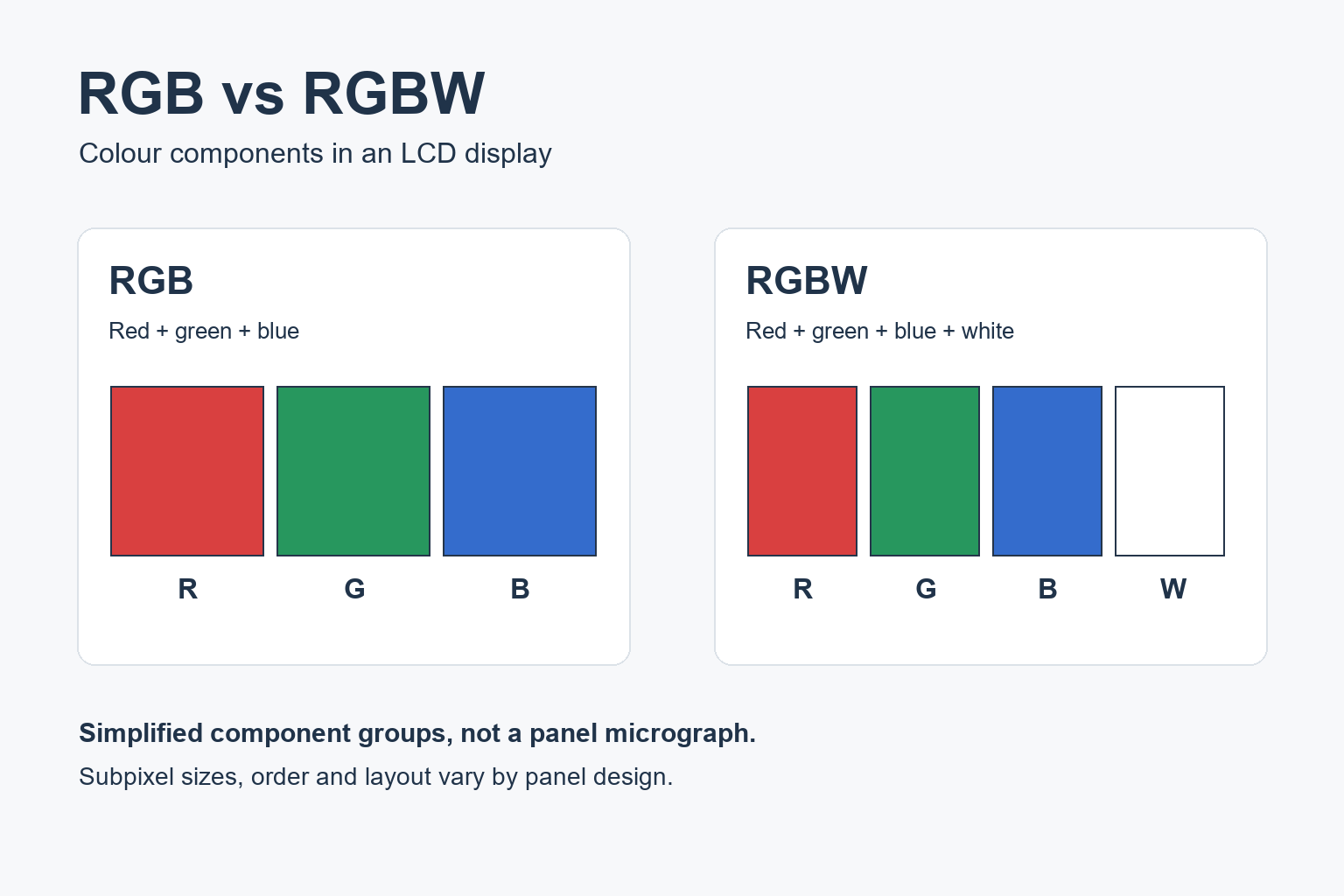
RGB LCDs use red, green and blue subpixels. RGBW designs also use a white component, which can increase light transmission. The letters alone do not establish image quality, native resolution or power savings.
- Confirm the exact panel model and native resolution.
- Compare fine text, saturated colours, photographs and white areas using the same source and settings.
- Check the finished display at the intended viewing distance and lighting.
- Separate 4K input acceptance from the panel's actual detail reproduction.
For a commercial display, the useful question is how the actual panel handles your content. A shop-window promotion, a menu with small prices and a touchscreen directory place different demands on the screen. This guide focuses on LCD displays used for digital signage, rather than RGB and RGBW lighting strips.
What is the difference between RGB and RGBW?
RGB means red, green and blue. A conventional RGB-stripe LCD uses repeating red, green and blue subpixels to build a colour image. Each subpixel controls part of the backlight passing through the panel. The combination creates the colour and brightness seen at normal viewing distance.
RGBW adds a white, broadly transmitting subpixel to the display system. The panel electronics distribute the image information across the available subpixels. RGBW is a description of the colour components, not a complete specification of their physical arrangement. Different panel designs can use different layouts and processing.
Paul Semenza’s article Making Color in LCDs, published in Information Display in January 2013, explains how colour filtering and subpixel arrangements affect light transmission. Two panels with similar headline specifications can still behave differently with the same content.
| Point to compare | RGB LCD | RGBW LCD |
|---|---|---|
| Colour components | Red, green and blue | Red, green, blue and white |
| White content | Produced by combining the colour components | The white component can contribute alongside RGB |
| Brightness and power | Depend on the complete panel and backlight | White transmission may offer an efficiency advantage; results depend on implementation and content |
| Fine detail | Check native resolution, signal and rendering | Also establish the actual subpixel layout and processing |
| Buying decision | Review a sample with your intended content | Review a sample with the same content and comparable settings |
Why does an RGBW display use a white subpixel?
A white subpixel can pass more of the backlight spectrum than a coloured filter. This is especially useful for white and less-saturated parts of an image. How much benefit reaches the finished screen depends on the panel, backlight, drive settings and image-processing method.
Japan Display’s 2014 environmental report describes WhiteMagic as a historical example of RGBW used for higher brightness or reduced backlight power. Its reported results concern that technology and comparison. They should not be copied into the specification of a different commercial screen.
When comparing quotations, ask for the measurement conditions behind a brightness or power figure. Were both screens set to the same luminance? Was the test a white field, a photograph or the actual signage playlist? A peak figure without its conditions is not enough to calculate running cost or compare everyday visibility.
Does more white brightness mean better colour?
White brightness and saturated-colour brightness are different things. A bright white background does not establish how bright a deep red logo or blue graphic will look. RGB-to-RGBW processing must balance the white contribution with the colour components to reproduce the intended image.
The engineering article Adding a White Subpixel, by Elliott, Credelle and Higgins in Information Display (May 2005), discusses that balance and several RGBW arrangements. The layout and mapping method matter; a white subpixel alone does not prove that colours will be washed out or more accurate.
For a retail rollout, put your own logo, food photographs and promotional colours into the sample playlist. Compare the screens at similar brightness and with exaggerated picture modes disabled. Ask for the colour-gamut specification and any relevant measurement report, then check whether the sample meets your own visual requirements.
RGB vs RGBW: what about text and 4K detail?
Start by separating the input signal from the panel. A screen accepting a 4K signal does not, on its own, establish its native panel resolution or how it resolves fine coloured detail. Likewise, the term RGBW does not automatically make a display unsuitable for detailed content.
Ask for the panel model, native resolution and subpixel arrangement. Where fine detail is important, request a sample test or a resolution measurement with a stated method. Do not classify every RGBW panel as the same design or decide the question from a close-up photograph without knowing the signal and scaling settings.
Test black text on white, white text on black, small coloured text and thin horizontal and vertical lines. Include a real menu or directory page at its intended size. Check the result from the closest normal viewing position as well as the typical reading distance.
Keep the player and signal path consistent during the comparison. Scaling, sharpening, image compression and colour-signal settings can also affect detail. If text looks unclear, check those settings before attributing the entire result to the panel’s subpixels.
Which checks matter for commercial digital signage?
Shop-window advertising
Test the actual promotion through the shop glass during the bright part of the day. Include both large photography and the smallest message customers need to read. Reflections, placement and the finished screen’s brightness matter alongside panel structure.
Our high-brightness window displays are a relevant starting point for window-facing projects. Confirm the panel configuration and installation requirements for the model being quoted; the product category alone does not establish whether its subpixel layout is RGB or RGBW.
Menus, directories and touchscreens
Prioritise prices, labels, map names and interface controls. Test the smallest intended type, including coloured text, before approving a sample. For touch applications, view the screen from the angle a customer will use, with the final protective surface fitted where possible.
A commercial interactive kiosk needs a readable interface as well as suitable display hardware. Bring the real application to the test. A demonstration video cannot show whether a dense directory or ordering page will be comfortable to use.
Indoor promotions and information screens
Review mixed content rather than a single bright test image. Include photography, text, dark scenes and brand colours. If several screens will be visible together, compare their settings and appearance as a group. Keep an approved sample or reference record for the installation team.
For fixed indoor installations, compare the available wall-mounted commercial displays against your mounting space, viewing distance and operating schedule. These practical requirements remain important whichever subpixel system is used.
A useful RGB and RGBW comparison test
Prepare one short test file and use it for every candidate. Keep the player, connection, screen size and viewing conditions comparable. Record any differences that cannot be matched. This gives the supplier a clear requirement and makes your decision easier to explain.
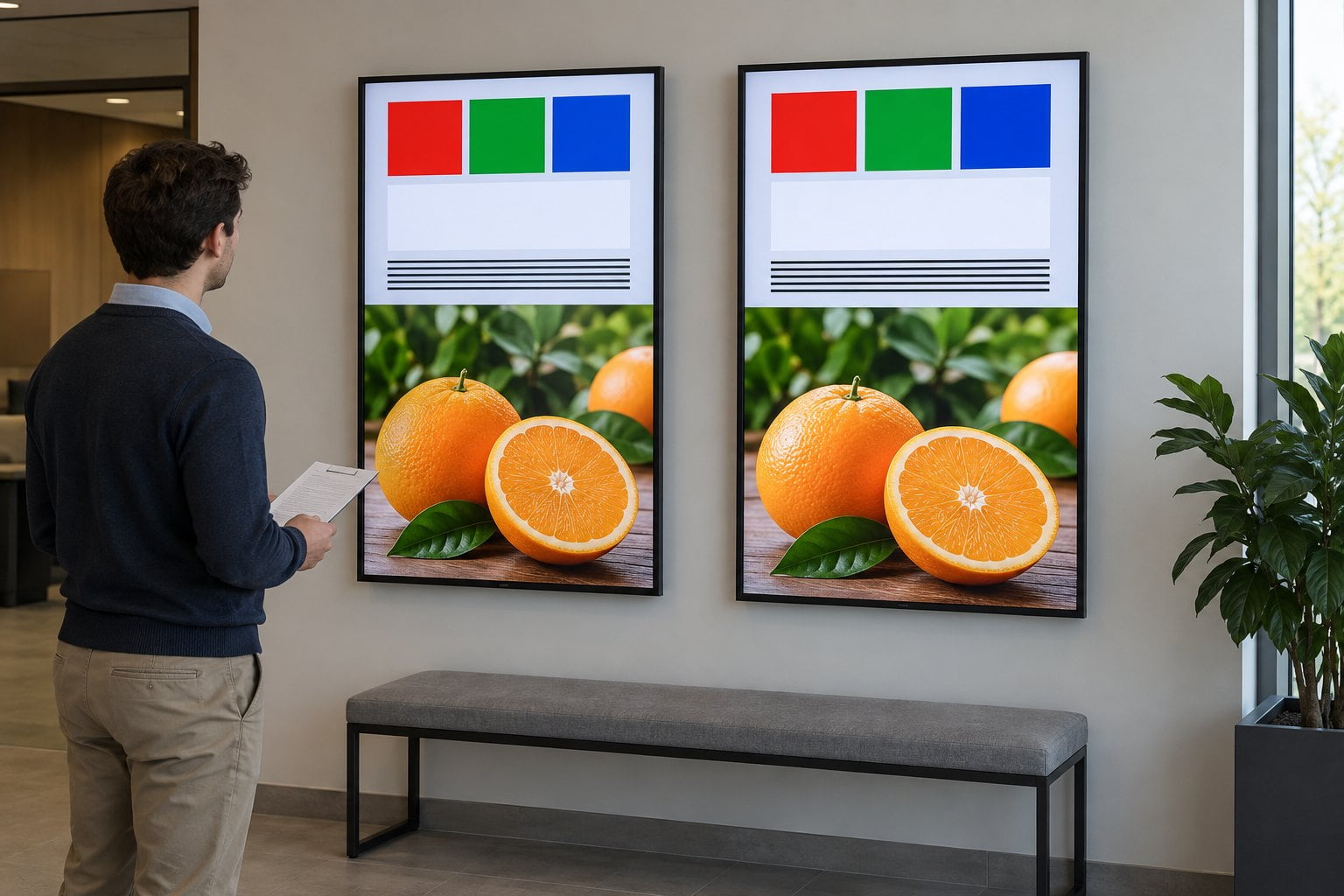
- Confirm the exact panel model and native resolution in writing.
- Display your smallest text and fine-line graphics without unintended scaling.
- Compare white areas, saturated colours and photographs at similar screen brightness.
- Check the image through the final glass or touch surface, in the intended orientation.
- Review visibility from actual customer positions and under the expected lighting.
- If energy use matters, measure power with the same content, brightness and operating mode.
- Record the accepted settings and require approval before a panel substitution.
Use the findings to approve a particular configuration. They are more useful than a general statement that one panel label always wins. Keep the test content with your purchasing record so replacement screens can be checked in the same way.
Common questions about RGB and RGBW LCD panels
Is RGBW the same as an RGBW LED strip?
No. The letters refer to similar colour components, but an LCD subpixel structure and a lighting strip are different systems. Advice about lighting controllers, colour temperature or strip wiring does not establish the performance of an LCD signage screen.
Does RGBW always use less power?
No universal saving can be assumed. The complete display, content, brightness and operating mode determine consumption. Compare measured power at equivalent conditions rather than applying a percentage from another manufacturer’s panel.
Should I insist on RGB for every signage project?
Specify the result you need and verify the proposed panel. Fine text, colour-critical graphics and bright window advertising need different checks. RGB can be a procurement requirement where your testing supports it, but the label alone does not replace a sample evaluation.
What should I ask YJCEN to confirm?
Send the screen size, installation location, viewing distance and a sample of your content. Ask for the proposed panel configuration, brightness, resolution and operating requirements. Contact YJCEN to discuss a commercial display for your application and the checks needed before approval.