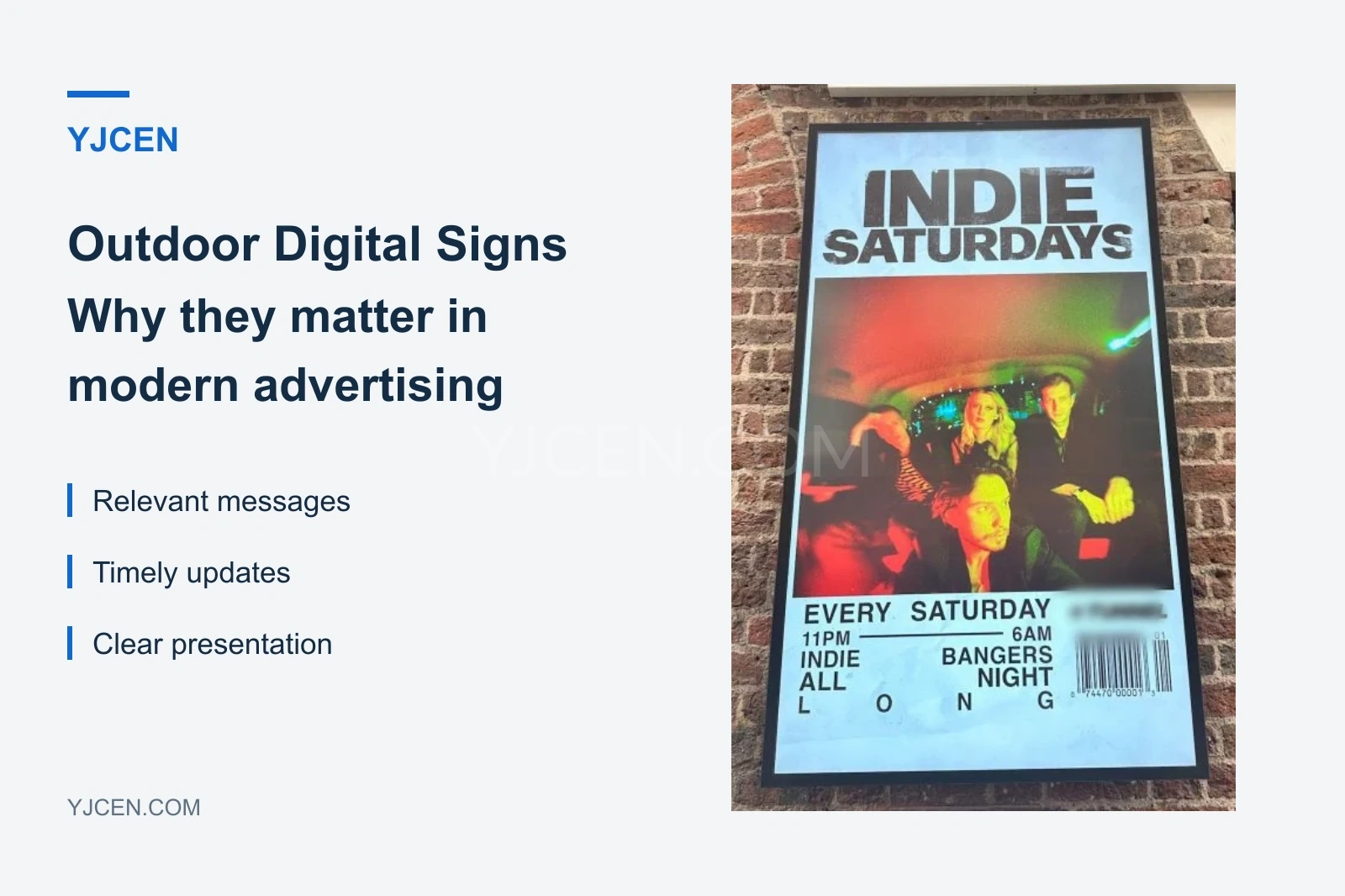
A restaurant can advertise breakfast to the morning crowd and dinner later in the day. A retailer can replace an expired promotion without waiting for another print run. An entertainment venue can change its entrance display to match the event taking place that evening.
These are practical reasons to consider outdoor digital signs: they give a fixed advertising location the flexibility to carry different messages as business needs change.
Outdoor digital signs combine a visible physical location with changeable content. Their advertising value depends on whether that flexibility helps the business show a relevant message that people can understand and act on.
A screen alone cannot guarantee attention, visits or sales. But when the offer, location, timing and presentation work together, digital signage can make advertising more responsive and easier to maintain.
This guide focuses on displays operated by businesses at their own premises, including retail entrances, restaurant forecourts and drive-thru lanes. Purchasing advertising space on a third-party billboard network involves a different planning and buying process.
Quick Guide: What Makes Outdoor Digital Advertising Useful?
Before choosing a display, establish what the advertising needs to achieve.
- Give the location a purpose. Decide whether the message should encourage entry, support a purchase or promote an upcoming visit.
- Identify useful content changes. Consider different offers, times of day, events and local requirements.
- Compare update workflows. Include staff time and the delay between approval and correct display.
- Design for the viewing opportunity. Match the message to the audience’s position, distance and available time.
- Measure a defined result. Track publishing efficiency separately from customer response and sales.
1. Put a Relevant Message Near a Decision
A business entrance, an ordering point and an event forecourt serve different advertising purposes.
At an entrance, the message may need to give someone a reason to come inside. At a drive-thru ordering point, it may need to help a customer compare products or recognise an available offer. Outside a venue, it may promote a future visit or explain what is happening that day.
The location gives the advertisement context. Digital content lets the business adapt its message within that context.
| Location | Advertising task | A useful message |
|---|---|---|
| Retail entrance | Give passers-by a reason to enter | A current offer with a clear product, price or benefit |
| Restaurant forecourt | Show what is available now | The relevant meal period, menu or promotion |
| Drive-thru ordering area | Support a product choice | Readable categories, prices and selected featured items |
| Event venue entrance | Promote attendance or a return visit | The current event or the next relevant programme |
These are planning examples, not claims of measured commercial results.
The principle is to connect the advertisement to something the viewer can reasonably do next. A general brand video and a clearly priced lunch offer may both be valid content, but they serve different purposes.
Choose the intended customer action before choosing the media format.
2. Keep Advertising Aligned with Time and Availability
A printed advertisement can communicate an offer effectively. The difficulty arises when the offer changes more often than the physical material can conveniently be replaced.
Digital signage can support different messages by time of day, campaign period or location. A business might schedule breakfast and lunch promotions, end a weekend offer automatically or distribute a shared campaign with local details.
These functions depend on the selected playback and content-management system. Samsung’s VXT documentation, for example, describes scheduling content and playlists for particular periods and distributing content remotely. It demonstrates available software capabilities, not compatibility with every display or an included feature of every signage purchase. Samsung VXT content-management features
Flexibility is useful only when the message stays accurate.
A promotion should have an owner, a start time, an end time and an appropriate replacement. Product availability also needs a defined update process; it does not automatically synchronise with a display unless a suitable integration is provided.
The advertising benefit is straightforward: the business has more control over when an offer appears and when it stops appearing.
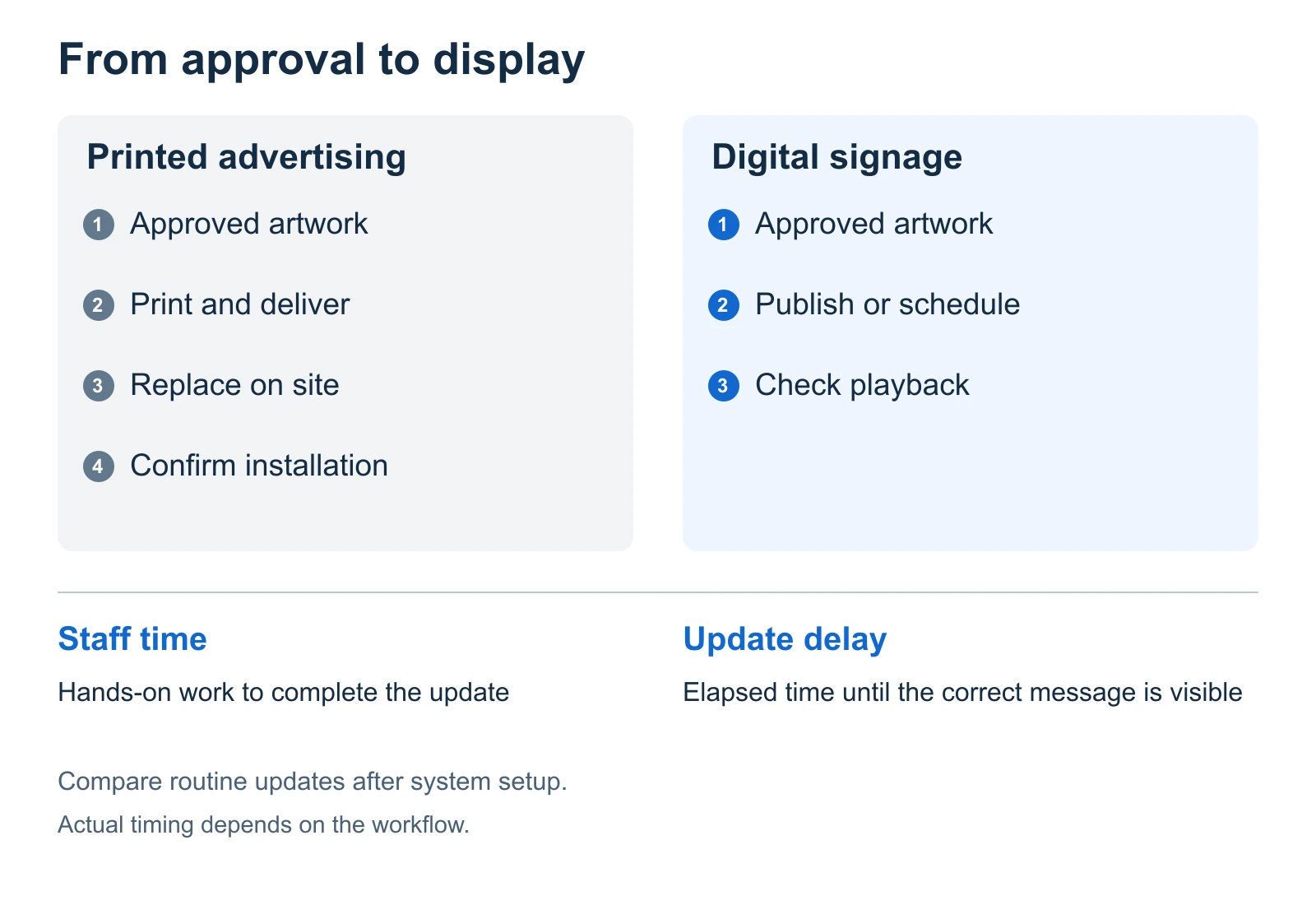
3. Reduce the Time Between Approval and Display
The cost of printed advertising includes more than production. Updates may require delivery, physical replacement and coordination across locations.
Digital signage can remove physical production and distribution from many routine changes after the system has been installed and configured.
| Update stage | Printed advertising | Networked digital signage |
|---|---|---|
| Prepare the advertisement | Design, check and approve the artwork | Design, check and approve the artwork |
| Distribute the approved version | Print and arrange collection or delivery | Upload and distribute files through compatible software |
| Display the message | Install or replace the material at each location | Publish or use a supported playback schedule |
| Correct an error | Amend or reprint, then replace the material | Revise, republish and verify playback |
| End the campaign | Remove or replace the advertisement | Use a supported end schedule and follow-on content |
| Confirm completion | Check that the correct material is installed | Check that the correct content is playing |
Initial equipment installation, software configuration and training remain separate investments. Digital content still needs design and approval.
Staff time and waiting time both matter
Staff time is the hands-on work needed to complete an update.
Update delay is the elapsed time between approving the advertisement and displaying it correctly.
A poster might take only a short time to replace but still wait for printing, delivery or someone’s next site visit. During that interval, a campaign may be missing or an expired offer may remain visible.
For a business with frequent changes, this delay can be as important as the printing bill.
Consider a restaurant switching from breakfast to lunch. A digital schedule can reduce reliance on staff remembering to change the promotion during a busy shift. Across several branches, central distribution can also reduce repeated coordination.
However, uploading a file is not the same as confirming its display. The content may be assigned to the wrong playlist, waiting for distribution or unavailable to an offline player.
Measure the workflow through to correct playback. That is when the advertising update is complete.
4. Use Dynamic Content to Improve Understanding
Digital signs can display product photography, static offers, animations and video. The useful format depends on what the audience needs to understand.
A short demonstration may help explain a product. A static design may communicate a price more directly. A menu may need to remain stable long enough for a customer to compare choices.
Adding movement or more slides does not automatically improve the advertisement.
For example, six designs displayed for ten seconds each create a one-minute loop. A person passing briefly may leave before the most relevant offer appears. This is an illustrative planning example, not a recommended playback duration.
For each design, check:
- Can the viewer identify the offer without seeing another slide?
- Are the essential price and conditions visible together?
- Is the next action clear?
- Can the information be understood from the expected viewing position?
For a brief viewing opportunity, make the message self-contained. Avoid requiring someone to wait for a price reveal or follow a sequence to understand the offer.
Where customers need to compare information, consider keeping essential details stable while using a separate area for changing promotions.
5. What Research Can—and Cannot—Tell Us About Results
Research provides evidence that digital signage can influence purchasing, but it also shows why context matters.
A study published in the Journal of Marketing analysed 237 in-store advertising campaigns involving 30 million shoppers. The researchers reported an 8.1% increase in the likelihood of purchasing featured products following exposure to digital signage. The effects varied with product and campaign characteristics. This was an indoor point-of-sale study, not a test of outdoor storefront displays, and the figure is not an expected sales increase for a new outdoor installation. Herhausen, de Jong and Grewal: In-Store Advertising with Digital Signage
Earlier field research in the Journal of Retailing found different outcomes across store formats, including positive, minimal and negative sales effects in the settings studied. Message content also affected the results. Roggeveen, Nordfält and Grewal: Do Digital Displays Enhance Sales?
These findings support a disciplined approach: evaluate the audience, message and setting together rather than apply a universal uplift percentage.
For an outdoor installation, we recommend testing a specific advertising task. Examples include encouraging redemption of a particular offer, presenting a relevant menu at the correct time or reducing the number of locations displaying expired promotions.
A screen creates an opportunity to communicate. The campaign still has to make that opportunity useful.
6. Make Sure the Advertisement Can Be Read
An advertisement may be accurate and well timed yet fail to communicate because of reflections, small text or an obstructed viewing position.
Outdoor readability depends on the display, content and environment together. Brightness is important, but it does not describe the entire viewing experience.
A technical article listed by NIST discusses daylight-readability assessment through ambient contrast, including reflected illumination. The practical implication is to evaluate visibility under the intended lighting conditions rather than rely on a brightness figure alone. NIST: Reflections on Sunlight-or Daylight-Readability
Check the proposed content from the actual viewing distance and angle. Confirm that product details and prices remain legible, that surrounding reflections do not obscure the message, and that changes in daylight do not undermine the presentation.
Also distinguish a screen behind shop-window glass from equipment exposed directly to rain and dust.
An IP66 outdoor digital signage display is one option to evaluate for exposed installations. Its suitability still needs to be assessed against the site’s lighting, temperature, mounting and service requirements. Our outdoor digital signage selection guide explains those equipment decisions.
The advertising plan should establish what people need to read; the installation must make that reading possible.
7. A Real Example: Event Promotion at a Live Music Venue
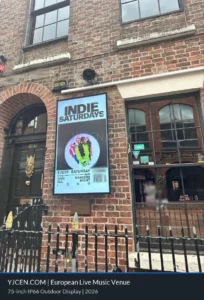
In 2026, YJCEN supplied one 75-inch IP66 outdoor display directly to a live music venue in Europe. Mounted vertically on the venue’s street-facing exterior wall, the screen promotes upcoming events to passersby.
The customer reported that the display reduced the printing and maintenance associated with traditional posters. They also highlighted its waterproof performance during rainy weather.
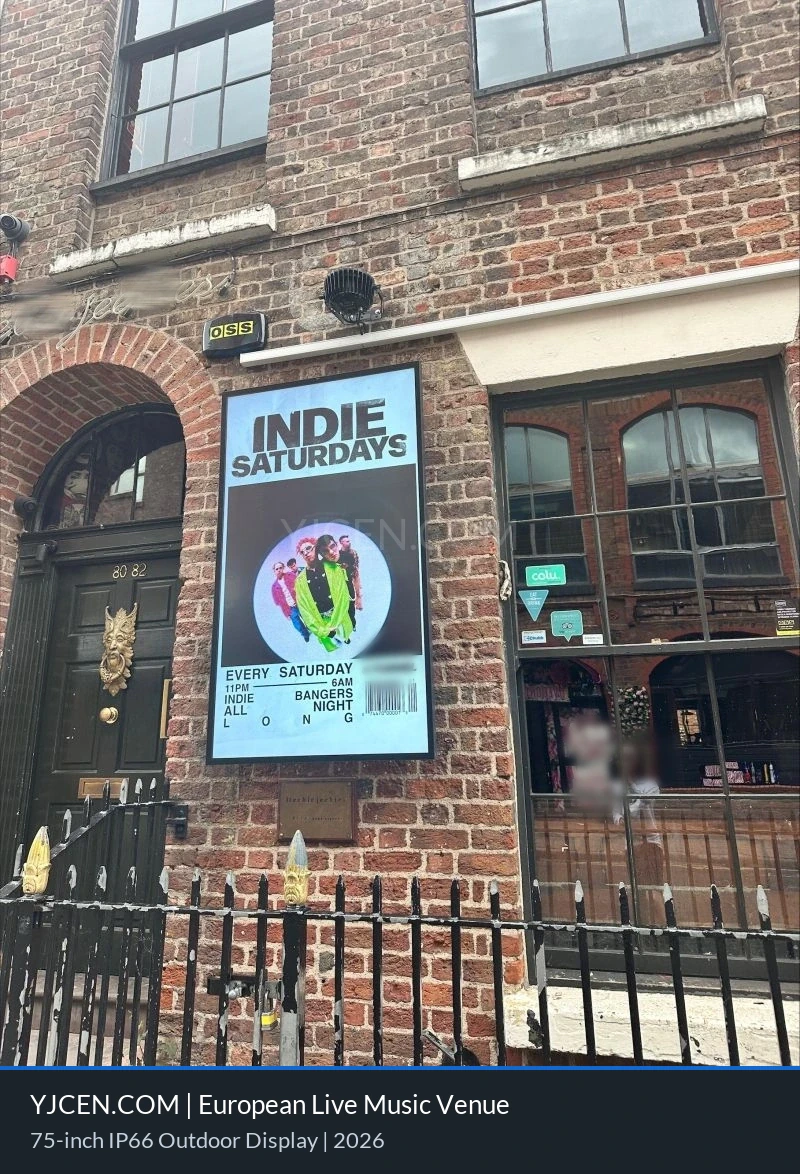
The project illustrates how one advertising location can carry changing event promotions while reducing reliance on printed posters. The case does not report a measured increase in attendance or ticket sales.
Read the European live music venue project
8. Decide Whether Digital Is Worth the Investment
Digital signage deserves closer consideration when a business has useful reasons to change its advertising regularly.
The case becomes stronger when campaigns are time-sensitive, several locations require coordination or physical replacement work is difficult. Print can remain appropriate for a stable message, a temporary requirement or a location where a simple physical sign already meets the need.
Both formats can work together. Permanent signage can identify the business while a digital display carries changing offers.
Compare costs over the same period and for the same advertising workload:
- Digital: equipment, installation, electricity, software, connectivity, content work and maintenance.
- Print: production, delivery, fitting, removal, replacement and staff coordination.
Then test one improvement rather than ask a pilot to prove everything.
| Intended improvement | What to measure |
|---|---|
| Faster campaign deployment | Time from approval to confirmed display |
| Less manual replacement work | Staff time per update |
| More accurate advertising | Percentage of checked locations displaying valid content |
| A traceable customer response | Redemptions of a campaign-specific offer |
| A possible sales effect | Featured-product sales across suitably comparable periods or locations |
Redemptions show a response associated with a campaign, but do not establish how many purchases would otherwise have occurred. Sales comparisons also need to account for factors such as discount levels, seasonality, weather and other marketing.
Operational improvements can be valuable on their own. Launching on time, reducing repeated replacement work and avoiding expired messages are results worth recording.
Frequently Asked Questions
What is the main advantage of outdoor digital signs?
They allow businesses to change advertising at a fixed location without repeatedly replacing physical material. With suitable software, businesses can also schedule content and coordinate updates across locations.
Are outdoor digital signs better than printed advertising?
They are often more useful for frequently changing or time-sensitive messages. Print can remain suitable for stable information and simpler requirements. Compare the actual workload and costs rather than assume one format is always better.
Does an outdoor digital advertisement need video?
No. A clear static design may communicate an offer more effectively when viewing time is short. Use motion when it helps explain the message, and keep essential details readable.
Can outdoor digital signs increase sales?
They can support advertising near a customer decision, but no screen guarantees a sales increase. The offer, audience, location, visibility and execution all matter. Test a defined objective before making a wider investment.
What should a business do first?
Identify one recurring advertising need and document how it is handled today. Establish what the audience should understand, where updates are delayed and how an improvement will be measured.
Outdoor digital signs are most useful when a business can turn their flexibility into timely, understandable advertising. Start with that requirement, then build the content process and installation around it.
Planning outdoor advertising for your business?
Tell us where the display will be installed, what you want customers to notice or do, and how often your advertising changes. Add a site photo and the number of locations if available. YJCEN can help you assess a suitable display configuration and provide a quotation for your project.